 agp.cooper
Optimising What Exactly?
-
It is not easy to optimise most problems have:
- multiple local optima
- multiple objectives
- objective functions may result in degenerative (useless) solutions
- constraint functions may result in degenerative (useless) solutions
- the need to start with a feasible solution
The process involves mapping out the feasibility areas and then focusing in on the most important objectives that result in the best solution.
-
Finding an initial feasible solution
Fortunately we can start with DIY Walkers solution (but at half scale):
- Axle: (0.0 mm,0.0 mm)
- Hip: (-48.0 mm,33.0 mm)
- Crank L1: 30.0 mm
- Thigh L2: 60.0 mm
- Idle L3: 40.0 mm
- Shin L4: 70.0 mm
- Knee Angle: 90.0 degrees
-
Here the foot trace down range is 120 degrees between the green markers and 180 degrees inclusing the green markers:
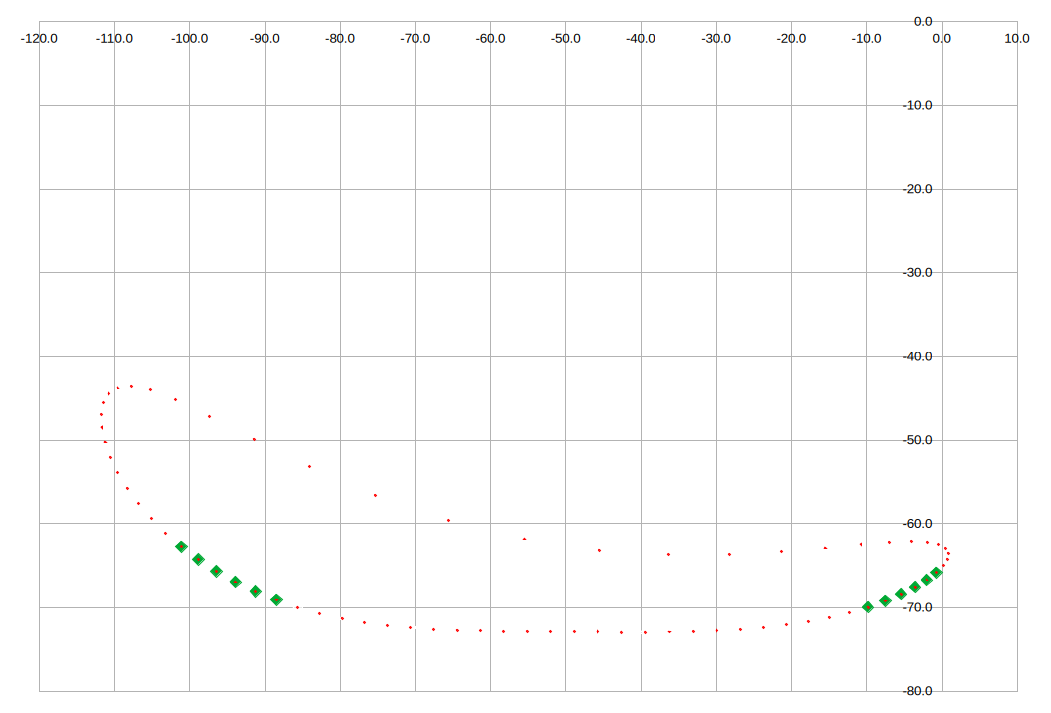
Note how the foot trace slow down near each left/right extremes, and is very fast when the foot up.
-
Extending the Flat Bottom Range
The first major objective identified was the need to have a flat bottom (as much as practical):
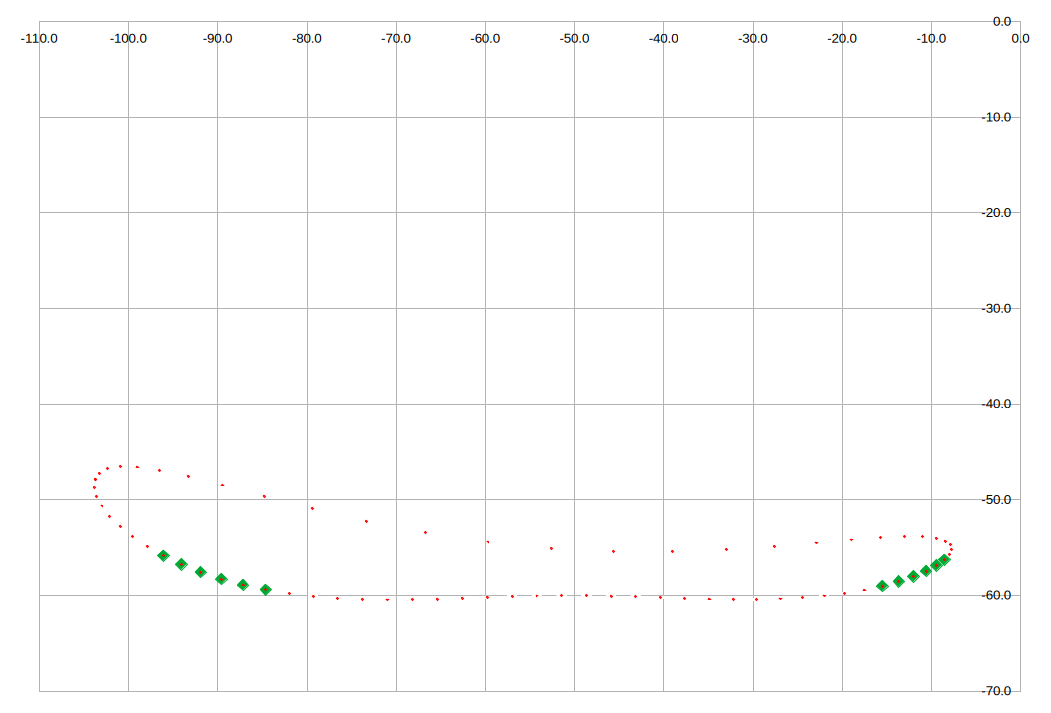
While this objective has been meet for 120 degree range (suitable for a three leg walker). How ever foot lift has been lost.
-
A Symmetry Constraint
-
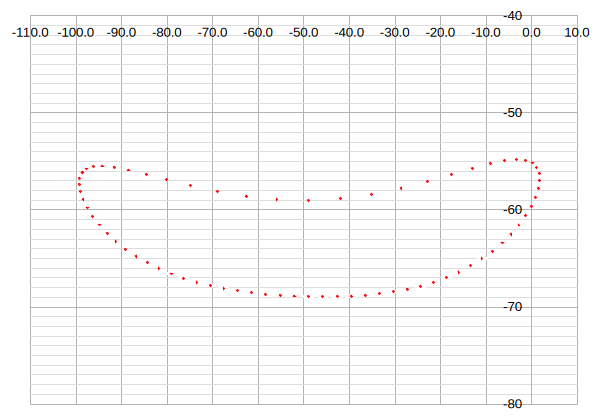
For symmetry, the difference between each Y point at each horizontal extreme is minimise, using:
- DeltaY = ABS(Yfwd-Ybwd)
- Minimum mid-section upper and lower range of 10.0 mm
Here is the result:
--
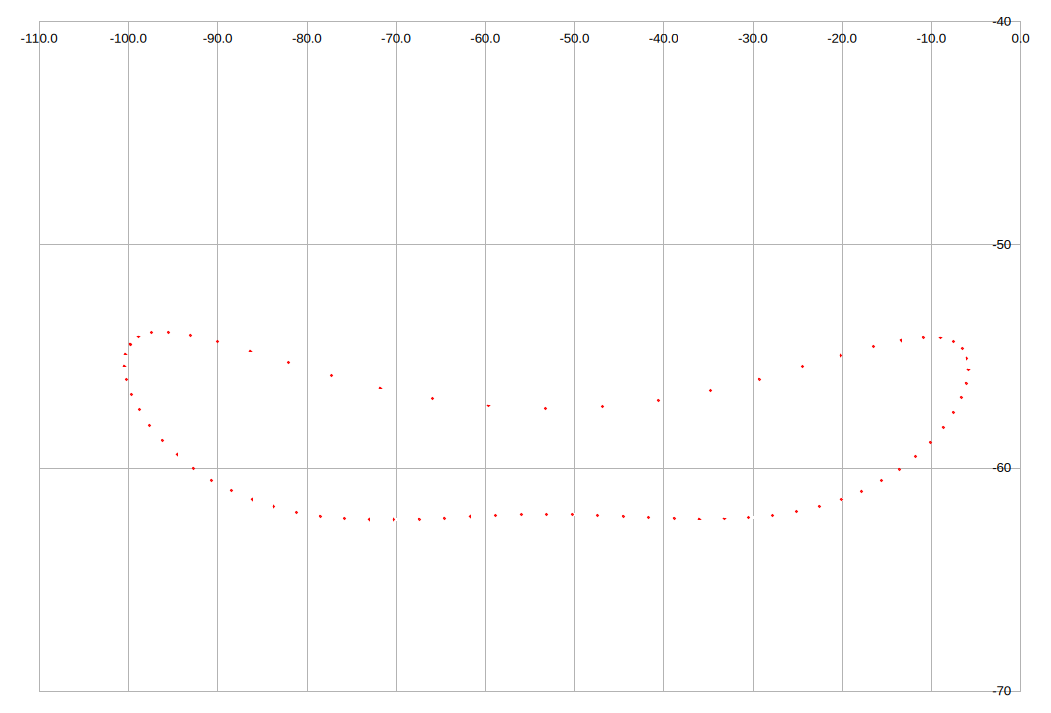
Using this as an initial feasible solution, we can impose a flat bottom:
-
The final walker parameter are:
- Axle: (0.0 mm,0.0 mm)
- Hip: (-53.1 mm,52.5 mm)
- Crank L1: 30.0 mm
- Thigh L2: 60.0 mm
- Idle L3: 59.3 mm
- Shin L4: 60.0 mm
- Knee Angle: 90.0 degrees
Reducing the minimum mid-section upper and lower range to 5 mm for the final result:
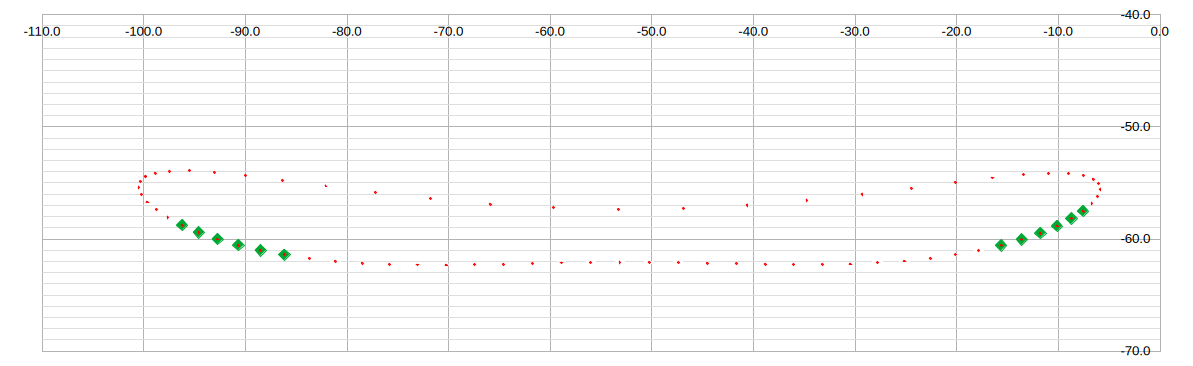
Note the flat bottom has been optimised for 120 degrees
-
The same design as imported into a CAD package:
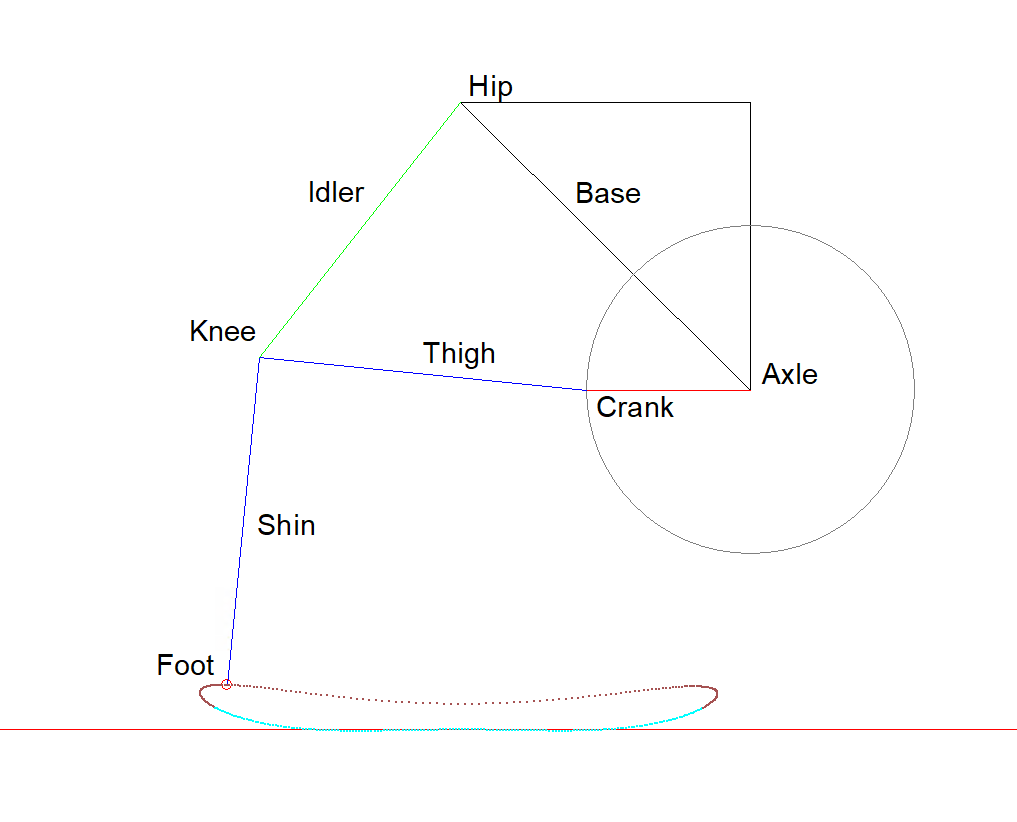
Note the cyan bottom range is for 180 degrees.
-
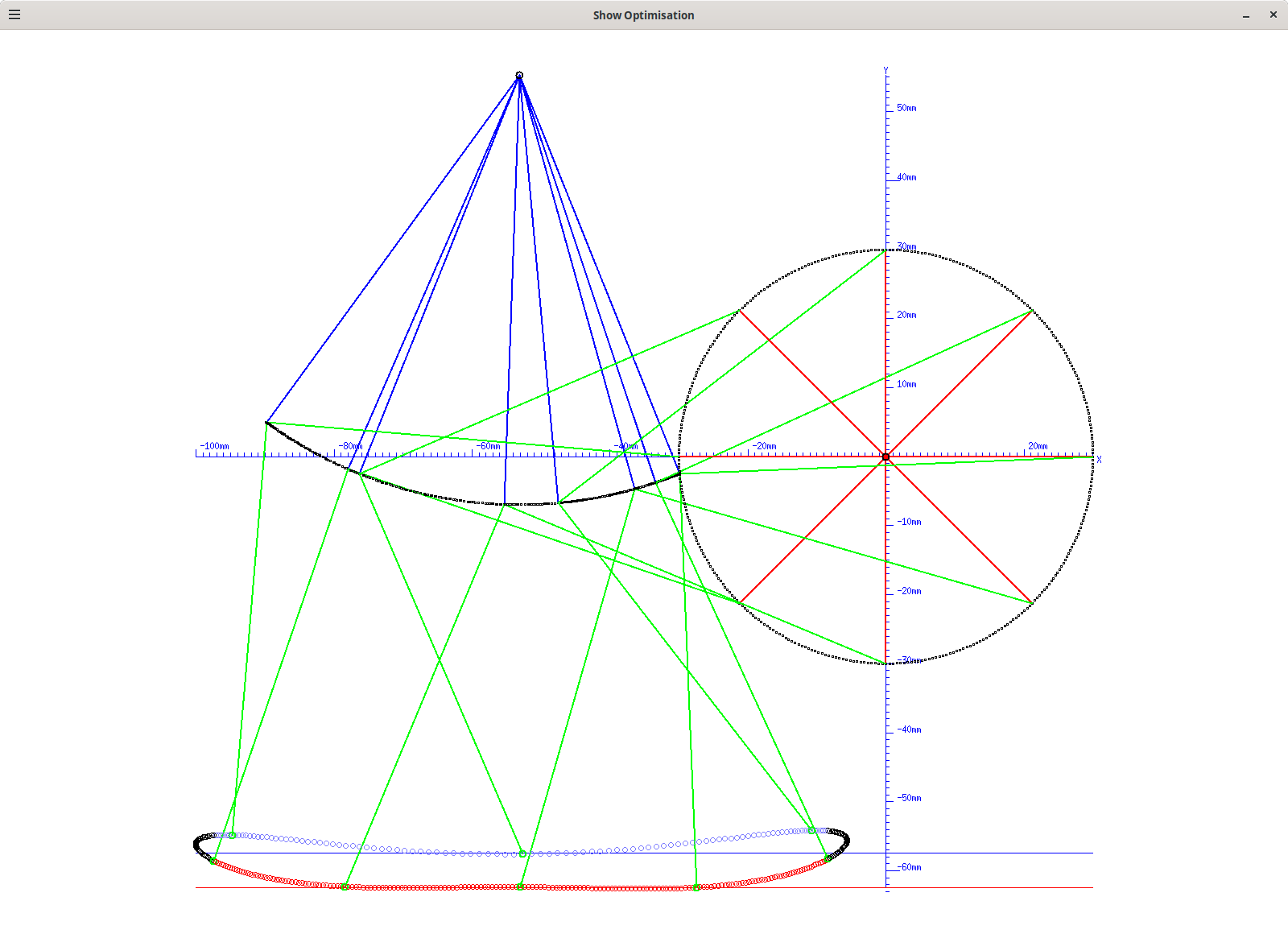
This is what I see after my optimiser runs:
-
Clearly the 4 bar linkage can be used for a three foot (120 degree) walker, but its use would be best for relatively smooth floors as the minimum clearance is about 5.0 mm (for a 94 mm step).
The cyan vertical range (for 180 degrees) is about 3.5 mm, suggesting a two foot (rather than three foot) walker is possible, but perhaps some what bumpy ride.
AlanX
Discussions
Become a Hackaday.io Member
Create an account to leave a comment. Already have an account? Log In.