 Arshia Keshvari
The Problem
Many IoT relay modules are excellent for turning things on and off, but they assume the controller is always alive.
That works for a lamp or a small hobby project. It becomes a problem when the controlled equipment must maintain a known physical state.
Imagine:
- A valve that should remain open during a short power interruption.
- A bypass circuit that must stay selected while a controller restarts.
- A motorized system where an unexpected relay change could create a dangerous movement.
- An installation where cloud services should never decide whether equipment operates.
Traditional relays usually require power to hold their position. When the controller loses power, the output disappears and the system may return to an unwanted state.
Reliable automation needs something different: hardware that remembers.
No holding current, no state loss on a brownout, no surprise re-homing after a reboot.
That's the specific problem Make Things Happy's IoTextra Octal3 module is built around, and it's why I wanted to get it working end-to-end with the existing IoTflow and IoThome software stacks before it's even fully out the door.
The Hardware
The IoTextra Octal3 combines two important pieces of automation hardware into one compact module:
- 4 isolated digital inputs
- 4 bistable (latching) relay outputs
The isolated inputs allow external sensors, switches, and control signals to connect safely without directly exposing the controller electronics.
The bistable relays are the key feature. Instead of keeping a coil energized continuously, they use a pulse to mechanically change position. Once switched, they stay there without consuming additional power.
This provides several advantages:
- State retention during power outages
- No wasted energy holding relay coils
- Predictable recovery after reboot
- Reduced risk of unexpected switching
The result is a modular I/O building block rather than a one-purpose relay board.
Wiring it into the stack
The two software layers this integrates with solve different problems:
- IoTflow is the no-code orchestration layer: a MicroPython kernel on the MCU side, MQTT as the transport, and Node-RED flows for the actual automation logic. It's the natural fit if you're coordinating the Octal3 alongside other IoTextra nodes on a network, or building out a Node-RED dashboard for manual/automatic valve control.
- IoThome sits on top of Tasmota instead, using Berry script drivers and pre-built GPIO templates so a node runs standalone — no broker, no server, fully on-device — which is the better fit for a single smart-home gate or blind controller that needs to keep working even if your home network has a bad night.
Controllers used:
- IoTsmart a compact System-on-Module (SOM) board based on ESP32-S3, RP2350A, and other MCUs that plug directly into IoTextra modules. These are designed for IoT-based distributed sensing and control.
- IoTbase a robust controller platform with better thermal management, more mounting options, and serial debugging capability during operation. You'd migrate to IoTbase when you need more I/O expansion, professional enclosure mounting, or are deploying in harsher environments.
Where this fits: IIoT, telecom, farming, home
The reason to reach for latching relays specifically, instead of the cheaper Relay2 or SSR modules already in the IoTextra lineup, comes down to what happens during the moments you're not actively controlling anything:
- Industrial automation — pneumatic valves and dampers on a packaging line that must not move during a brief control-power dropout or a PLC/controller reboot. A stuck-open or stuck-closed valve at the wrong moment can mean scrapped product or a jam; a latching relay simply can't drift.
- Telecommunications — physical bypass and backup-line switching in unattended cabinets. Once a bypass path is selected, it needs to stay selected for years without anyone maintaining coil power, and it needs to not un-select itself if the site loses power.
- Smart farming — irrigation valves opened with a single short pulse from a soil-moisture reading, then held open at zero energy cost — genuinely relevant when the "controller" is a battery-and-solar node in a field. The DI side reads water-level sensors or valve limit switches on the same board.
- Smart home — blinds, gates, and ventilation dampers where position retention after a power cut is the whole point. Nobody wants their blinds re-homing to "open" at 3 AM because the power flickered.
IoTflow Integration
IoTflow provides the automation layer that allows modules like the Octal3 to become part of a larger system.
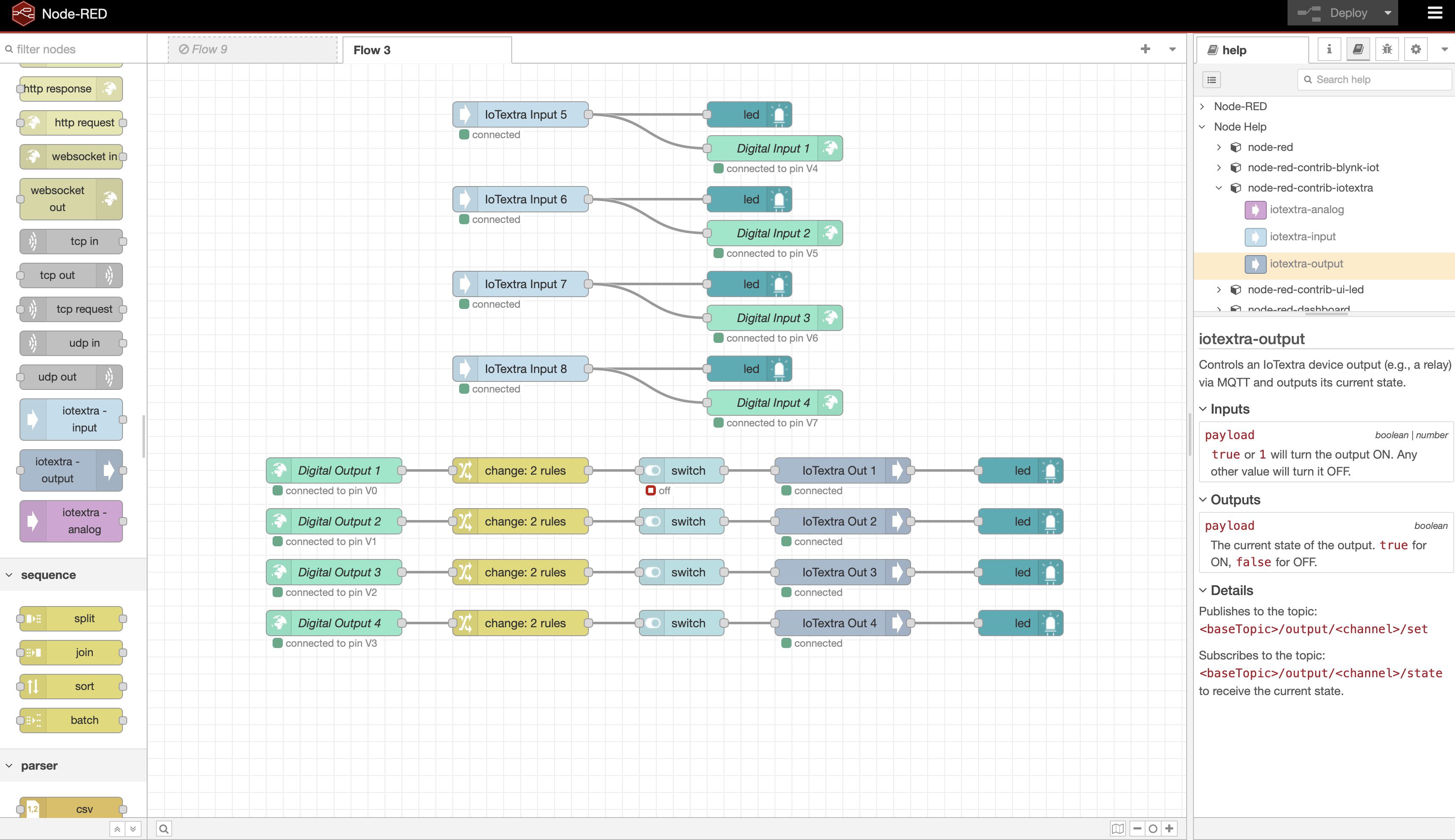
Using MQTT communication and Node-RED workflows, the Octal3 can expose predictable inputs and outputs that can be reused across different projects.
A simple automation might look like:
Sensor input → MQTT message → Node-RED logic → Octal3 relay pulse
The important idea is consistency. The same automation concepts can control a small workshop project today and a larger installation tomorrow.
Instead of writing custom firmware logic for every device, IoTflow creates a common language between hardware, workflows, and automation rules.
The Octal3 fits naturally into this approach because its physical behavior is already reliable. The automation layer decides when to switch; the hardware remembers the result.
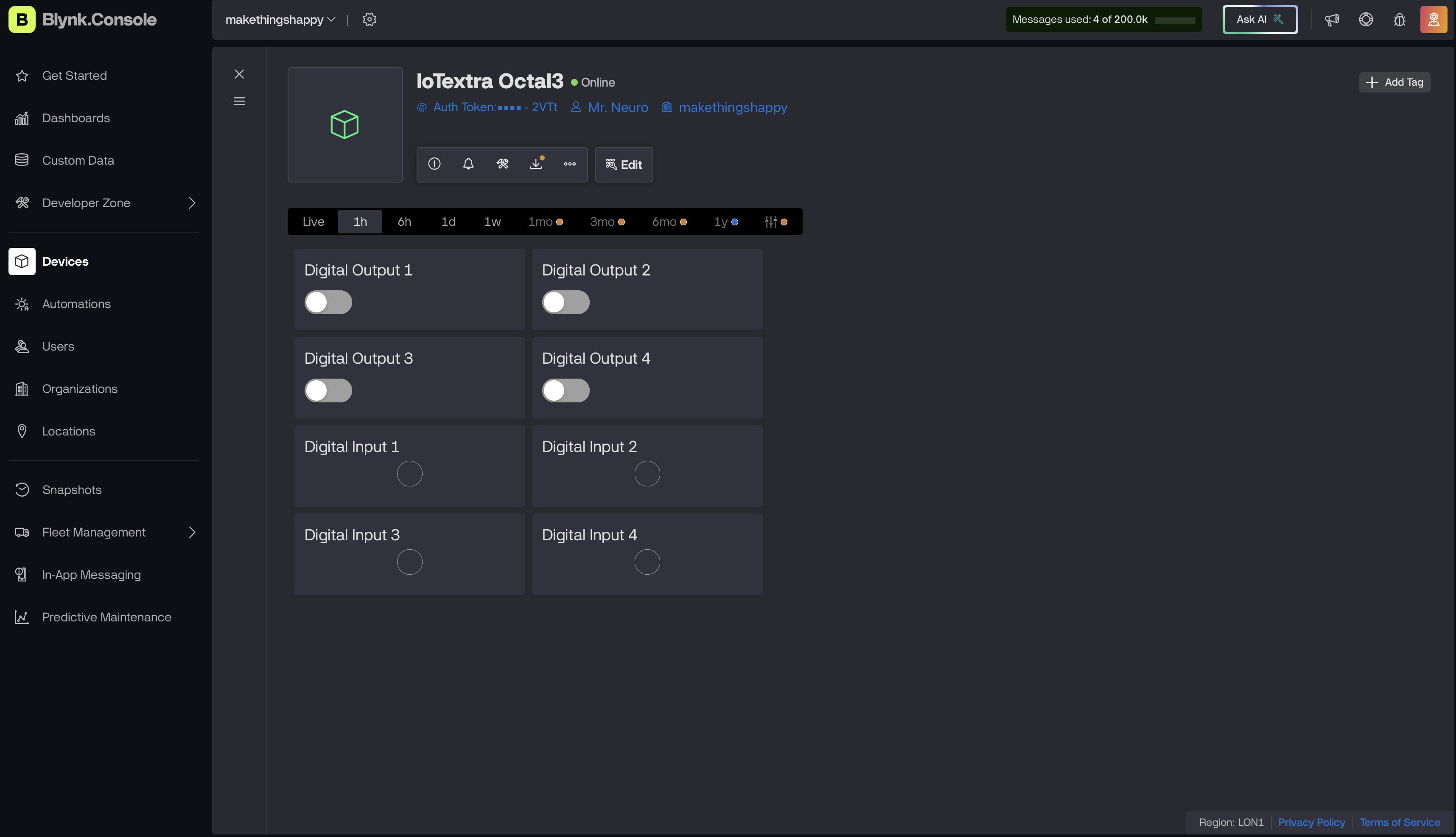
Using Node-RED you can also naturally integrate it into other third-party APIs and integrations such as Blynk, as shown below.
IoThome Integration
IoThome builds on the Tasmota ecosystem running on ESP32-based devices to provide local-first smart home automation without requiring cloud services.
The Octal3 fits this philosophy perfectly:
- Local control
- MQTT integration
- Tasmota-based operation
- Reusable templates and drivers
- Easy connection with existing smart home systems
This is not another WiFi relay board designed only for turning a light on and off.
It is a building block for automation where reliability matters.
With IoThome integration, the Octal3 can become part of smart home installations involving:
- Blinds and shutters
- Gates and access systems
- Ventilation equipment
- Pumps and valves
- Custom automation panels
The combination of Tasmota flexibility and bistable relay hardware creates a powerful mix: open software with dependable physical control.
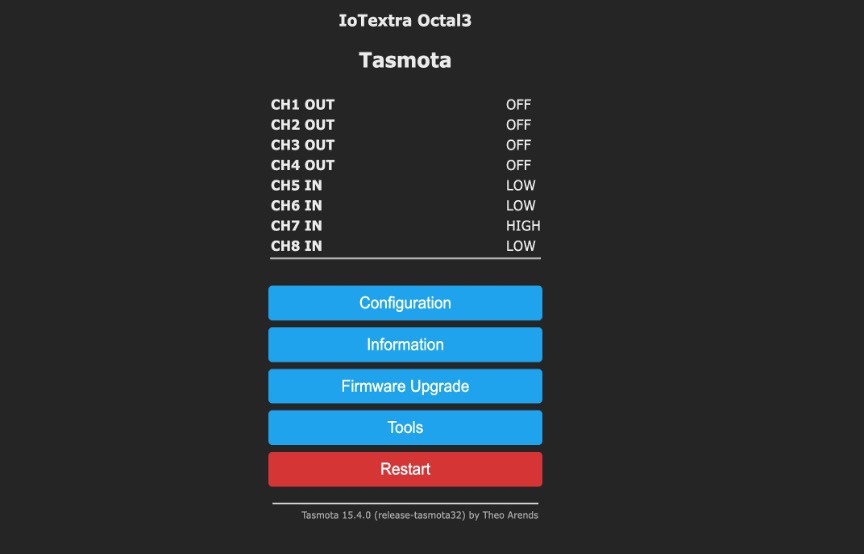
Example Tasmota UI for IoTextra Octal3:
Conclusion
The IoTextra Octal3 shows what happens when open IoT platforms move beyond simple switches and sensors.
By combining industrial-style I/O reliability with MQTT, Node-RED, Tasmota, and local automation, it creates a path between maker experiments and dependable real-world systems.
The idea is simple but powerful:
A smart device should not only know what to do. It should remember what it was told.
The Octal3 brings together:
- Industrial reliability
- Open IoT ecosystems
- Smart home compatibility
- Maker-friendly modular design
It is the kind of hardware that makes you look at old automation problems and think:
"Why wasn't it built this way before?"
There are many more possibilities waiting to be explored !
Build Your Professional Automation Network
All modules used in this project are part of the IoTextra series. You can find individual boards, connectors, and full kits at makethingshappy.io.
If you're looking for reliable, modular hardware for your next industrial IoT project, feel free to checkout Make Things Happy's ecosystem.
🌐 Explore the full IoTflow ecosystem: github.com/makethingshappy/iotflow
🏡 Explore the full IoThome ecosystem: github.com/makethingshappy/iothome
🛒 Buy IoTextra Hardware (Official Store): makethingshappy.io