M5 Shark
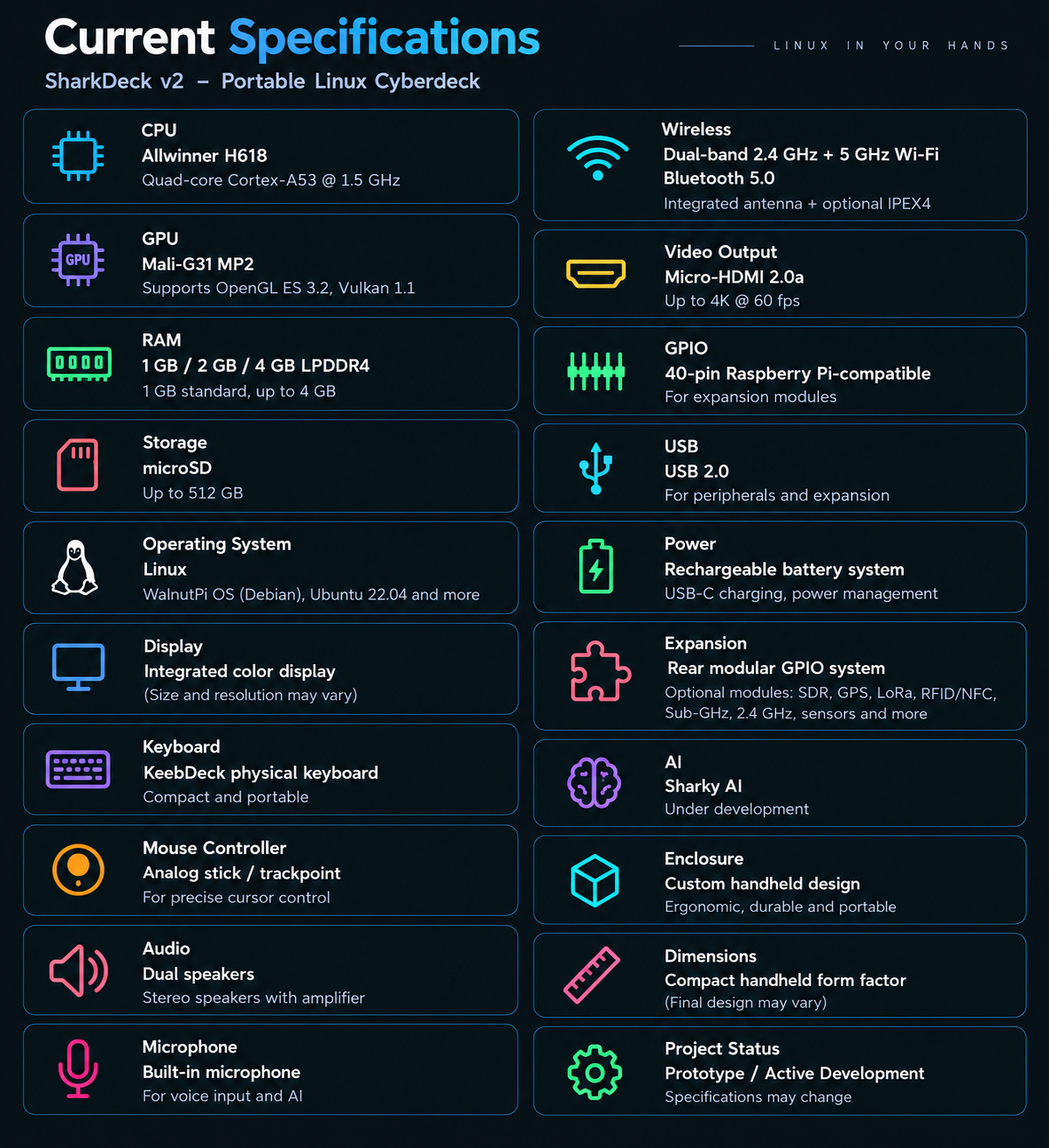
SharkDeck v2 is a compact handheld Linux cyberdeck currently under active development. It is built around the Walnut Pi ZeroW and combines a Linux computer, integrated display, KeebDeck physical keyboard, rechargeable battery, Sharky AI, and a modular rear expansion system in one portable device.
The goal is to create a small Linux computer for developers, makers, electronics enthusiasts, and people who want a portable environment for coding, terminal work, networking, AI-assisted development, and hardware projects.
Main Computer
SharkDeck v2 is powered by the Walnut Pi ZeroW, based on the Allwinner H618.
Official Walnut Pi ZeroW specifications include: (wiki.walnutpi.com)
- CPU: Allwinner H618
- Architecture: 64-bit ARM
- CPU cores: Quad-core Cortex-A53
- CPU speed: Up to 1.5 GHz
- GPU: Mali-G31 MP2
- RAM: 1 GB / 2 GB / 4 GB LPDDR4 configurations
- Storage: microSD, up to 512 GB
- Video: Micro-HDMI 2.0a
- Video output: Up to 4K @ 60 fps
- GPIO: 40-pin Raspberry Pi-compatible GPIO
- USB: USB 2.0
- Power input: USB-C, 5 V
- Board size: 65 × 30 × 5 mm
- Board weight: approximately 8.5 g
Memory
SharkDeck v2 can be configured with:
1 GB / 2 GB / 4 GB LPDDR4 RAM
Our base configuration can use 1 GB, with higher-memory versions available up to 4 GB.
These are board memory configurations rather than a removable laptop-style RAM module. (wiki.walnutpi.com)
Wireless Connectivity
The Walnut Pi ZeroW includes:
- Dual-band 2.4 GHz + 5 GHz Wi-Fi
- Bluetooth 5.0
- Integrated dual-band ceramic antenna
- Optional IPEX4 external antenna connection
The official ZeroW specifications say dual-band Wi-Fi, not Wi-Fi 6. Walnut Pi's newer 2B platform is the model officially listed with Wi-Fi 6. (wiki.walnutpi.com)
So for SharkDeck v2 we will list:
Wireless: Dual-band 2.4 GHz / 5 GHz Wi-Fi + Bluetooth 5.0
KeebDeck Keyboard
SharkDeck v2 uses a KeebDeck physical keyboard.
The keyboard is an important part of the device because SharkDeck is designed for real terminal and development work, including:
- Linux commands
- Python
- Shell scripting
- SSH
- Git
- Code editing
- File management
- Remote server access
- Development tools
This allows SharkDeck to be used as a real handheld computer without requiring an external keyboard.
Linux
SharkDeck v2 runs a full Linux environment.
The Walnut Pi platform officially supports systems including WalnutPi OS based on Debian and Ubuntu 22.04. (wiki.walnutpi.com)
SharkDeck is being optimized for workflows such as:
- Terminal
- Python
- Node.js
- Git
- SSH
- Networking
- Serial communication
- Automation
- Hardware development
- File management
- Remote development
Sharky AI
We are developing Sharky AI specifically for SharkDeck.
Sharky AI will provide an AI-assisted interface for:
- Coding
- Linux commands
- Scripts
- Debugging
- Documentation
- Terminal workflows
- Project development
- System tasks
Sharky AI and the SharkDeck software environment are currently under active development.
Rear GPIO Expansion Modules
One of the main features being developed for SharkDeck v2 is a modular expansion system on the back of the device.
Instead of putting every possible feature permanently inside SharkDeck, we are designing optional modules that can be attached to the rear of the handheld.
The expansion system is based around the GPIO interface, allowing SharkDeck to communicate with compatible module hardware.
We are working on rear modules for:
- SDR
- GPS
- LoRa
- RFID / NFC
- Sub-GHz radio
- 2.4 GHz radio
- Sensors
- Other hardware expansion modules
These features are not permanently integrated into the main SharkDeck.
The concept is:
SharkDeck provides the Linux computer. Attach the rear module you need for your project.
The exact electrical interface can vary depending on the module; the Walnut Pi ZeroW itself provides a 40-pin Raspberry Pi-compatible GPIO header, while it also exposes additional USB and peripheral functions through its hardware interfaces. (wiki.walnutpi.com)
SDR
We are also working on SDR support as part of the rear expansion concept.
SDR is not built permanently into SharkDeck v2.
The goal is to develop an optional module/software workflow that allows SharkDeck to act as a portable Linux platform for legitimate SDR development, spectrum visualization, signal analysis, education, and experimentation.
The SDR implementation is still being developed, and its final hardware interface may change during prototype testing.
Power
SharkDeck v2 is designed as a portable battery-powered computer.
We are developing an integrated rechargeable power system with focus on:
- Battery operation
- USB charging
- Power management
- Battery monitoring
- Efficiency
- Thermal management
- Reliable portable operation
Custom Enclosure
SharkDeck v2 uses a custom handheld enclosure designed around:
- Walnut Pi ZeroW
- KeebDeck keyboard
- Display
- Battery
- Internal electronics
- Rear expansion modules
We are continuing to improve the enclosure for ergonomics, cooling, durability, port access, module mounting, assembly, and manufacturing.