Close
0%
0%

Hestia32 - Open Source Smart Thermostat

A fully open-source, standalone smart thermostat for HVAC and European heating systems.

Similar projects worth following
Hestia32 - Open Source Smart Thermostat & HVAC Controller

Hestia32 is a fully open-source smart thermostat and HVAC controller designed for long-term ownership, local control and complete freedom to modify the hardware and software.

It is the successor to my HestiaPi project, an open-source Raspberry Pi-based thermostat that I originally developed several years ago and successfully crowdfunded through Crowd Supply. Hestia32 takes the same open-source philosophy into a new generation of hardware, using an ESP32-C5 and a dedicated thermostat design that can operate completely standalone.

Unlike many modern smart thermostats, Hestia32 does not require a cloud service, subscription or proprietary ecosystem. The thermostat can be installed and used entirely on its own, while local MQTT support allows it to integrate with existing home automation systems such as Home Assistant, OpenHAB and Node-RED.

Two hardware versions are being developed:

  • Hestia32 HVAC - designed for standard 24 V AC HVAC systems, including multi-stage heating and cooling and heat pumps.
  • Hestia32 EU - designed for European mains-powered heating and HVAC applications.

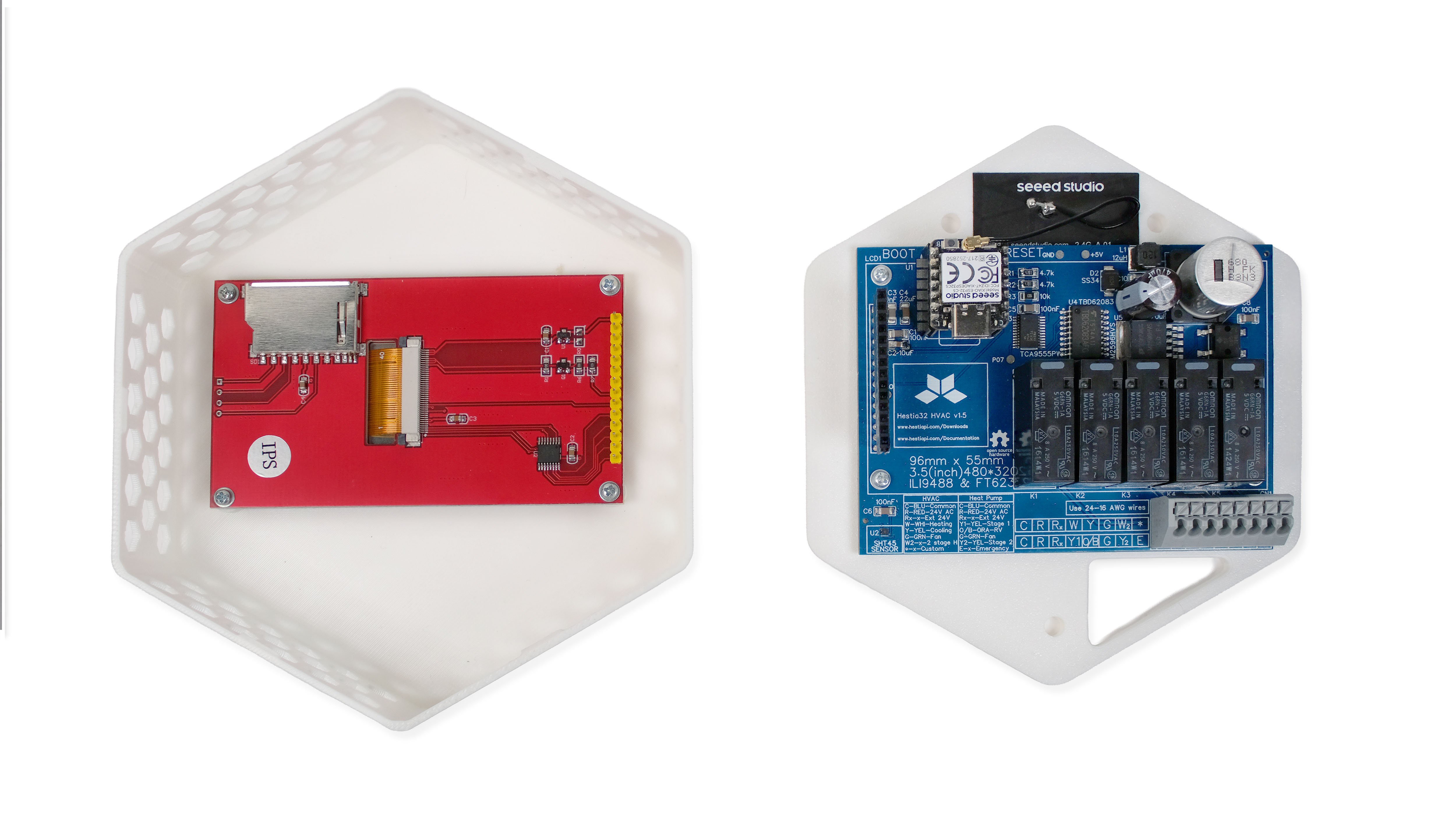
The thermostat provides five configurable relay outputs, allowing it to control different combinations of heating stages, cooling stages, heat pumps, fans, humidity equipment and domestic hot water. The humidity output can be configured for either humidification or dehumidification.

A 3.5-inch IPS display provides the user interface, while an SHT45 temperature and humidity sensor provides accurate environmental measurements. Wi-Fi connectivity is currently used for local networking and MQTT and secure OTA updates allow the firmware to be updated without opening the enclosure.

The project is being designed with future expansion in mind. Additional connectivity options such as Thread, Matter and Zigbee are planned as firmware/OTA additions, without requiring a hardware replacement.

Everything needed to understand, build, modify and manufacture Hestia32 is intended to remain open: firmware source code, schematics, PCB layouts, bill of materials, manufacturing files, enclosure CAD files and documentation will be published as part of the project.

The goal is simple: build a thermostat that belongs to its owner rather than to a cloud service or a particular vendor ecosystem - and that can continue to be repaired, modified and improved long after it was purchased.

Follow the project

Hestia32 is currently in development, with a Crowd Supply campaign planned for the next stage of the project.

Follow the Hestia32 pre-launch page on Crowd Supply:

https://www.crowdsupply.com/makeopenstuff/hestia32

The pre-launch page will be updated as development progresses and will be the primary source for campaign and availability information.

Features

  • Fully open-source hardware and firmware
  • Standalone operation - no cloud service or subscription required
  • 3.5-inch display with an integrated touch interface
  • ESP32-C5-based controller
  • Accurate SHT45 temperature and humidity sensor
  • Five configurable relay outputs
  • Support for multi-stage heating and cooling
  • Heat pump support
  • Configurable fan control
  • Humidification or dehumidification control
  • Domestic hot water control
  • Local MQTT support
  • Future Thread, Matter and Zigbee support planned through firmware updates
  • Home Assistant, OpenHAB and Node-RED integration
  • Secure OTA firmware updates
  • HVAC and European mains-powered hardware versions
  • Open-source PCB, schematics and manufacturing files
  • Open-source 3D-printable enclosure
  • Designed for repairability and long-term ownership

Hardware

  • Controller: Seeed Studio XIAO ESP32-C5 and Generic ESP32-C5 DevKit option
  • Display: 3.5-inch 320 × 480 color display with resistive touch interface 
  • Temperature / humidity: Sensirion SHT45 
  • Relay outputs: 5 × configurable mechanical relays 
  • Connectivity: Wi-Fi, with local MQTT 
  • Firmware updates: OTA 
  • Power: Dedicated hardware for 24 V AC HVAC systems or European mains-powered systems

The five relay outputs are software-configurable, allowing the same hardware to support different HVAC configurations rather than requiring a different thermostat for every application.

The complete hardware design, including schematics, PCB layout, BOM and manufacturing files are already public during the development phase on the GitHub repo link below.
  • Hestia32 Development Update #4 - Supporting a Generic ESP32-C5 DevKit

    gulliverrr • 5 hours ago • 0 comments

    One of the goals of Hestia32 is to keep the hardware as open as the software. That means more than publishing the source files: it also means giving people meaningful choices when building the device.

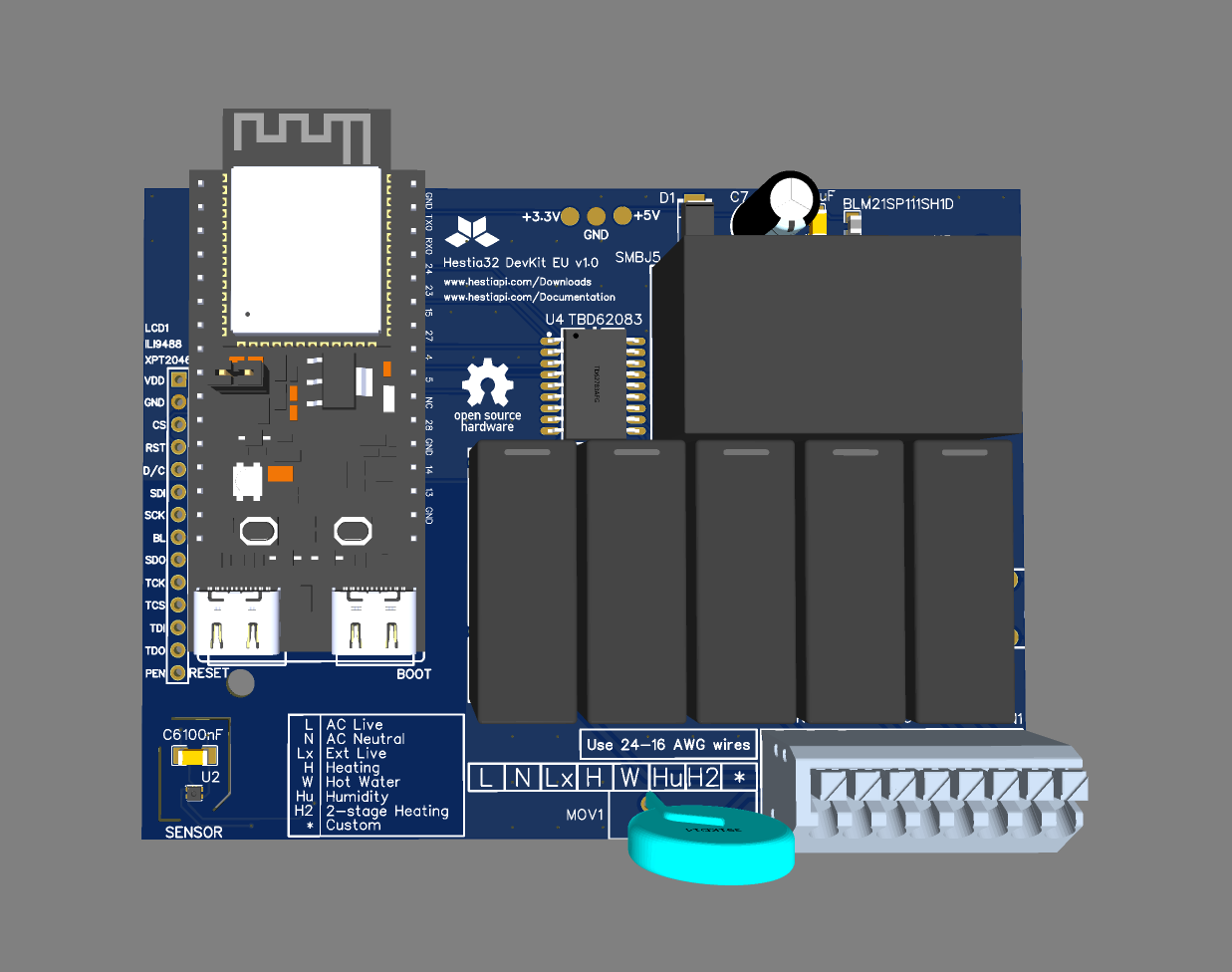
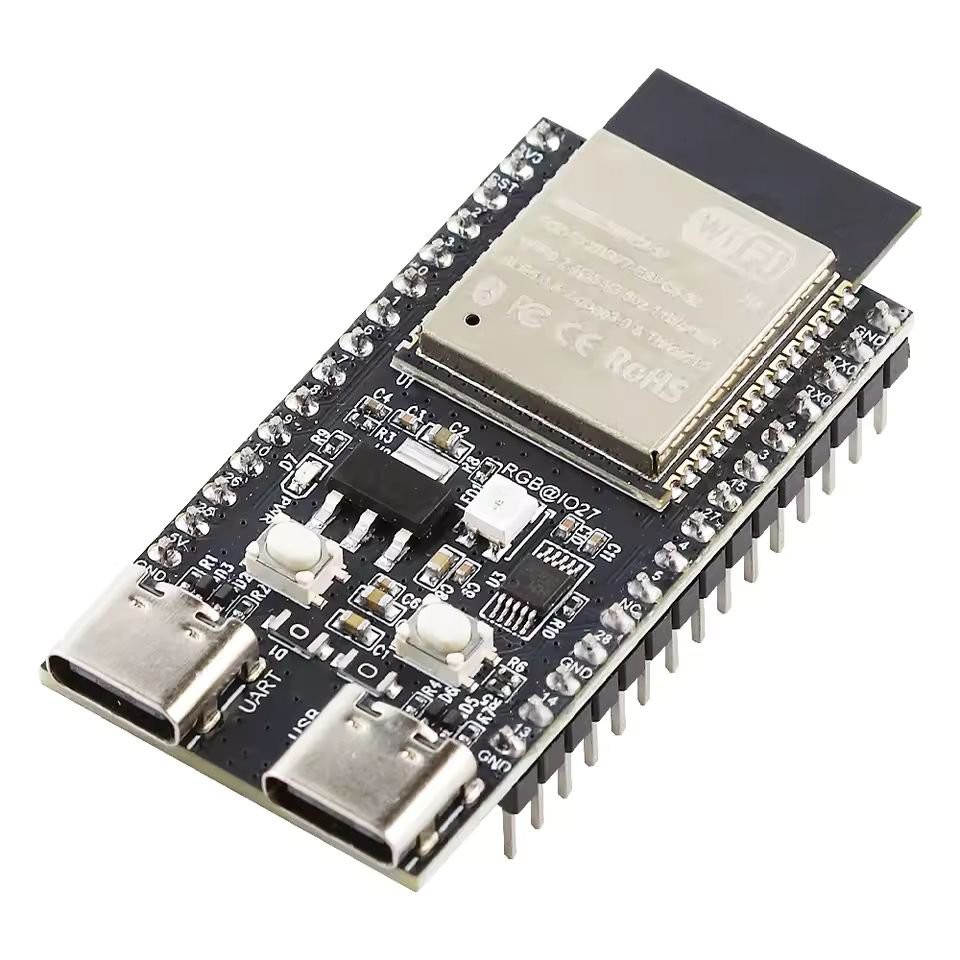
    The first Hestia32 designs use the Seeed XIAO ESP32-C5. I've now completed the HVAC and EU board designs using a generic 30-pin ESP32-C5 DevKit as well.

    https://github.com/MakeOpenStuff/hestia32/tree/develop/pcb

    Why support another board?

    The XIAO is a good fit for a compact design, but it shouldn't be the only way to build Hestia32.

    Some builders may prefer a generic development board, already have one available, or simply want to avoid depending on a particular module. Supporting both approaches makes the project more flexible and gives people another route to building their own thermostat.


    Same functionality, different hardware

    The generic DevKit variants are intended to offer the same functionality and feature set as their XIAO-based counterparts. The controller board changes, but the goal for the thermostat itself remains the same.

    The attached render shows the EU version with the generic 30-pin ESP32-C5 DevKit installed. The HVAC version follows the same approach.

    Keeping the project open

    For me, open hardware should give people the freedom to inspect, modify, build and maintain a design without unnecessary vendor dependence. Supporting an alternative controller takes additional design work, but it's consistent with that goal.

    These DevKit variants won't be included in the upcoming Crowd Supply campaign. I'm still exploring how best to make them available afterwards, potentially as bare boards.

    The main crowdfunding campaign remains planned for the primary Hestia32 variants.

    You can follow the project and subscribe for launch updates here:

    https://www.crowdsupply.com/makeopenstuff/hestia32

    More development updates as the hardware and user interface continue to evolve.


  • Hestia32 Development Update #3 - From prototype to production

    gulliverrr • 09/28/2026 at 12:10 • 0 comments

    One of the interesting transitions in an open hardware project is moving from a working prototype to something that can actually be manufactured consistently.

    I've reached that stage with Hestia32.

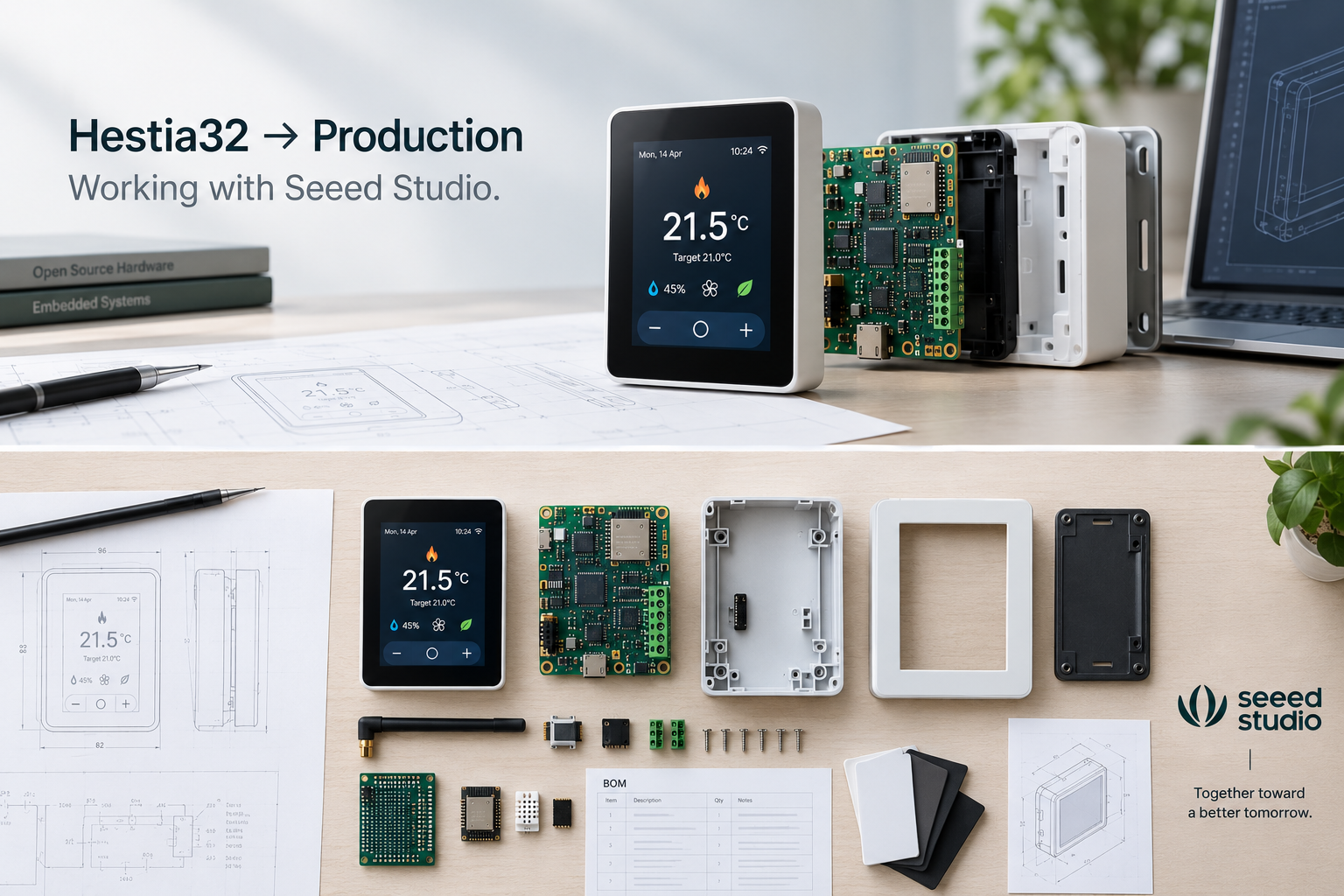
    I'm happy to share that Hestia32 is now working with Seeed Studio on bringing the hardware toward production.

    There isn't a finalized production agreement yet, but we've been working through the practical manufacturing side of the project.

    Optimizing the BOM

    The prototype BOM isn't necessarily the right BOM for production.

    We've been reviewing the component selection and optimizing the BOM with production costs, availability and manufacturing in mind.

    This is one of those parts of hardware development that isn't particularly exciting to look at, but it has a major effect on whether a design is viable beyond a handful of prototypes.

    Production quantities

    We're currently discussing an initial inventory level in the 100-200 unit range.

    That gives us a realistic starting point without immediately committing to a large production run.

    We're also discussing larger enclosure production runs, including the possibility of around 500 units.

    Enclosure production

    The enclosure is another part of the design we're working through with production in mind.

    In addition to the current 3D-printed enclosure approach, we're looking at production options including two-colour enclosures.

    I'll share more about the enclosure once there is something tangible to show.

    What's next?

    The longer-term plan is to work with Seeed through its Co-Create/Bazaar ecosystem, making Hestia32 available beyond the initial crowdfunding campaign.

    For now, though, the planned first step is Crowd Supply.

    If you'd like to follow Hestia32 and get notified when the campaign moves forward:

    Hestia32 on Crowd Supply

    There's still plenty to do before production, but this is an important milestone: the project is moving from designing and validating hardware toward figuring out how to make it available to other people.

  • Hestia32 Development Update #2 - Fixing the thermal issue

    gulliverrr • 09/21/2026 at 17:27 • 0 comments

    During testing of the previous Hestia32 XIAO HVAC PCB, I found an unexpected problem: the SHT45 temperature sensor was consistently reading around 6-7°F higher than the actual ambient temperature after the board had been running for a while.

    The cause turned out to be heat traveling through the PCB copper planes from other components towards the sensor.

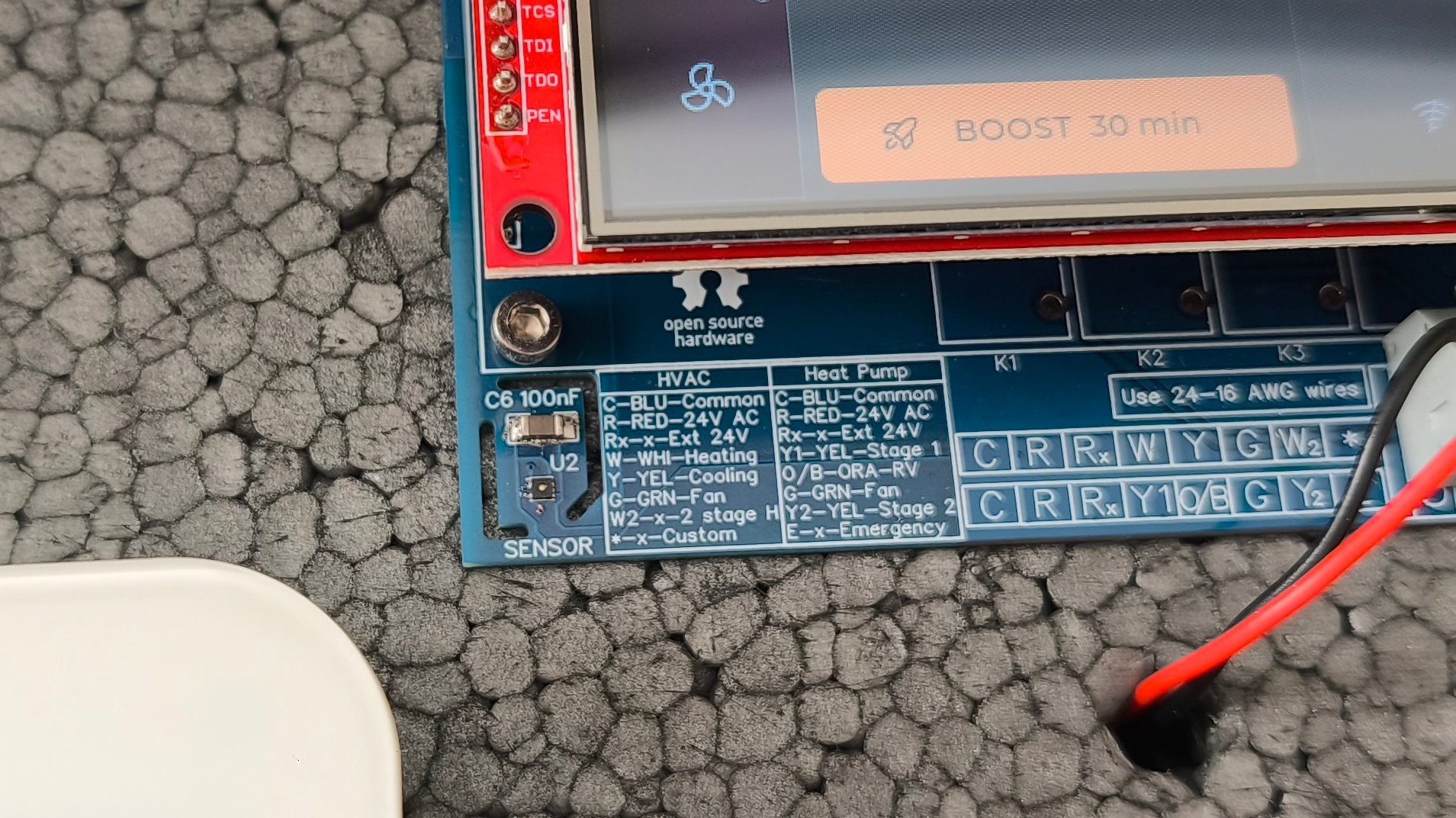
    For the next revision, I removed the copper fill around the sensor and added two L-shaped slots to create an air gap around that section of the PCB. I kept two narrow bridges: one carries the sensor connections while also providing mechanical support, while the other is purely structural.

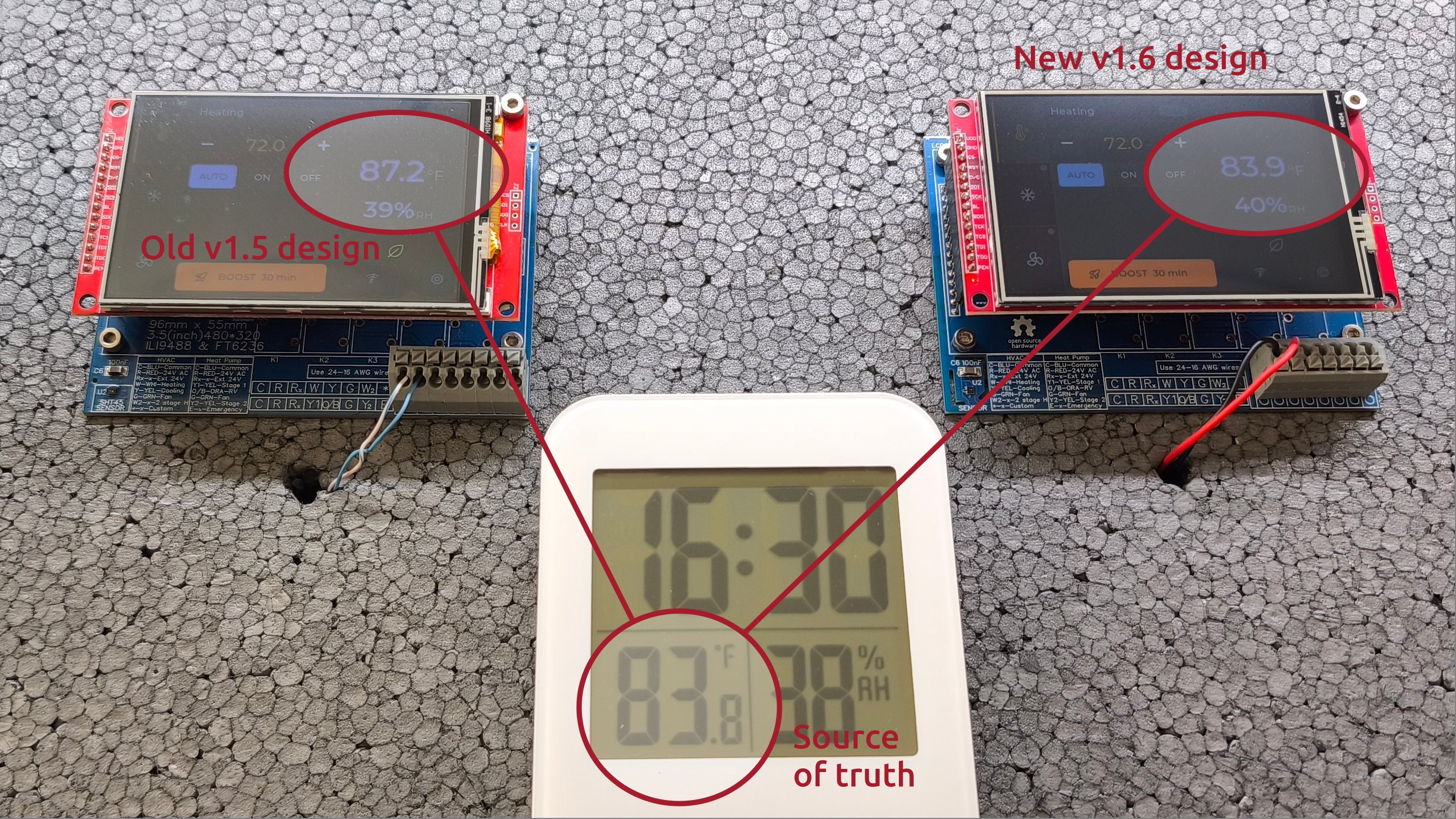
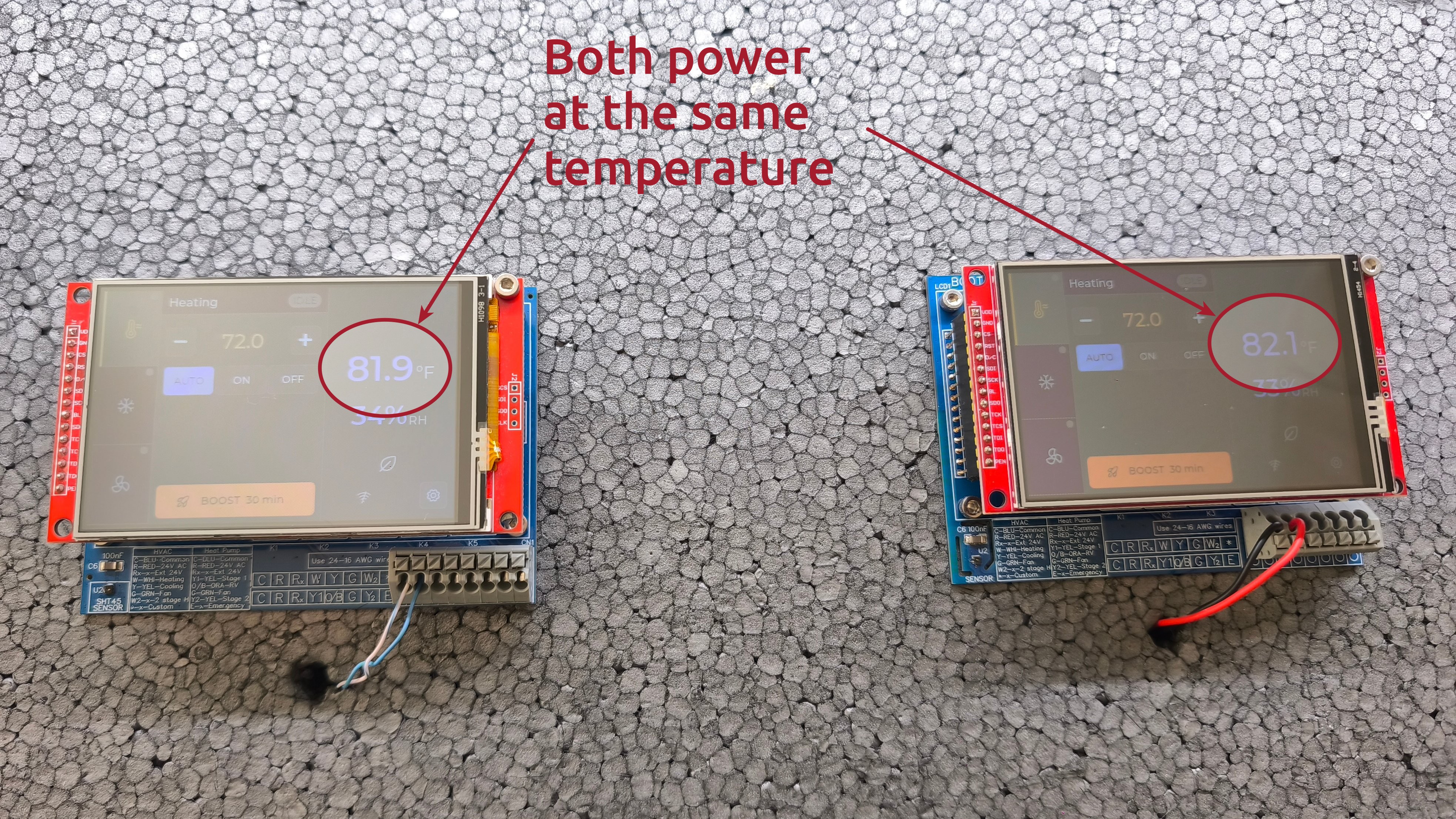
    I then tested the two revisions side by side on a 10 cm thick styrofoam "wall", powered from the same 24V AC source and connected to Wi-Fi. The displays were deliberately left on continuously to maximise power consumption and therefore heat generation.

    After two hours:

    • Old v1.5: 87.2°F
    • New v1.6: 83.9°F
    • Reference thermometer: 83.8°F

    That reduced the measured temperature error from +3.4°F to +0.1°F, or roughly a 97% reduction.

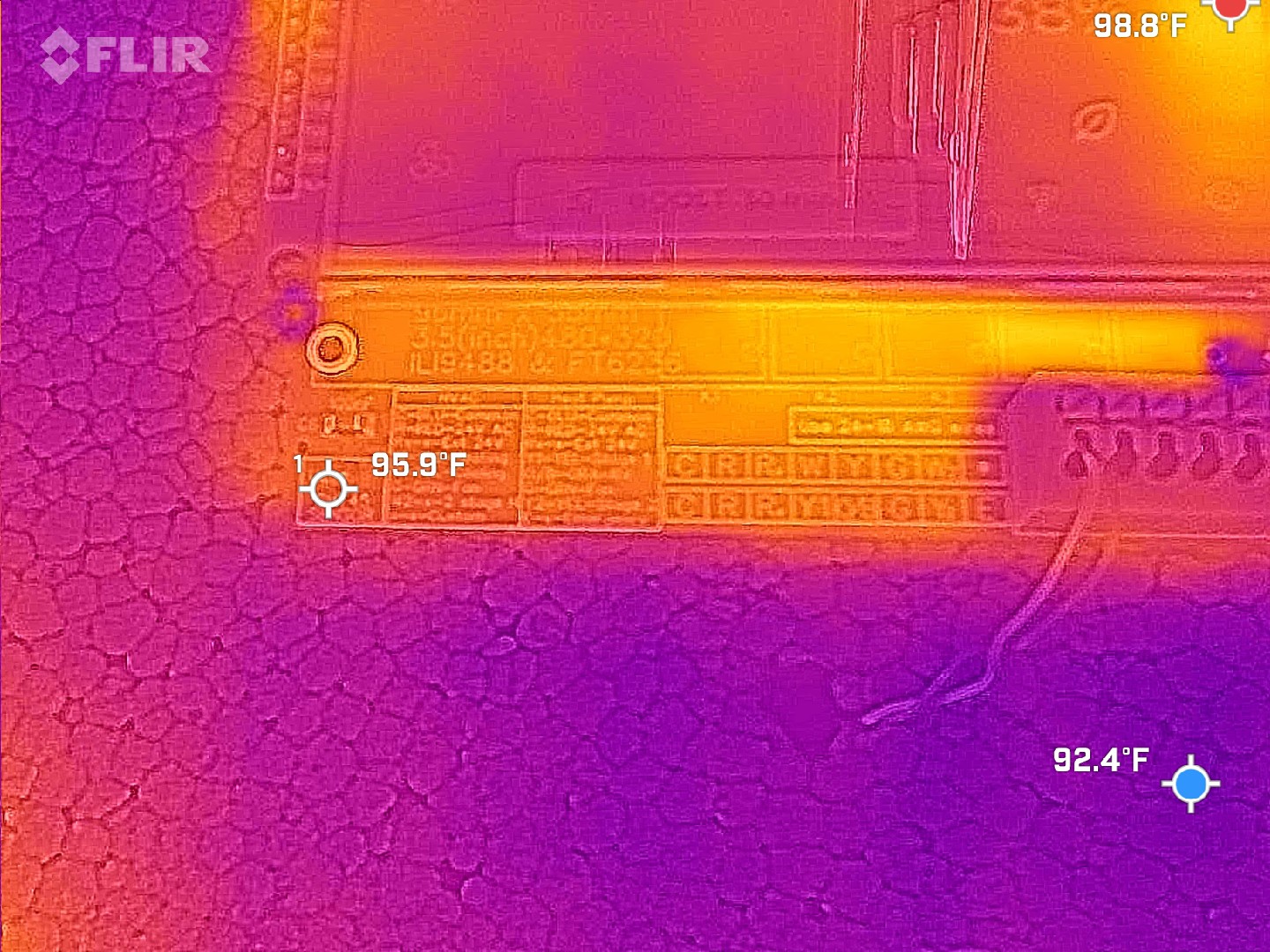
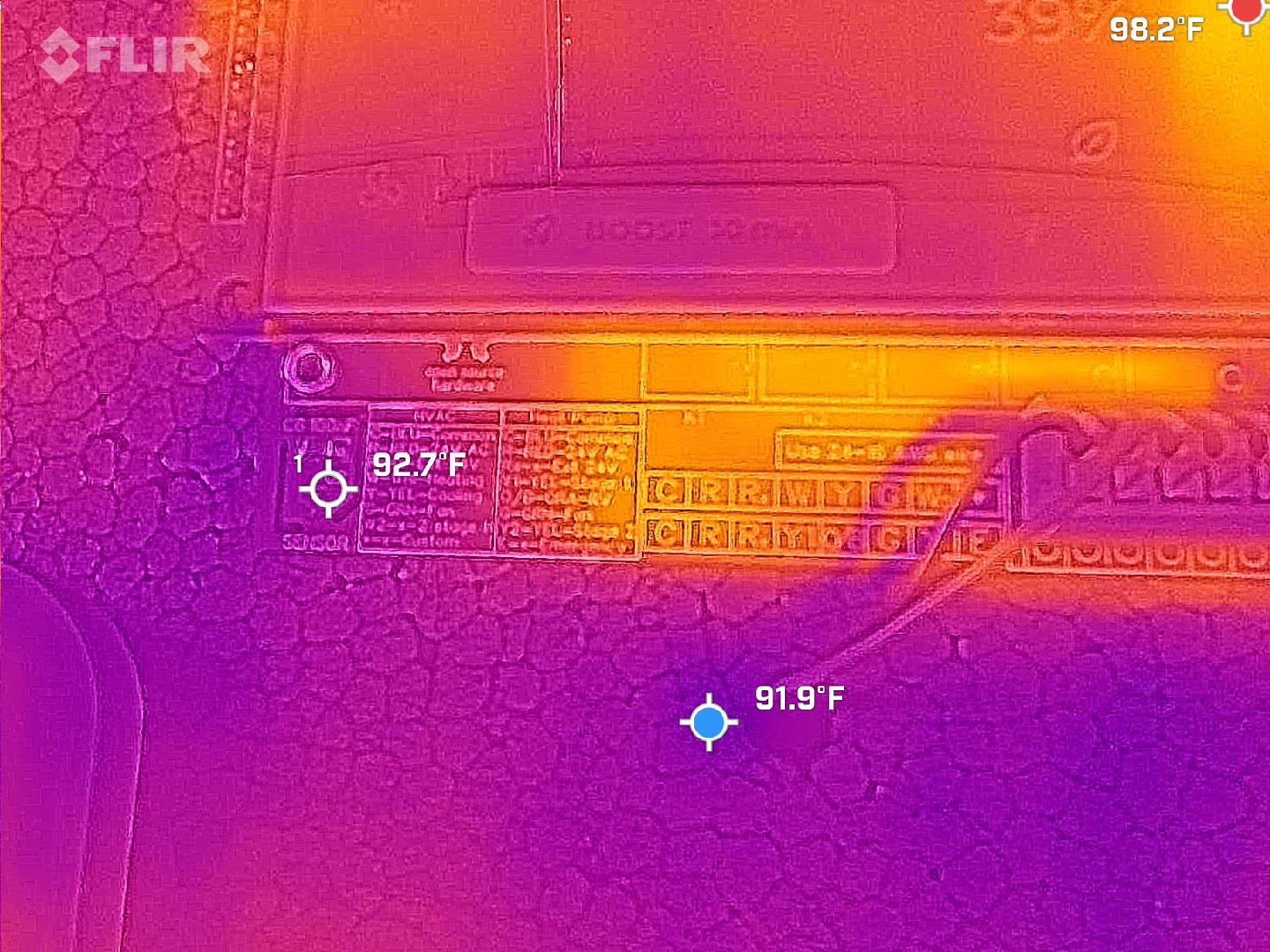
    A thermal camera made the difference particularly obvious. On v1.5, the copper fill creates a visible thermal path towards the sensor. On v1.6, the copper-free area and PCB slots substantially isolate the sensor from the rest of the board.

    There is still more validation to do, but the new design is behaving much closer to what I want: the sensor measures the environment rather than the PCB.

    Next up: continued hardware validation and the touchscreen UI.

    The Testbed
    The Testbed
    Old Design - no air gap
    Old Design - no air gap
    New Design - with air gap
    New Design - with air gap
    Old Design - heat path present
    Old Design - heat path present
    New Design - heat path disrupted
    New Design - heat path disrupted
    Starting position
    Starting position

View all 3 project logs

Enjoy this project?

Share

Discussions

Similar Projects

Does this project spark your interest?

Become a member to follow this project and never miss any updates