 JP Gleyzes

Specifications
Tide clocks a generally built from a quartz clock mechanism with an approximate period of 6h and 12 minutes (in France). So they are not very accurate nor fancy ...
I wanted to build a "real tide clock" that is a device showing the sea level... with water !
The principle is rather simple and gives the basic specifications set of this project:
- you just have to empty one bucket to fill another one at the exact cycle of the tides
- to be "nice" one of the buckets must be fully hidden...
- the pumps needed to fill/empty the buckets must be silent and tiny enough for the mechanism to be fully hidden
- the device should be "artistic" (ie not ugly !)
- And finally all this must be "smart" and connected to internet to follow the exact cycles of the tides at your local place and time
Tides in France and in the USA
In metropolitan France, the tidal cycle consists of two high tides and two low tides each day, with an interval of approximately six hours between each event.
The daily rhythm
- Exact duration: This complete cycle lasts 24 hours and 50 minutes.
- Shift: Tide times shift by about 50 minutes each day.
- Alternation: The sea rises for nearly 6 hours (flood tide) and then falls for nearly 6 hours (ebb tide).
Amplitude and coefficients
- Tidal range (the difference in height between high and low tide) varies according to the phases of the moon and the sun:
- Spring tides: During the new moon and full moon, the forces combine. Tides are stronger (high coefficients).
- Neap tides: During the first and last quarters, the forces counteract each other. Tides are weaker.
- Equinoxes: The year's largest tides occur around the spring and autumn equinoxes due to the optimal alignment of the celestial bodies.
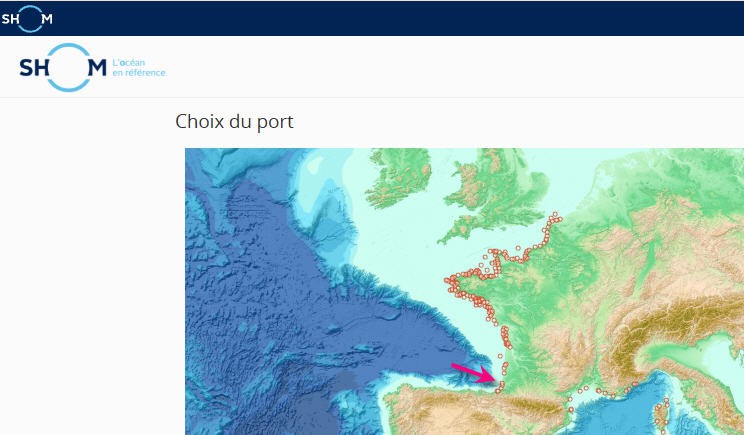
Here is a daily cycle for Biarritz in France september 21rst 2026. It is provided by the French governemental institute SHOM (Service hydrographique et océanographique de la Marine)
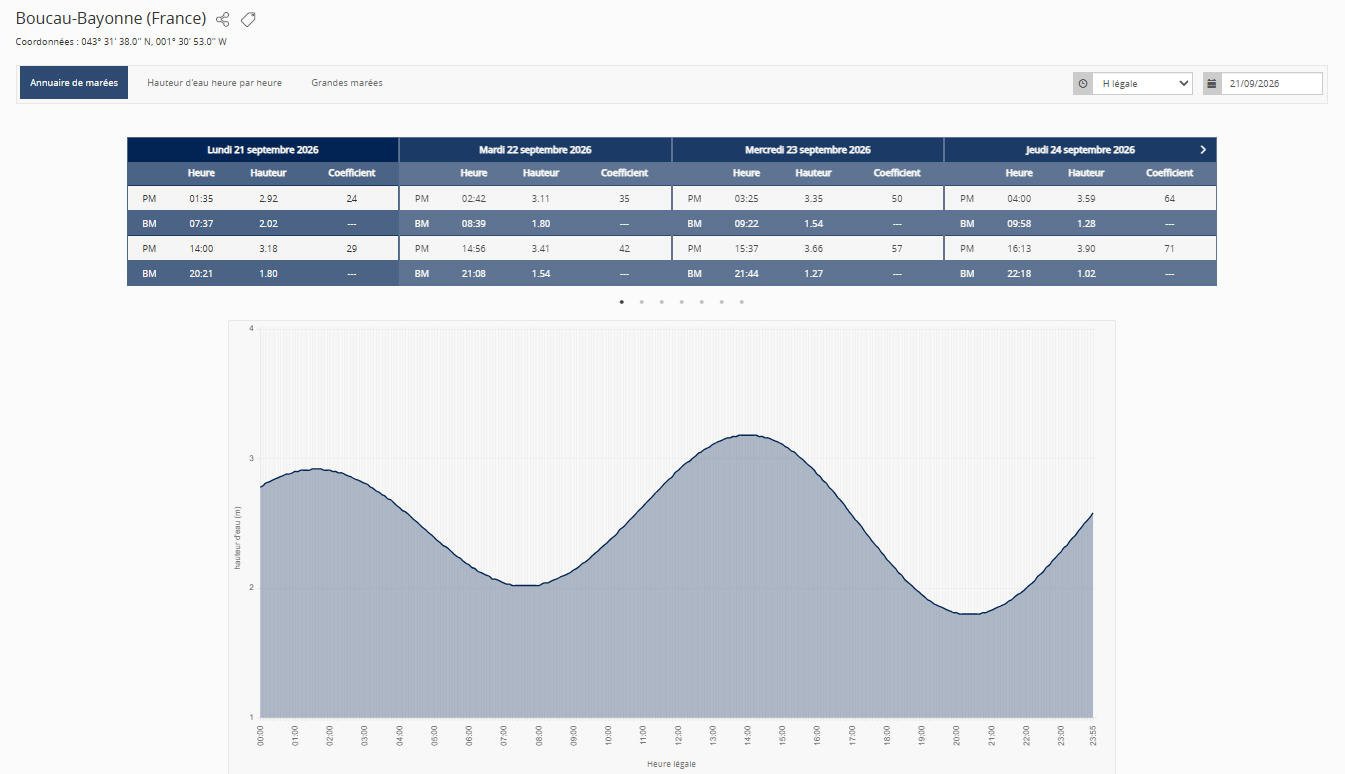
This behavior is typical for France but not strictly identical for other countries (eg USA)
Tides main diffrences between France and USA:
Because both France and the United States have extensive coastlines bordering different bodies of water, comparing their tides depends on the specific region. However, there are key differences in tidal range (height), tidal cycles (frequency), and localized phenomena.
Tidal Amplitude (Height Differences)
- France:
- The Atlantic & English Channel: Northern and western France experience some of the largest tidal ranges in the world. sup class="superscript" data-turn-source-index="1"> During spring tides, water levels here can shift by as much as 12 to 14 meters (39 to 46 feet) between high and low tide.
- The Mediterranean Coast: 30 to 40 cm (1 foot)>span class="citation-16 citation-end-16"> due to the enclosed nature of the basin.
- United States:
- East Coast & Gulf Coast: Most of the US Atlantic coast experiences modest tides (typically 1 to 2 meters / 3 to 6 feet). The Gulf Coast has extremely small tides, often less than 0.6 meters (2 feet).
- Exceptions (Northeast & Alaska): The US does have spots with massive tides. Northern Maine (near the Bay of Fundy) experiences ranges of 4 to 6 meters (13 to 20 feet), and parts of Alaska (like Anchorage's Cook Inlet) see tides exceeding 9 meters (30 feet).
Frequency and Timing (Tidal Cycles)
- France: The entire Atlantic and English Channel coasts follow a semi-diurnal tide pattern—exactly two high tides and two low tides of roughly equal height every lunar day (about 24 hours and 50 minutes).
- United States: The US features three distinct tidal patterns depending on the coast:
- Semi-diurnal: Common along the East Coast (two equal high/low tides per day).
- Mixed Semi-diurnal: Standard along the Pacific Coast (California, Oregon, Washington) and Alaska. This means two high tides and two low tides daily, but they differ significantly in height (e.g., one very high tide and one modest high tide).
- Diurnal: Common in the Gulf of Mexico, where...