Gian Marco

Design approach
The system was designed around household behaviour rather than around devices.
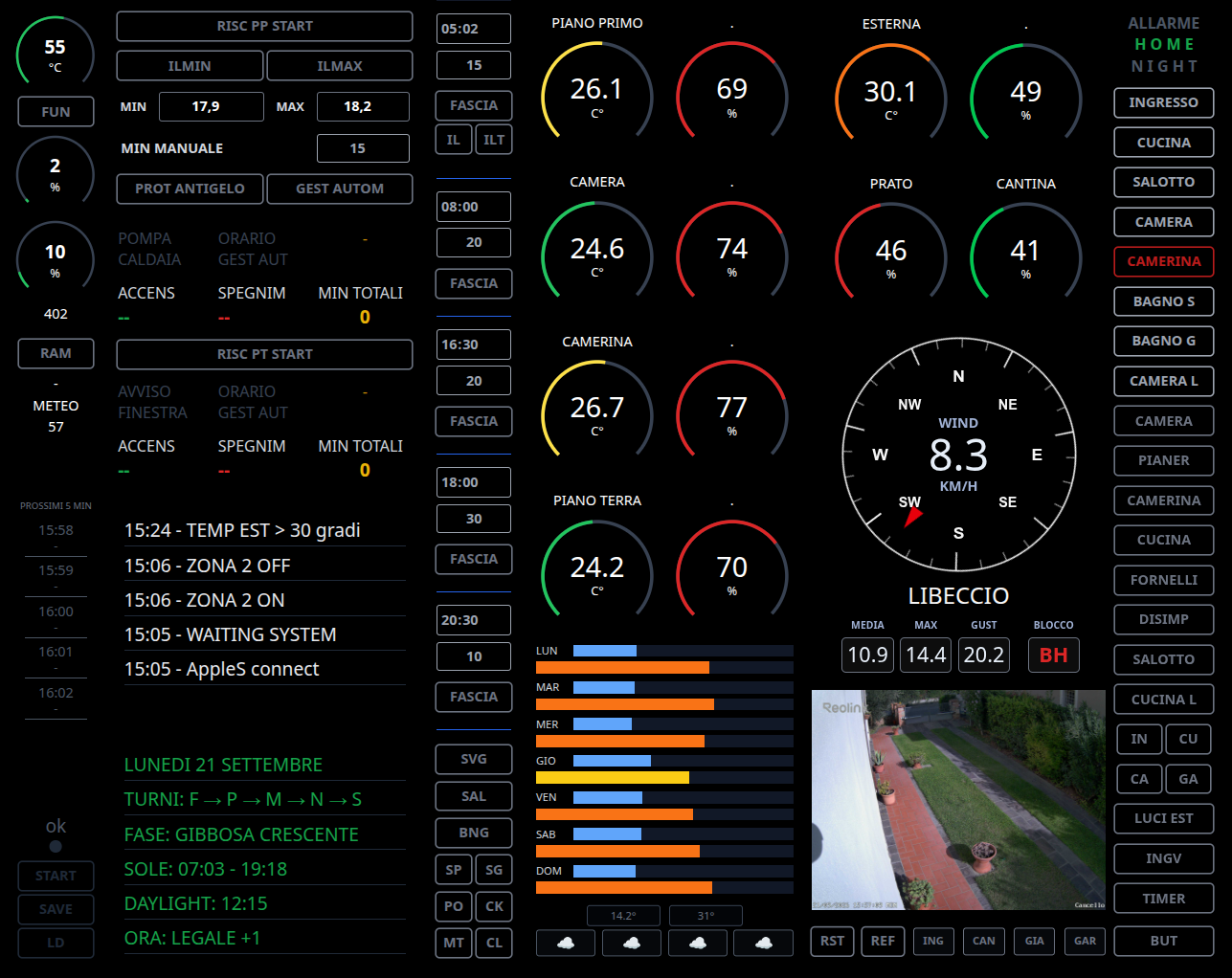
Main dashboard — climate, weather, security, cameras and system status. The dashboards are only the visible layer; most of the project lives in the Node-RED logic behind them.
A significant part of the development consisted in analysing what actually happens in the house every day: when people are normally present, how rooms are used, working shifts, recurring tasks, security routines, appliance cycles and the conditions under which an automation should — or should not — act.
The objective was not simply to connect more devices, but to make the automation adapt to the household instead of forcing the household to adapt to the automation. Many functions therefore depend on several pieces of context rather than on a single sensor or command.
Architecture
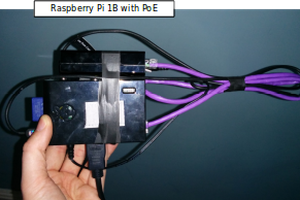
The system runs on a Raspberry Pi 4 with 4 GB of RAM, with Node-RED acting as the central automation engine.
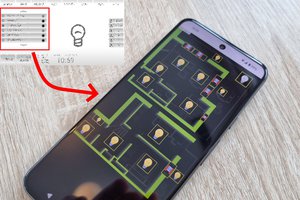
Device communication is handled through a mix of MQTT, Zigbee2MQTT, Wi-Fi devices and HTTP services. SQLite is used where persistent local data is useful, while custom HTML dashboards provide the main fixed interfaces around the house.
The architecture is intentionally layered: deterministic Node-RED logic handles the core automation, while voice interfaces, mobile dashboards and selected AI-assisted functions are added on top of that logic.
Smart irrigation
The irrigation system is not a simple ON/OFF controller.
Before starting a watering cycle, Node-RED can evaluate soil humidity, wind speed, weather conditions, work schedules and the current state of the system. The two irrigation zones are managed independently, and the final decision is based on several inputs rather than on a single timer or sensor.
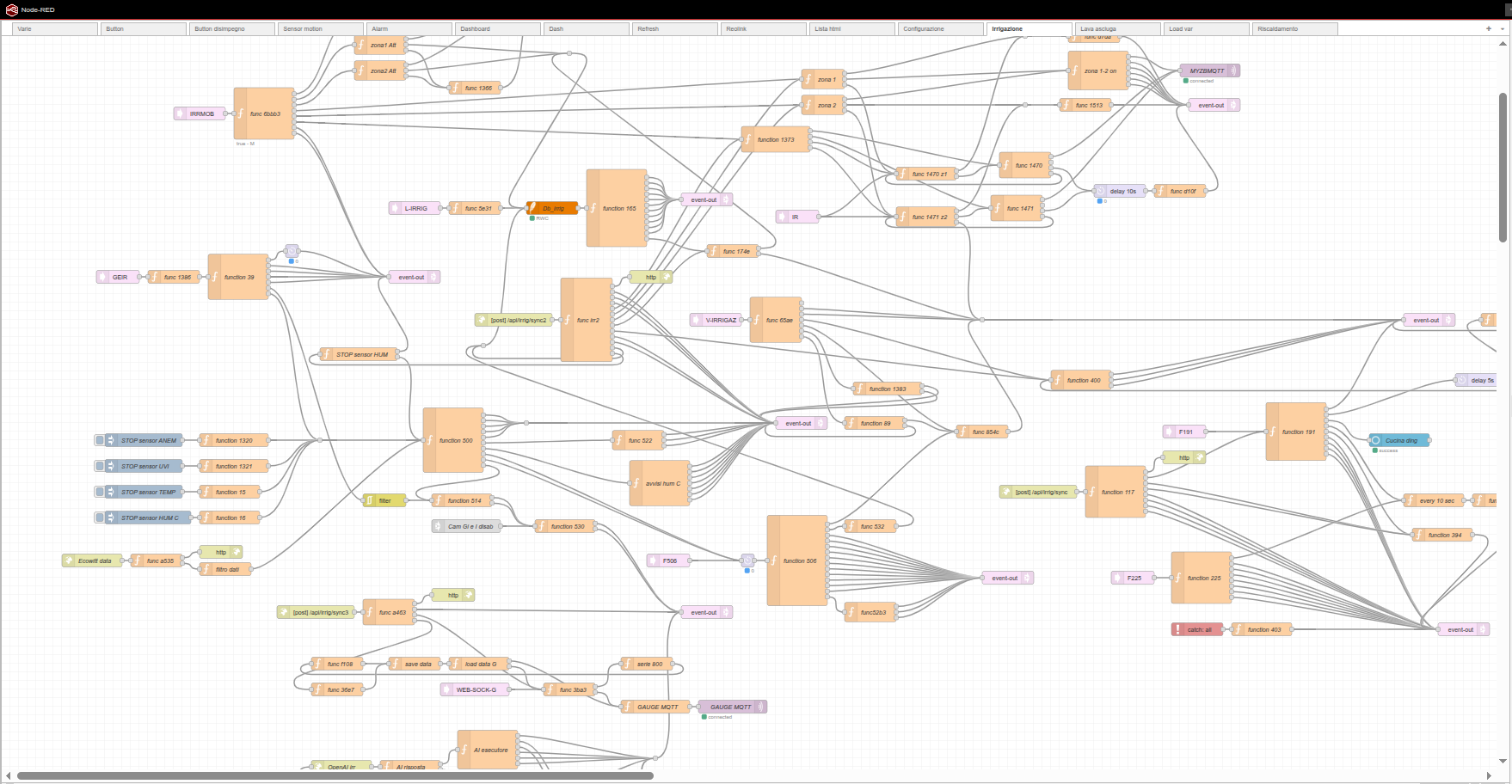
Complete irrigation flow — the dashboard is only the visible front end; most of the decision-making happens inside this Node-RED logic.
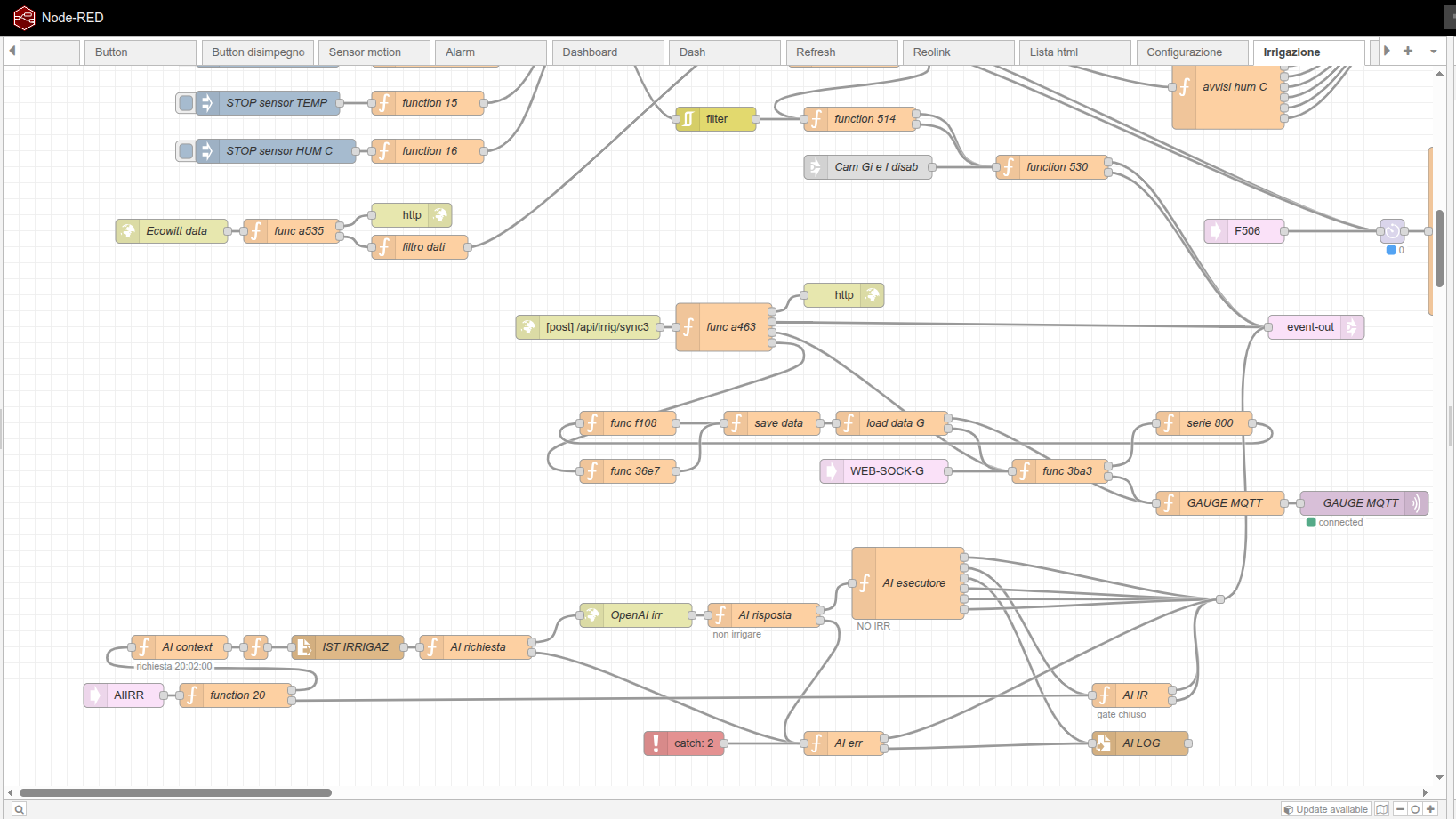
Irrigation logic detail — sensor and weather data are filtered and combined before the system evaluates watering conditions and manages the two irrigation zones.
During an active watering cycle, the kitchen dashboard can automatically switch to the irrigation view and show the remaining time for each zone.
More recently, AI has also been added as an additional verification layer for selected irrigation checks, while the core automation remains deterministic and under Node-RED control.
Conversational interface
The Amazon Echo devices are not used only for one-way voice commands.
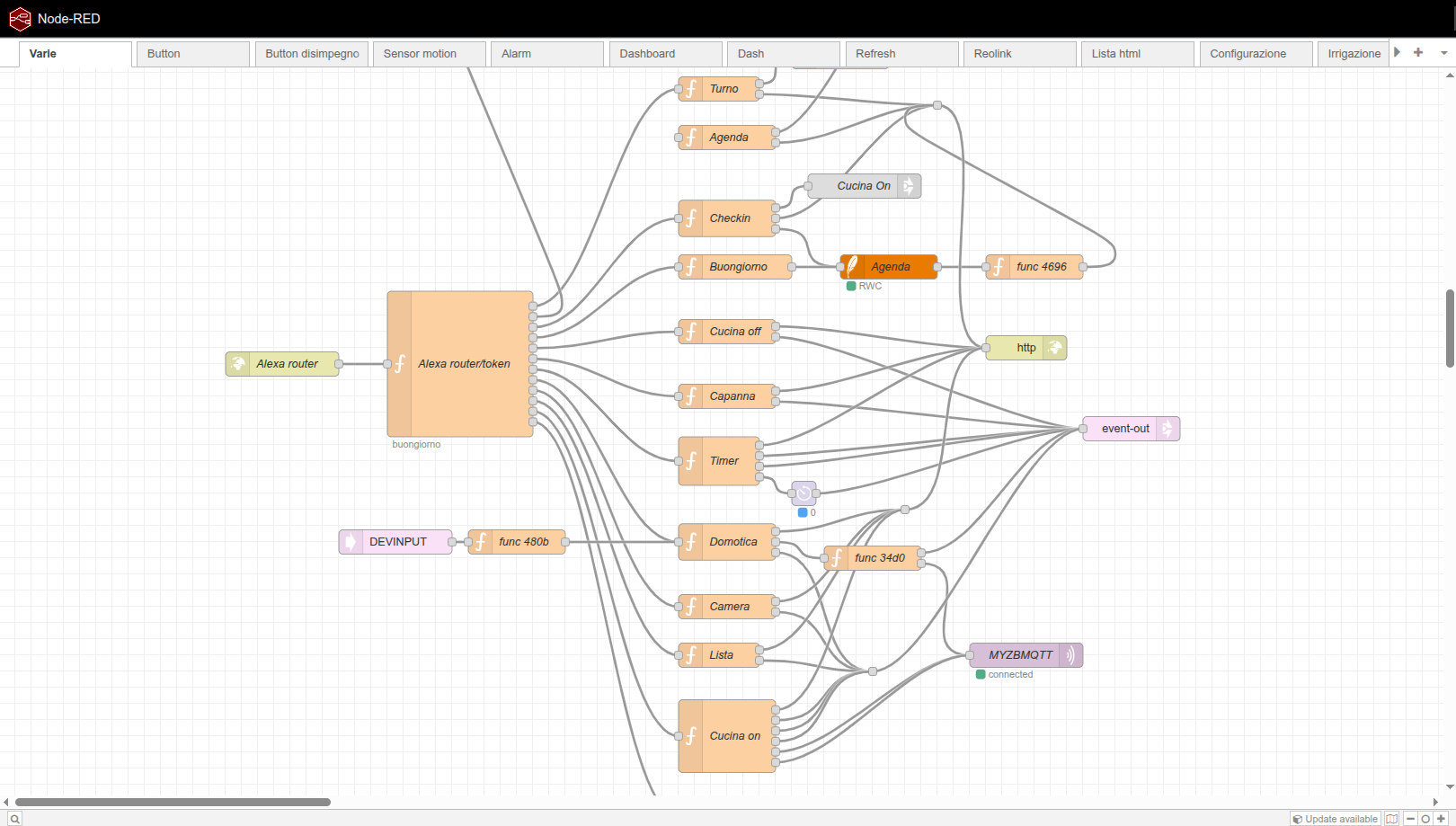
Voice interaction flow — a custom Alexa router distributes spoken requests to different Node-RED functions such as agenda, timers, cameras, shopping list and home automation. Some interactions can continue through follow-up questions and responses.
Several custom Alexa skills provide a bidirectional interaction layer between the occupants and Node-RED. Depending on the function, the system can receive a request, retrieve or evaluate the required information, ask a follow-up question when additional input is needed, process the answer and continue the automation.
These interactions are used for functions such as household status, agenda, timers, shopping list, camera-related actions and other daily operations.
Node-RED can also initiate spoken messages independently when an event requires attention.
This bidirectional interaction is an important part of the system: the occupants do not only issue commands to the house — the house can also request information from them.
Security & AI-assisted monitoring
The security system combines door and window sensors, motion sensors and cameras, with different behaviours for HOME, NIGHT and AWAY modes.
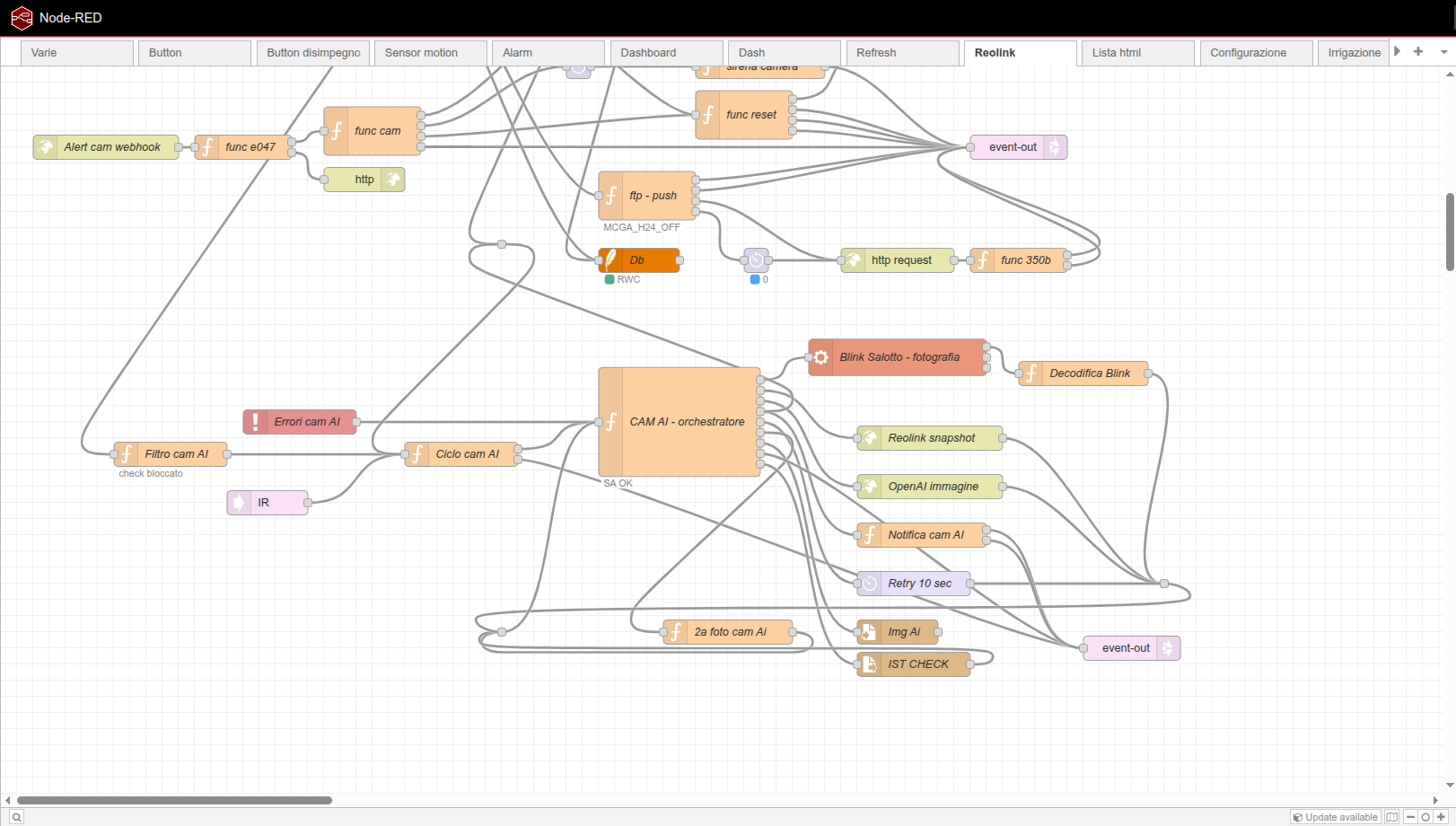
AI-assisted camera workflow — camera events can trigger image acquisition, AI analysis, retries or a second image check before Node-RED decides whether to notify or continue the automation.
AI has been introduced into selected camera workflows where conventional motion detection alone...
Read more »
 manishabiswas17081993

 Matt Farley