 Clivia
A route is useful, but it is not the whole test record
It is tempting to reduce a GNSS drive test to a coloured route on a map. That route can show where a receiver reported a state, but it usually cannot answer the next question: what was happening in the data path at the same time?
For this test, we placed a SCOUT PRO RTK+DR receiver on a vehicle, connected its integrated USB-C cable directly to a Windows 11 laptop, and used KALMIX Trace 1.5.7 during the drive. The goal was not to create an accuracy benchmark. We wanted a record that would still be useful after the vehicle returned: one that could distinguish a missing serial stream, a correction-path question, and a receiver-reported solution-state transition.
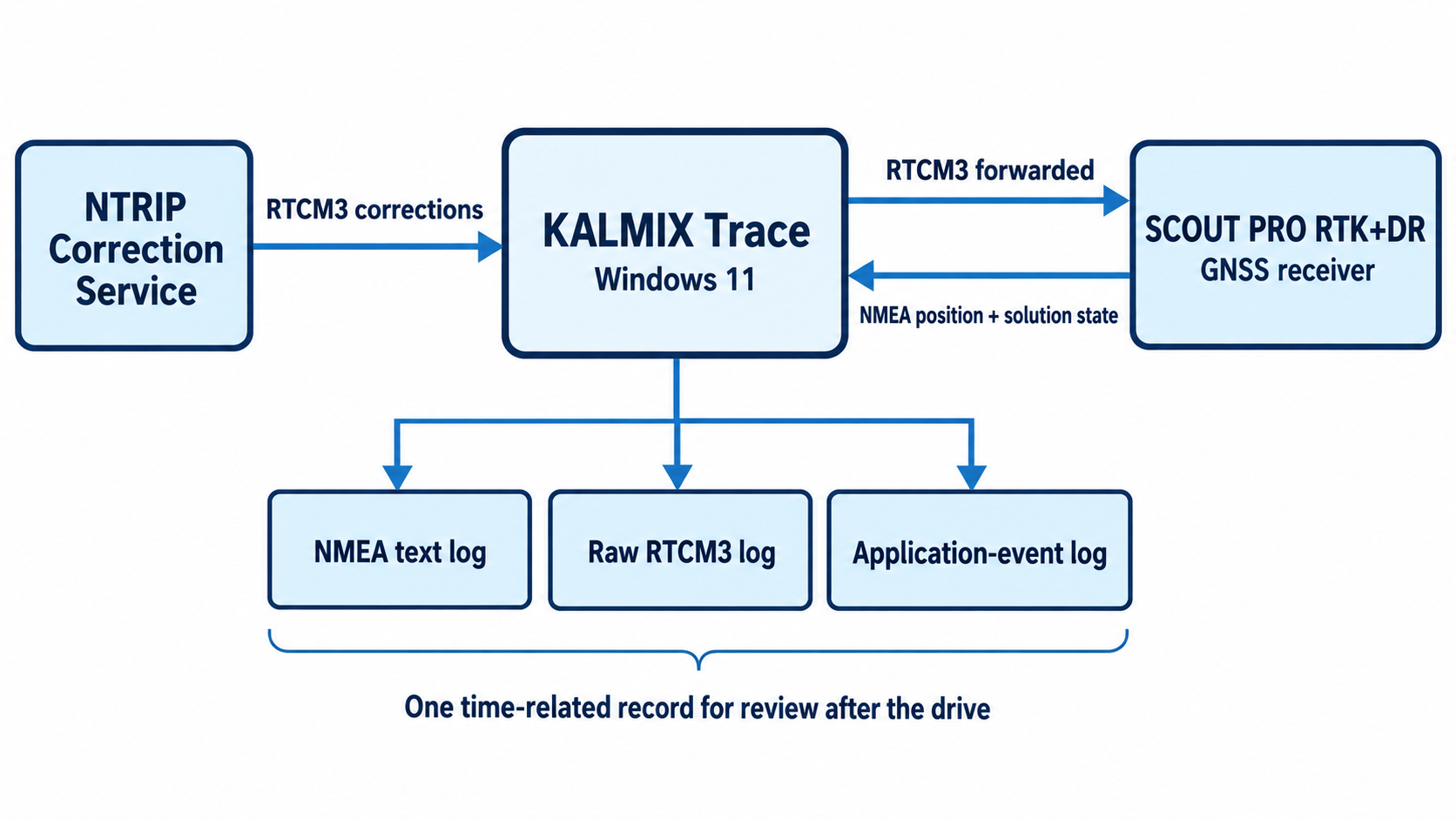
Figure 1. Trace preserves receiver output, correction data, and application events as one time-related road-test record.
Three records, three different questions
We enabled logging before connecting the serial port and the correction service. That produced three files from the same drive:
NMEA text: What did the receiver report as its position, solution state, satellite count, and related fields?
Raw RTCM3: Was the correction stream retained at the host for the same session?
Application events: When did Trace open and close the serial port, start or end the correction connection, and exit?
None of the files is sufficient by itself. NMEA can show that a receiver changed from Fixed to Float, but it cannot independently prove why. An RTCM3 file can show that correction data existed at the host, but it cannot prove that every message was used by the receiver. Application events give the Windows-side timing, but they do not replace receiver output.
Together, they narrow the question before someone starts changing settings at random.
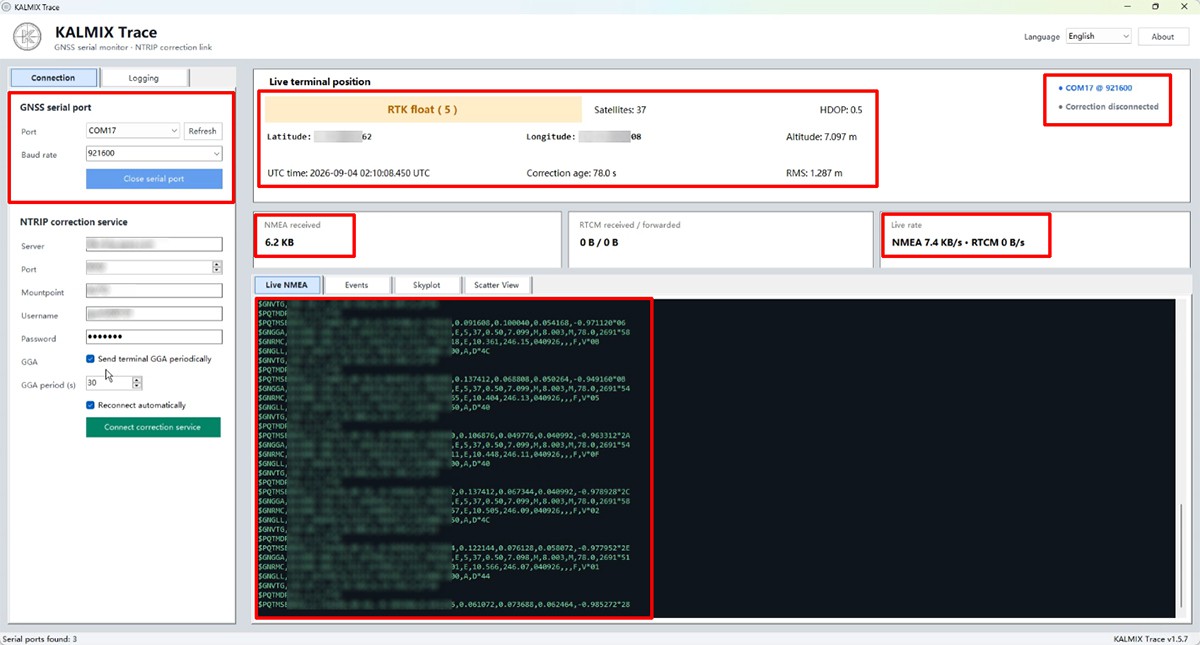
Figure 2. A readable live NMEA stream confirms that the receiver serial connection is active before correction troubleshooting begins.
“Connected” is not the same as “Fixed”
One easy mistake is to treat an NTRIP connection indicator as the answer to the whole RTK question. It is not. “Connected” says the Windows host has reached the correction service. A useful review still checks whether RTCM is arriving and being forwarded, then checks the solution state reported by the receiver.
This distinction matters especially during dynamic testing, where sky view, multipath, local conditions, the correction source, receiver configuration, and convergence time can all affect what the receiver reports. A clean diagnostic record should make those uncertainties visible instead of assigning a cause too quickly.
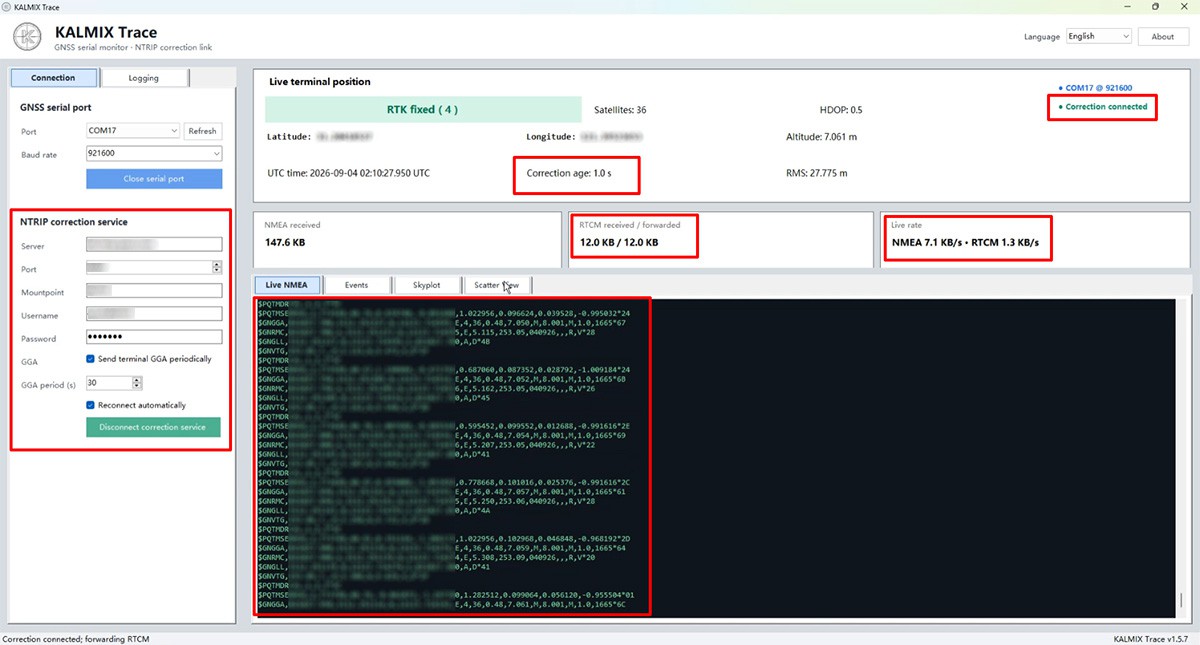
Figure 3. Correction data being received and forwarded is a separate observation from the receiver-reported solution state.
What we check after the drive
The first review is deliberately conservative.
First, check the start and end of each file and retain the Windows time zone for application events.
Next, use one position-epoch NMEA sentence type to examine continuity. Do not count every NMEA line as a separate position update.
Then locate transitions between the receiver-reported Standalone, Float, and Fixed states.
Confirm that the RTCM3 record belongs to the same timestamped session.
Finally, align any connection event, screen recording, or permitted road footage before suggesting a possible explanation.
In our reference session, the three records shared one timestamp prefix. That is a simple but valuable detail: it ties the NMEA output, raw correction record, and application events to one driving session rather than three unrelated files copied into the same folder later.
What this method does not prove
This logging method does not measure absolute position error. It does not prove that a state transition was caused by a particular tree, building, road segment, or correction outage. It also does not establish whether dead reckoning contributed to a solution without additional evidence and an appropriate test design.
Those limits are useful. They keep a project log from turning receiver status labels into broader performance claims. The practical result is more modest: a road test leaves a reviewable set of clues, and the next test can be designed around the unanswered question.
What comes next
The next useful step is not to publish a receiver ranking. It is to add controlled cases: a verified serial-port failure, a correction-service or forwarding interruption, and a case where corrections arrive but the receiver does not reach Fixed. Each case needs its own permitted evidence and recovery record.
For a related Windows checklist on separating NTRIP connection status from receiver solution status, see:
https://dev.to/kalmix_tech/ntrip-connected-isnt-rtk-fixed-a-windows-gnss-troubleshooting-checklist-2ejc
Public sanitized examples and analyzer:
https://github.com/KalmixTech/trace-log-analyzer
Test date: September 4, 2026
Discussions
Become a Hackaday.io Member
Create an account to leave a comment. Already have an account? Log In.