 Jorj Bauer
To understand what Ms. Albright built in this drive image, you have to understand what she was reacting to.
Pascal was designed by Niklaus Wirth in 1968 as a teaching language: strong typing and structure, deliberately forcing a programmer to think systematically about a program rather than just making it work. It was aimed squarely at two anti-patterns of the day, FORTRAN and BASIC goto-spaghetti, and the assembly and COBOL "just execute these instructions" style.
Then UCSD had a problem. Computing work was being done on the university's big expensive central machines, while students increasingly had access to cheap microcomputers, and every microcomputer had a different processor and architecture.
Ken Bowles's answer, in 1977, is the thing this whole project jives with: do not compile to machine-specific code. Compile to an abstract P-code, and build a virtual machine for it on each platform. In 1979 Apple shipped Apple Pascal and made it the language of the platform, and in 1984 the College Board made Pascal the AP Computer Science language, which is how it ended up in her classroom five periods a day.
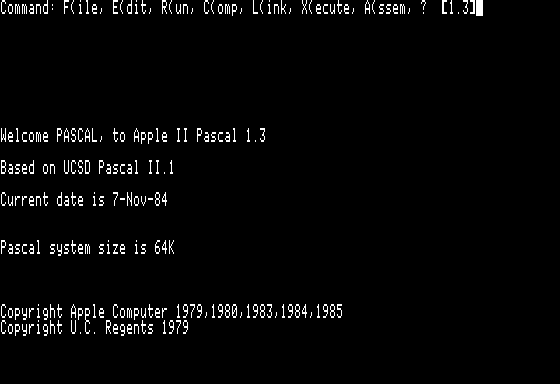
So why the hate? The p-System was a complete contained development environment: OS, editor, compiler, runtime, debugger, file management, utilities. The language was verbose and formal. The environment was heavy and difficult to work with from outside.
You were either in Pascal, or you were outside of it. Working between the Pascal environment and the established ProDOS environment was truly messy.
I worked in Apple Pascal once - the summer of 1985, just as Back to the Future hit theaters - and one of the reasons I loved that movie so much was that it helped me escape from it.
Discussions
Become a Hackaday.io Member
Create an account to leave a comment. Already have an account? Log In.