 Jorj Bauer
Back in Entry 8, I mentioned Back to the Future because it came out days before Ms. Albright started her work. But that really was more of Back to the Future Part II: us here, in 2026, revisiting 1985. We're more on the original timeline here while we peer back to 1985 from 2026.
You see, Ms. Albright is in many ways my Flux Capacitor here. I've gone back and, with her idea, moved forward to build this time capsule; everything in this entry is, alas, not hers; it could never have been.
It would be a shame for her work to not see the light of day; I've spent as much time as I have on this write-up, and a corresponding talk for JawnCon 2026, simply because this gem shouldn't be lost to time on a broken hard drive image that nobody ever sees.
This is where I finally answer the question of, "what can we do, with modern technology, based on Ms. Albright's work?"
In her final rung, it's clear where Ms. Albright is headed. She's got a stub editor, written in LUA, that isn't quite complete; she's got multiple runtimes for different kinds of programs; she's got games that her students built in it, demonstrating its capability, and defining its rightful place in the educational flow of things. Give kids Logo. Augment with LUA, which teaches them to reach; it doesn't beat them down with structure like Pascal.
If she had attained that - and indeed, it's possible that she did and it's lost in this drive image's corruption, or went on to live on another machine - she had the full replacement for the Apple Pascal system. Edit in ProDOS in a more friendly editor, like what came with the final version of Merlin-8, to which she was clearly accustomed; compile in ProDOS natively; generating binaries right in ProDOS as well, available to use, copy, and distribute with no fuss.
So I've built on her work, bringing it to everyone in a simple, usable medium: the web.
lua2e.k8s.jorj.org - the Lua2e playground
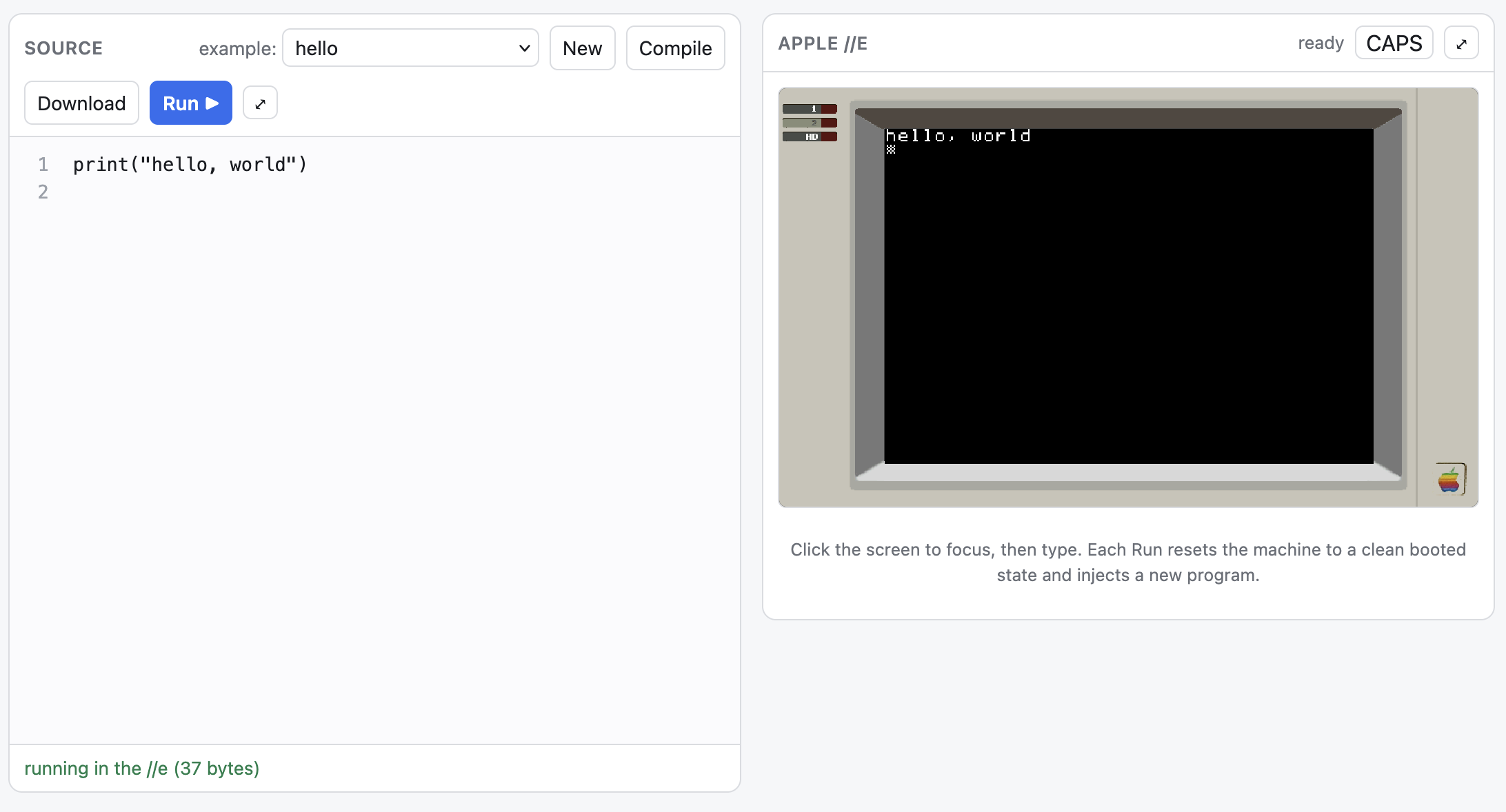
Write LUA on the left, see it run in my 2e emulator on the right.
I've included all of the example code that exists in her archive; go ahead and play the Snake game she fretted about wasting her time in her kitchen, or play the full port of the Integer Basic game AppleTrek, which stretches to use her full memory model that uses a RAM expansion card as-built. You can see her editor running, as I finished it off; or, run the artifacts that I've built on top of the whole ecosystem.
Since Ms. Albright was keen to show how this ecosystem was better than the p-System, I thought there might be no better way to do that than to port Wizardy I, written in Apple Pascal, to LUA. There's a disk image called "Proving Grounds" which shows the capability.
I thought the Wizardry series was nice, but it was really the Ultima series that I loved to play. So I've also built an Ultima-like engine in LUA, and crafted a simple scenario called Chippewa Falls, WI in which you play Ms. Albright, buying computer parts to take them to her school. It's maybe a 15 minute game as-is, merely as a demonstration of what is possible here.
My last piece of code is her last as well: her Editor lives in two places, both in the "examples" section (so you can see the code itself) and as a disk image (where you can see it actually saving and restoring disk files).
Lastly: this whole page is, itself, a full Apple //e emulator. It's a WASM compiled version of Aiie, which has graduated from its original Teensy 4.1 embedded emulator build (still maintained!) and is now a full cross-platform desktop emulator, as well has having this web version for the Lua2e playground. Drop any .woz disk image on the web page and it will boot; or give the URL fragment your own web-based .WOZ disk image and it will load.
Thanks for making it this far - I was going to end on something meaningful about recovery, and craft, and people who build things that nobody asked for. But the whole of this started because of a teacher who wanted fifteen-year-olds to have a better tool than the one they had been handed.
Period instruments are no longer required.
Go and use it. Make your own fun stuff.
Discussions
Become a Hackaday.io Member
Create an account to leave a comment. Already have an account? Log In.