 diddy
OFFgrid-SDR 1.4 is out, and it's the biggest update yet. It's still one file (index.html), still runs from a pen drive, and still needs no internet. But it now does a lot more than listen.
Grab it from GitHub: github.com/diddy-boy/OFFgrid-SDR
And no stick needed to try it: open index.html?demo, and every new feature has a simulated station to play with.
==== WATERFALL REPLAY: REWIND THE RADIO ====
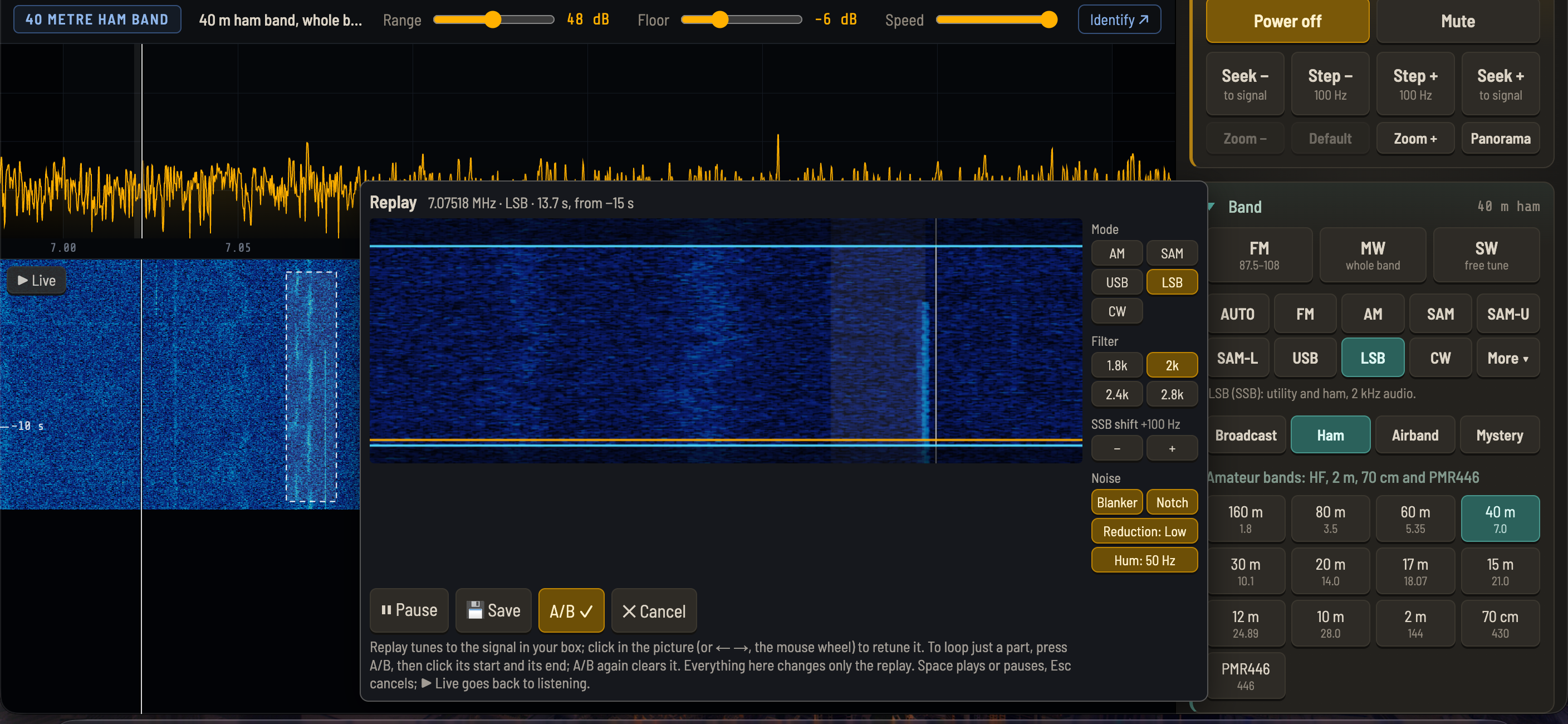
Ever spotted something interesting on the waterfall a moment too late? Switch on the waterfall buffer (15, 30 or 60 seconds) and OFFgrid-SDR keeps the raw radio signal in memory. Press pause, draw a box around any signal from the last few seconds, and a replay window opens with a zoomed view of that moment, playing it on a loop.
• The replay has its own mode, filter, SSB shift and noise filters, so you can try AM, SSB or CW on the same captured moment without touching your main settings
• Click inside the picture (or use the arrow keys or mouse wheel) to retune within the box
• In CW, the Morse in just that section is decoded
• A/B loops just the part you're interested in
• Save writes two files: an MP3 of what you hear, and a raw IQ file named so SDR#, SDR++ and others open it at the right frequency
How it works: the samples are stored as 8-bit I/Q (2 bytes each), so 30 seconds at 2.048 MS/s is about 123 MB. Each waterfall row records which stored samples it came from, so a box drawn on the picture maps exactly onto the signal. Replay runs those samples through a separate demodulator about 24 times faster than real time, so changing the mode on a replay is close to instant.
==== AUTO: "WHAT IS THAT SIGNAL?" ====
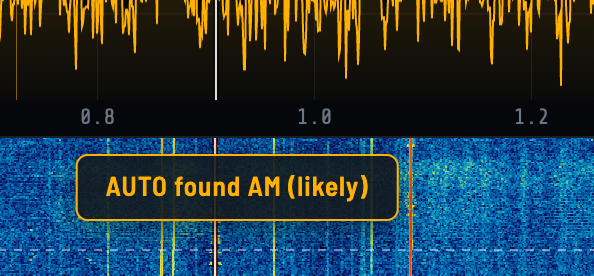
AUTO is a switch. Turn it on, and every time you tune somewhere new, OFFgrid-SDR listens for a couple of seconds, works out what the signal is, switches mode and tunes precisely onto it. A banner says what it found and how sure it is.
• Shortwave: CW, RTTY, PSK31, NAVTEX, DSC, weather fax, SSTV, Hellschreiber, AM and SSB
• VHF/UHF: narrowband FM and airband AM
• The FM broadcast band: wideband FM
• It even recognises DRM digital broadcasts (which a browser can't decode) and tells you what that block of hiss is
• If nothing is clear, it picks the band's usual mode: the right sideband on the ham bands, AM on broadcast bands, narrowband FM on VHF
The fun part was finding a signature for each mode:
• RTTY's two tones alternate (one on, the other off), while a Morse carrier and its keying sidebands rise and fall together. Measuring how the two tones move over time tells them apart.
• PSK31 flips its phase. Comparing the signal's phase 15 ms apart (spanning the dip at each flip) shows reversals that no other mode has.
• SSTV is frequency-modulated, so its strength is almost perfectly steady, unlike a voice.
• For SSB, speech is strongest at its low end, right next to the suppressed carrier, so where the energy bunches up tells you USB from LSB.
My favourite bug: AUTO kept "finding" a steady carrier on empty frequencies. It was the stick's own DC spike, which wasn't even in AUTO's view. The decimation filter that narrows the view lets strong signals fold back in, so a spike 22.5 kHz away appeared exactly 1.5 kHz from the dial. AUTO now ignores the spike where it folds to, as well as where it really is.
==== SIX NEW DECODERS ====
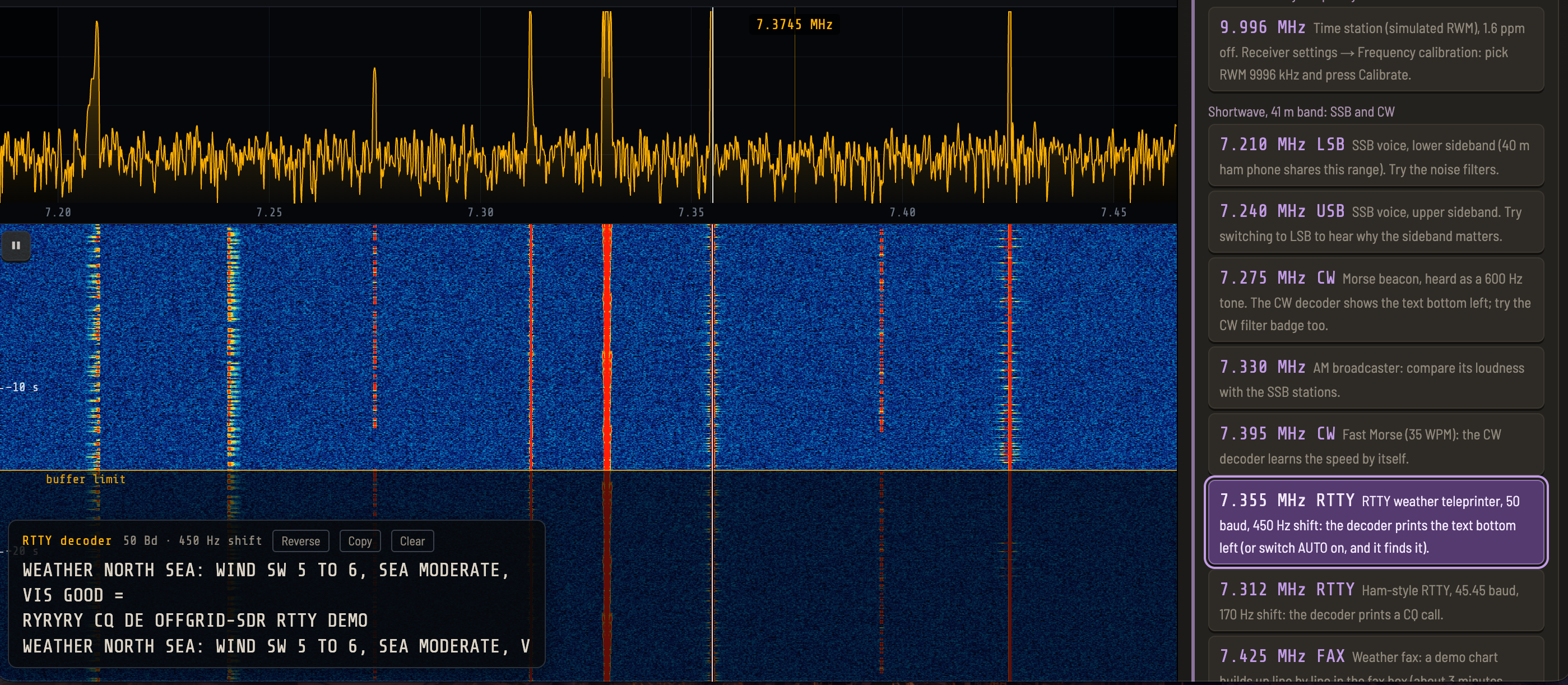
• RTTY: weather, news and ham teleprinter text. It finds the shift (170, 425, 450 or 850 Hz) and the speed (45.45, 50 or 75 baud) by itself.
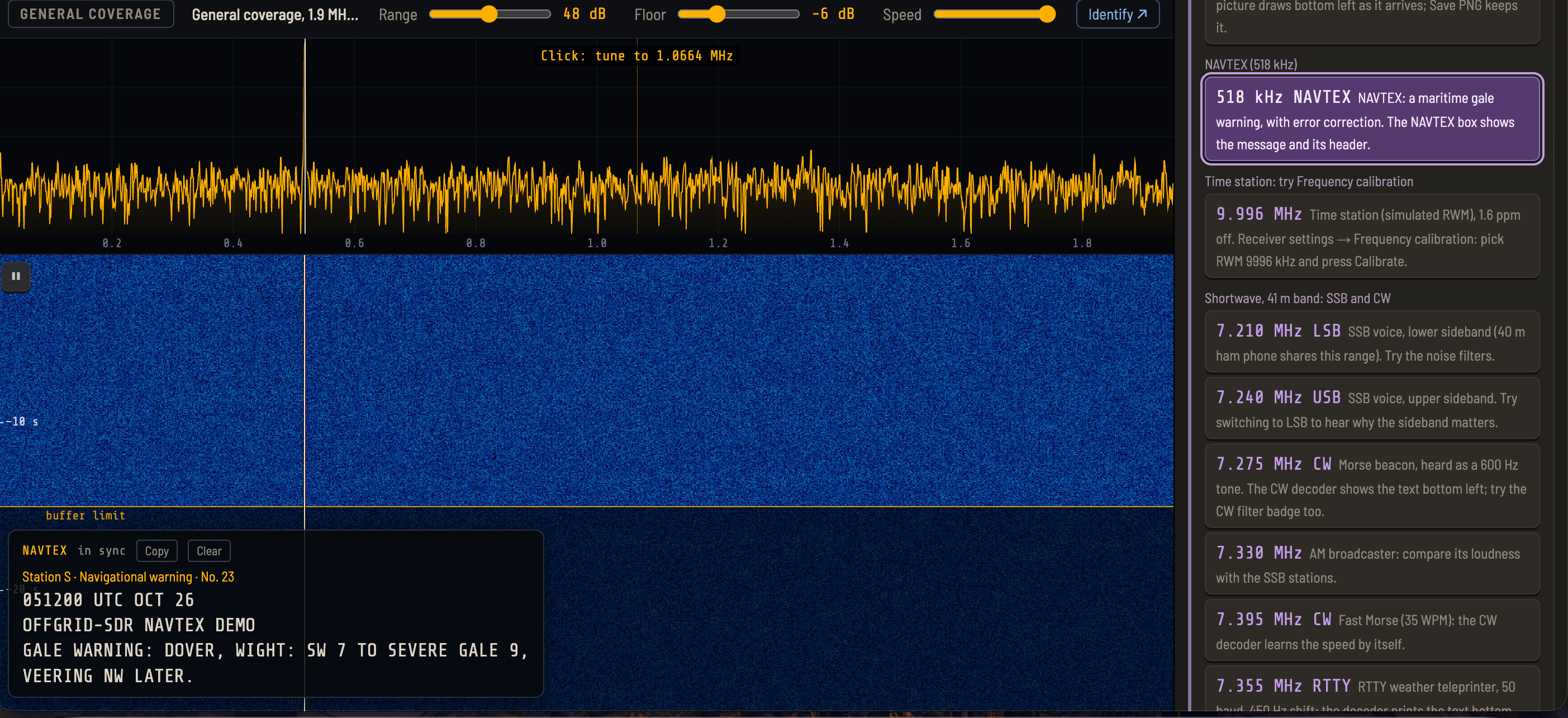
• NAVTEX: maritime safety and weather messages on 518, 490 and 4209.5 kHz, with error correction (every character is sent twice).
• DSC: ships' distress, urgency, safety and routine calls, listed with who called whom (MMSI numbers), distress calls in red. A quirk of DSC: its check bits count the zeros, so an upside-down symbol checks out too. The decoder has to work out which way up the signal is from the phasing symbols at the start of each call.
• SSTV: slow-scan TV pictures in the Martin, Scottie and PD formats, drawn line by line as they arrive, and saved as PNG. On shortwave (14.230 MHz) and VHF, ready for the ISS on 145.800 MHz.
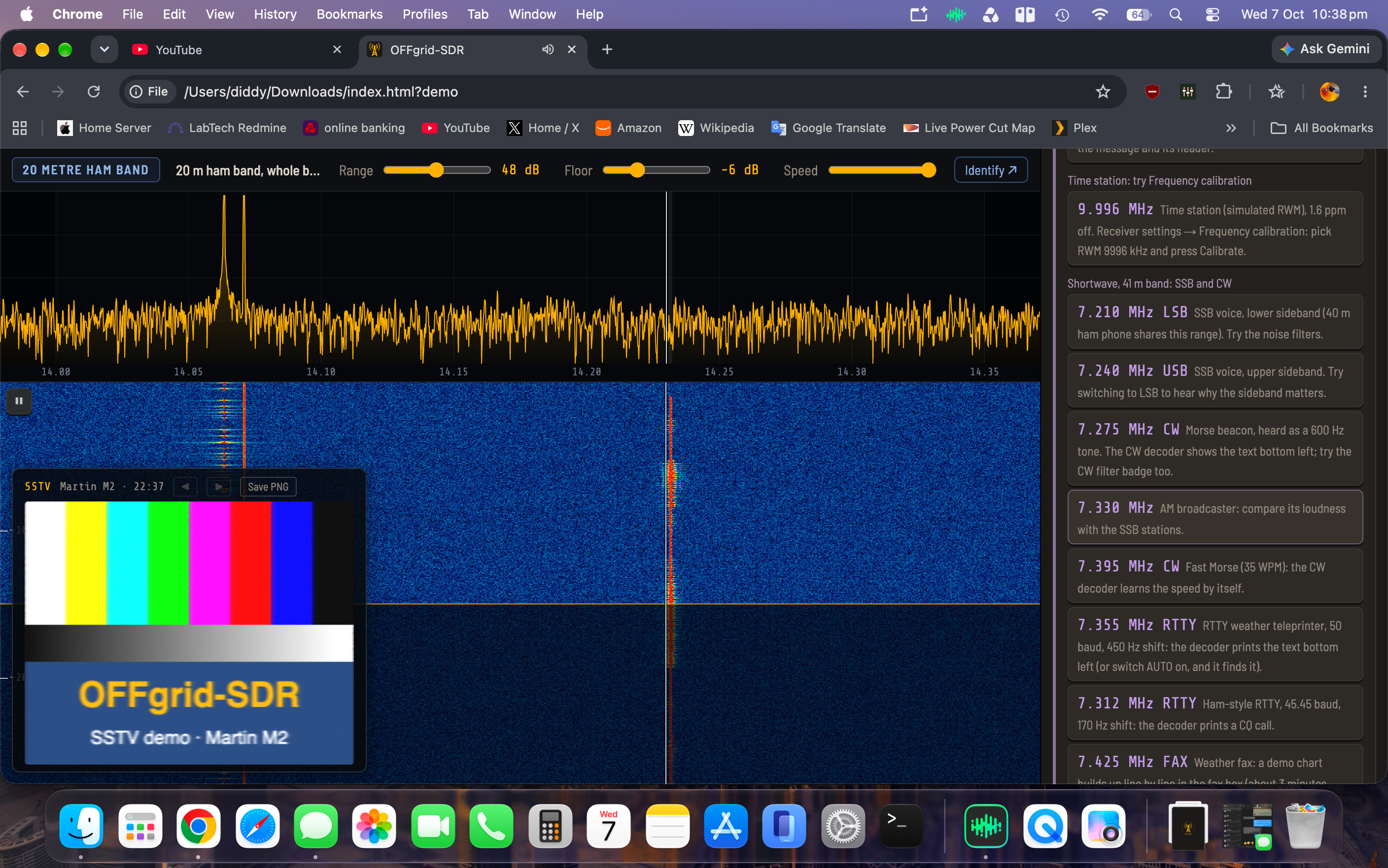
• PSK31: keyboard-to-keyboard ham text. Click a signal and it snaps onto it.
• Hellschreiber: the tone paints the letters, and you read them by eye, just like the 1930s machines. The strip is drawn twice, stacked, so there's always a complete row of letters, however the timing falls.
==== FREQUENCY CALIBRATION ====
Pick a time station (RWM, WWV/WWVH/BPM or CHU) and press Calibrate. OFFgrid-SDR mixes the carrier down, averages a few seconds, and measures it to a fraction of a hertz with a long FFT. It then sets the stick's ppm correction, and confirms it with a second measurement. The correction is saved in settings backups, so a kit can be sent out already calibrated.
==== A NEW MODE LAYOUT ====
The same ten buttons on every band:
AUTO · FM · AM · SAM · SAM-U · SAM-L · USB · LSB · CW · More
FM picks wide or narrow by itself (wide on the FM broadcast band, narrow on VHF/UHF). The decoders live under More. Modes that don't fit where you're tuned are greyed out, with the reason in the tooltip, so the row never changes shape.
A shout-out for SAM-U and SAM-L: synchronous AM using just one sideband, to dodge a neighbour splattering into the other side. It's usually only found on specialist receivers, and it has rescued a lot of difficult stations for me. It comes from Jacobo Tarrío's excellent demodulator library, which OFFgrid-SDR is built on.
==== SMALLER ADDITIONS AND FIXES ====
• CW tuning help: click near a Morse signal to snap exactly onto it, or press Z to zero-beat
• An RDS status line (searching / no data / locked · 98% good), so you can tell "no RDS" from "signal too weak for RDS"
• RDS now heals itself: it could stall after a pause, or on a busy computer, and it now restarts by itself if it loses lock
• AUTO, zero-beat and calibration no longer freeze the display: they process samples as they arrive instead of all at once at the end (found by a tester running a VM alongside!)
• An FPS readout beside CPU and RAM
• On direct-sampling sticks like the Nooelec on HF, the RF gain slider is greyed out with an explanation (the signal bypasses the tuner there)
• Lots of new demo stations: RTTY, NAVTEX, DSC, SSTV, PSK31, Hellschreiber, DRM, and a time station for calibration
Thanks to everyone who has tried OFFgrid-SDR since the rtl-sdr.com write-up, and as ever to Jacobo Tarrío, whose webrtlsdr and signals libraries make it all possible.
If OFFgrid-SDR is useful to you, there's a "Buy me a coffee" button in the ? help panel.
73!
Discussions
Become a Hackaday.io Member
Create an account to leave a comment. Already have an account? Log In.