 S.I.
S.I.Hi everyone! I’m a KOSEN student building a DIY EFNMR Quantum Computer.
In this log, I want to share the origin of our project name, the meaning behind our logo, our core concept, and our newly created catchphrase.
Origin of the Project Name
NMRQCP
This is both my profile name and the official name of our DIY quantum computer project. NMRQCP comes from the initials of "Earth's Field Nuclear Magnetic Resonance Quantum Computer" (EFNMRQC). Since EFNMRQC was a bit too long, we dropped the "EF" to make it NMRQC, and added a "P" for Project—resulting in NMRQCP.
What Our Logo Represents

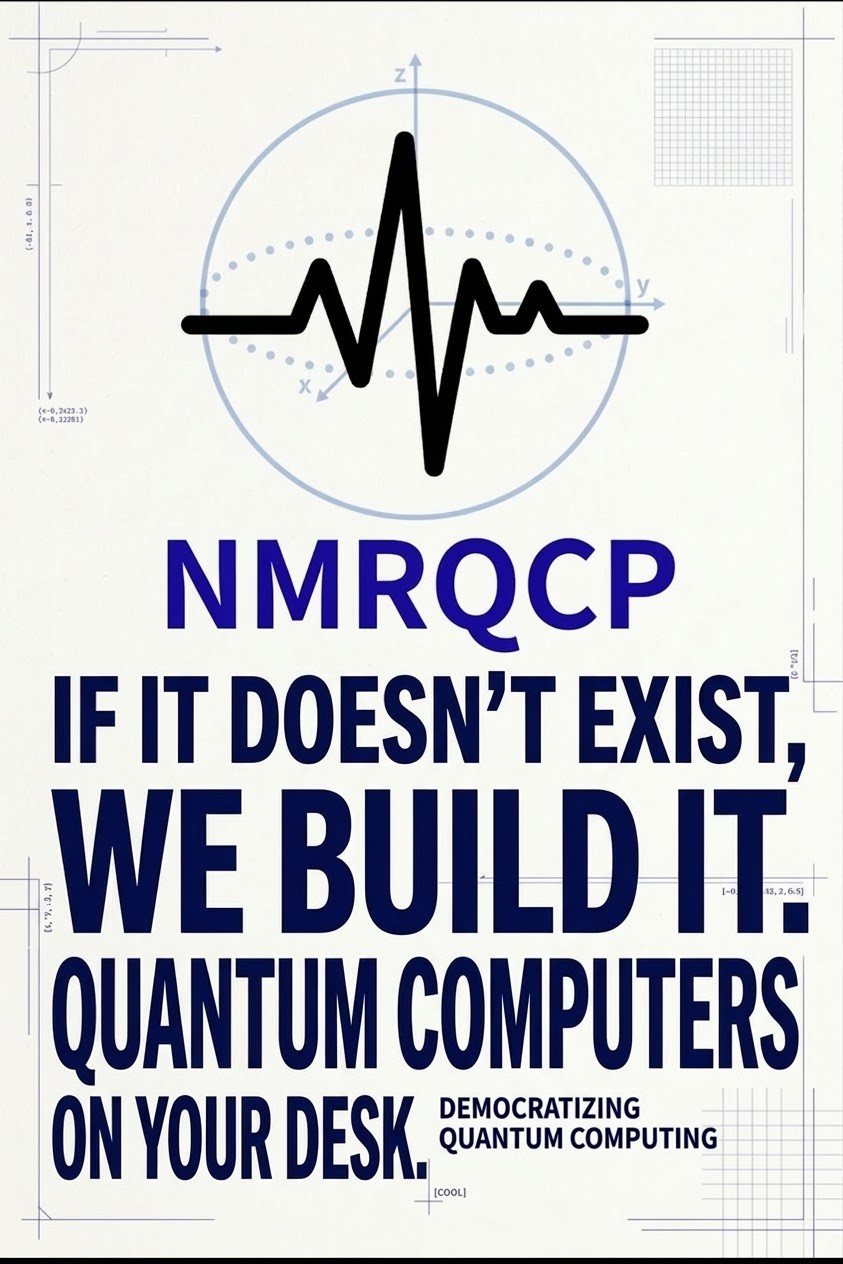
This is the official logo of our project. The Bloch sphere in the background represents quantum computing and the manipulation of quantum states, while the waveform in the foreground represents the actual NMR signal (FID wave) that we capture and read with our EFNMRQC hardware.
Project Concept
Democratizing Quantum Computing
This is the core concept driving our project. Right now, actual quantum computer hardware is locked behind closed doors—accessible only to massive corporations, research institutes, and universities. Our mission is to change that and make quantum hardware accessible to anyone.
By developing a low-cost, easy-to-build quantum computer and open-sourcing all of the designs and code online, I want to help build a society where anyone can get hands-on experience with quantum hardware—a truly democratized quantum future.
(If you want to read more about why I want to make this accessible to everyone and how I first got into quantum mechanics, check out our project details or this article (in Japanese).)
Our Catchphrase
"If it doesn't exist, we build it. Quantum Computers on your desk."
The first half—"If it doesn't exist, we build it"—comes from my lifelong maker motto. I desperately wanted to touch and tinker with quantum computer hardware, but had zero access to it. This project was born out of that exact frustration: if there's no way for me to touch one, I'll just build one myself.
The second half—"Quantum Computers on your desk"—captures the exact defining feature of this project: creating a quantum computer compact and accessible enough that anyone can build and run it right on their own desktop.
Follow Our Journey!
- Real-time updates on X (Twitter): https://x.com/nmrqcproject
- Detailed development logs and source code on GitHub: https://github.com/nmrqcproject/nmr-qc-project/blob/main/README.md
- Detailed development logs in Japanese / 日本語での詳しい開発記録 (Zenn): https://zenn.dev/nmrqcp
Discussions
Become a Hackaday.io Member
Create an account to leave a comment. Already have an account? Log In.