 Jim Smith


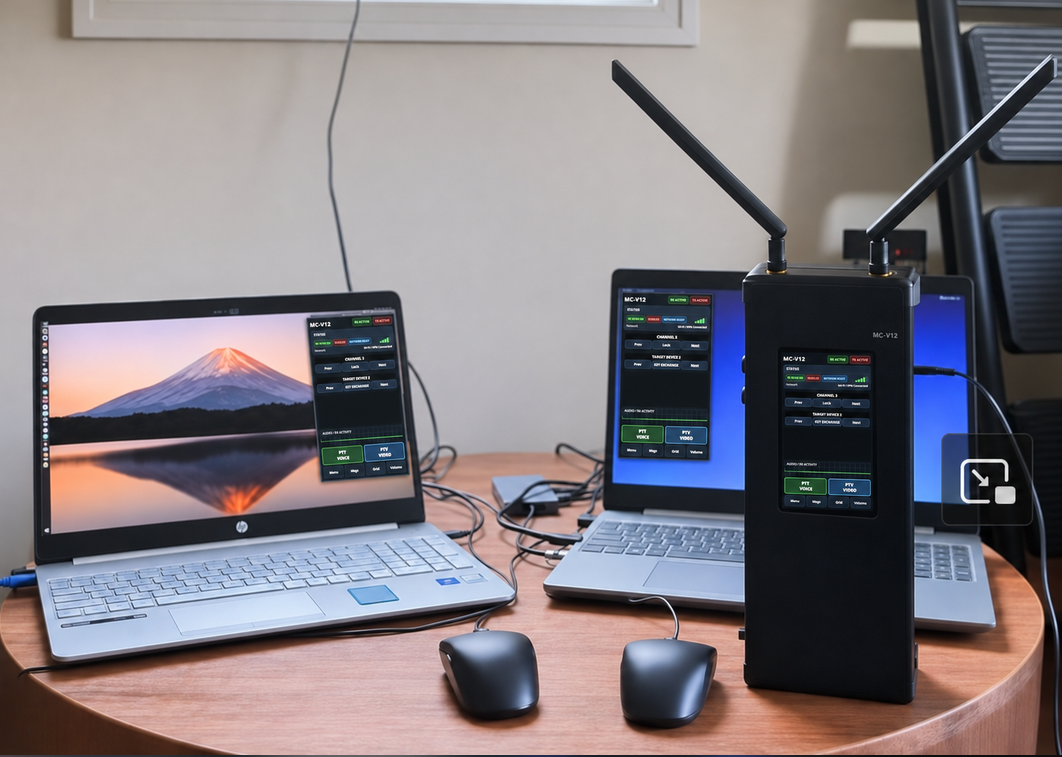
MC-V12: Custom 16-FSK & 4-FSK Encrypted Radio — Live Image Streaming, Voice, Text, and Diffie-Hellman Key Exchange
https://video.wixstatic.com/video/10a442_b54fcda87a0f4bce8352088bcf5e0f89/480p/mp4/file.mp4
https://video.wixstatic.com/video/10a442_f909db2bae08493cb98d0d33e2eb0221/360p/mp4/file.mp4
MC-V12 — Technical Description
The MC-V12 is a custom-designed, self-contained digital radio communication system running Linux on a single-board computer, with all software written from scratch in modern C++17 and C++20. The system transmits and receives simultaneous live image streams, voice, and text data over a custom RF link using 16-FSK (Frequency Shift Keying) modulation — with no dependency on WiFi, cellular infrastructure, or any existing network.
Modulation & RF Layer
The RF layer uses one 16-FSK channel and multiple 4-FSK channels, implemented entirely from scratch, all operating on a single center frequency. 16-FSK encodes data by shifting between 16 discrete carrier frequencies, with each symbol representing 4 bits. 4-FSK encodes data by shifting between 4 discrete carrier frequencies, with each symbol representing 2 bits.
- Voice — encoded using a low-latency, low-bitrate audio codec well suited to constrained RF bandwidth
- Live image streaming — continuous frame transmission at 1–2 frames per second at approximately 150×180 pixel resolution, sufficient for real-time situational awareness
- Text — short message transmission broadcast to all devices or selectively to encrypted recipients
Packet Architecture & Selective Decryption
The MC-V12 uses a custom packet protocol designed around the selective decryption model. Every packet carries a device identifier in its header. When a device receives a packet, it inspects the identifier before attempting any decryption:
- If the identifier matches the receiving device, the packet is decrypted and processed
- If the identifier does not match, the packet is silently discarded without further processing
- Non-encrypted broadcast packets carry a universal identifier and are processed by all devices on the network
This architecture means that encrypted communications are invisible to unintended recipients at the protocol level — not just computationally protected, but actively discarded before any decryption attempt is made. The system does not rely on security through obscurity; the encryption itself is cryptographically sound, and the discard mechanism adds a clean protocol-level separation on top of it.
Encryption — Diffie-Hellman Key Exchange
Encrypted private sessions between two MC-V12 devices are established using a Diffie-Hellman key exchange performed over the air.
The exchange works as follows:
- Device A initiates a key exchange request to Device B over the RF link
- Both devices independently compute a shared secret from the exchanged public values — neither device ever transmits the secret itself
- The derived shared secret becomes the session encryption key for all subsequent encrypted communications between those two devices
- All other devices on the network, lacking the shared secret, cannot decrypt the encrypted packets — and per the packet protocol above, their devices discard those packets automatically
No pre-shared keys are required. The key exchange happens entirely over the air (as shown in the video below), on demand, between any two devices on the network. Non-encrypted data, broadcast text, general status — continues to flow to all devices simultaneously regardless of whether any encrypted sessions are active.
RoIP — Radio over IP
The MC-V12 implements RoIP (Radio over IP), which bridges the RF communication layer transparently over an IP network. When RoIP is active, the system encapsulates the same packet structure used for over-the-air RF transmission and routes it over a standard IP connection.
... Read more »