 BreeStephany


As I gave a brief overview in my project description, I work my day to day as an electrician in the industrial world, but also love everything electrical and electronics and am ever trying to grow my knowledgebase of new ways of doing quality work.
Recently, I have been tasked with something that seems to be baffling even some decently well versed electrical engineers around me. Building a faraday cage as a machine guard that does not inhibit vision from those looking in, at least completely, while serving as an effective means of both machine guarding and shielding RF in a high voltage / high energy environment.
Just how much voltage or energy you may ask? 16.5kVDC or 16500 volts direct current at 6000~15,000W, pulsed at between 3 and 13.5mHz.
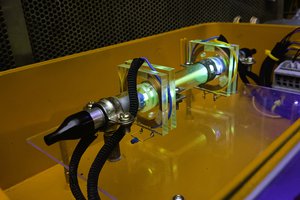
What we have are high energy RF generators used primarily for RF induction heating of metallic parts, which we use to heat treat metal parts at an extremely high rate of speed, approximately 400~800 parts per minute.
So why a faraday cage?
While, specifically, in the US, which electrical installations are heavily governed by the requirements of the National Fire Protection Association's (NFPA), National Electrical Code (NEC) guidelines when installing electrical components or equipment or modifying existing electrical installations or equipment.
Per Article 665.2 "Dielectric Heating Applicator Shielding" of the National Electrical Code (NEC), "protective cages or adequate shielding shall be used to guard dielectric heating applicators. Interlock switches shall be used on all hinged access doors, sliding panels, or other easy means of access to the applicator. All interlock switches shall be connected in such a manner as to remove all power from the applicator when any one of the access doors or panels is open."
Per Article 100, Applicator is defined as follows
"Article 100 Applicator. The device used to transfer energy between the output circuit and the object or mass to be heated. (665) (CMP-12) "
Now, this would often be a concern for the equipment manufacturer specifically, but in my case, I am working with much older, somewhat custom in-house fabricated and designed equipment built off of heavily modified RF induction equipment designed and built decades ago.
Why not just put a cage around it?
While the NEC does not have a specific definition of the word "shielding", electrical shielding in common practice in the electrical trade is the placement a conductive or magnetic barrier around a circuit, cable, or piece of equipment to block or redirect external electromagnetic fields and prevent unwanted electrical noise.
With that said, The NEC code does read "protective cages OR adequate shielding", which is up to the interpretation of the Authority Having Jurisdiction (AHJ) ultimately as to whether or not both means are required. With that said, NEC Article 665.26, "Grounding and Bonding", does read as follows
Article 665.26 Grounding and Bonding. "Bonding to the equipment grounding conductor or inter-unit bonding, or both, shall be used wherever required for circuit operation, and for limiting to a safe value radio frequency voltages between all exposed non-current-carrying parts of the equipment and earth ground, between all equipment parts and surrounding objects, and between such objects and earth ground. Such connection to the equipment grounding conductor and bonding shall be installed in accordance with Article 250, Parts II and V"
It is my interpretation, and an interpetation shared by many around me, that "applicator shielding" or shielding around an induction coil and the unshielded leads going to said coil, shall be installed for the purpose of limiting radio frequency voltages to a safe value between all exposed non-current carrying parts of the equipment.
SO... if you have read this far, hopefully means that you too are interested in learning more and may even have some insight yourself on this subject.
What I do know is...
 Rhea Rae

 Simon Liu
 Foxtek


 NathanStrachen