 Jeff Wisgo
On an earlier bench night I told the RS00 to produce a set torque, but its own sensor reported only about half that while the motor was turning. If the motor really delivers only half, the inertia I measured that night is wrong, and so is every torque the simulation assumes. The only way to settle it was to measure the torque from outside the motor.
The RS00 sits in a printed stand with a 300 mm lever on its output. A strap runs from the lever's 200 mm hole to a luggage scale, and a cord ties the scale to the table. The motor holds six torque steps from 0.5 to 5 N·m. The scale reading times the 200 mm arm gives the real torque.
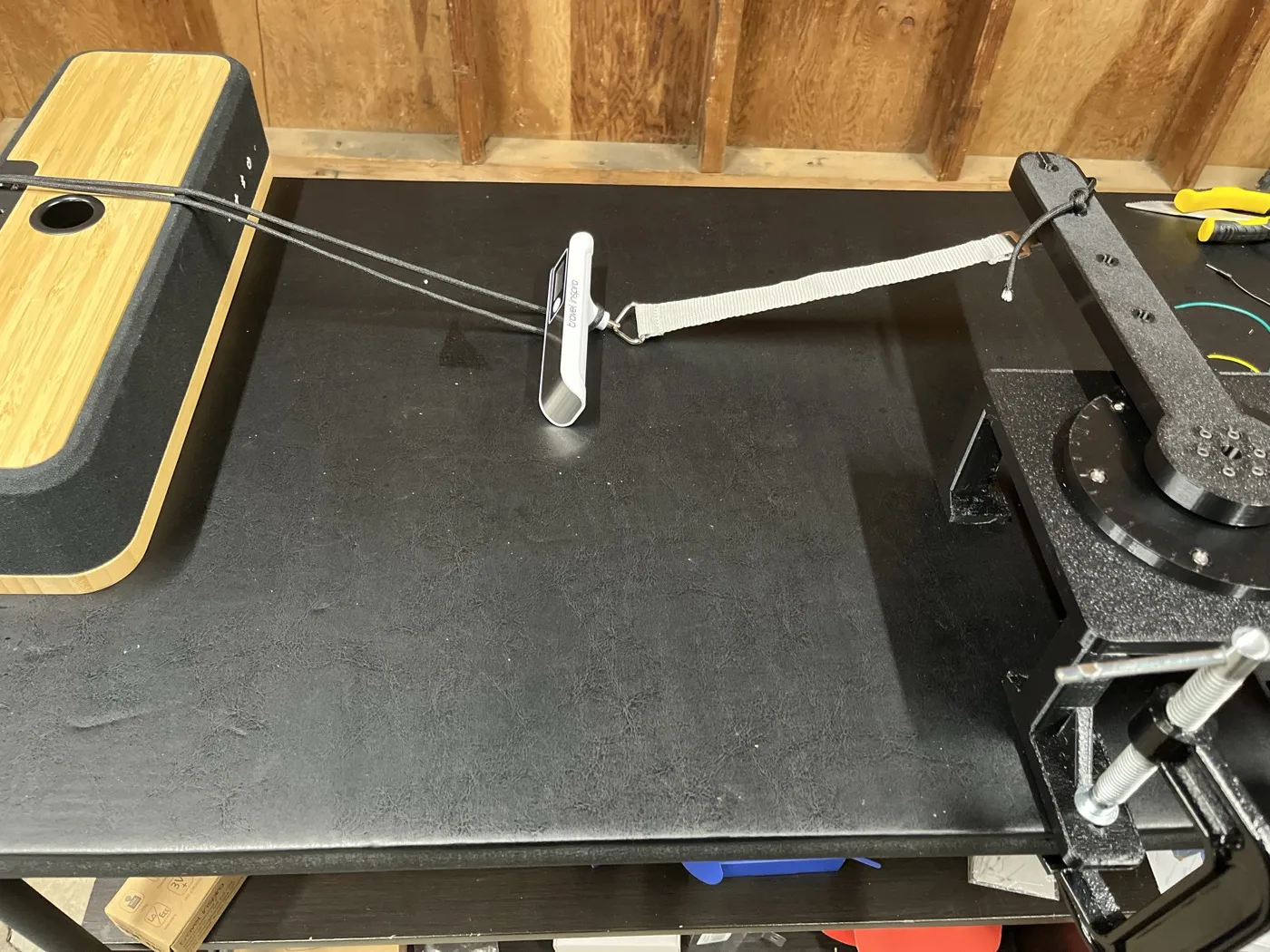
The torque test: lever, strap, luggage scale and cord
It took five runs to get a clean one. The scale freezes its reading after each pull, and the first holds were too short to read and reset it. A slack cord then let the lever swing far enough to trip the safety stop. Longer holds, a tighter cord and spoken cues from the Mac ("pulling", "read now", "reset the scale") fixed both.
From 3 to 5 N·m the motor delivered 89 to 95% of the command. Across all the steps it works out to about 98% of the command minus a fixed 0.35 N·m. That fixed loss is most likely gearbox friction while the output is held still. The readings repeated within one scale count between runs.
So the motor does what it's told. The low reading while turning was never a fault in the sensor or the motor. It comes from how a motor behaves while it speeds up. Part of its torque goes into spinning up its own rotor and gears, and only the rest reaches whatever is attached. As far as I can tell from the logs, the RS00's reading reports that remaining part, the load on the output. With only friction attached, that came to about half the command. While the motor slows down the reading even flips sign, because friction always pushes against the motion. Holding still, nothing is speeding up, so the reading and the real torque match, as they did in this test. It also means the inertia from the earlier test stands, about 0.022 kg·m² at the output, four times what the simulation was using. The simulation gets that update next, and then comes the heat test on the knee motor.
All in all, this was a good science experiment, and I learned a little bit about physics along the way. Exercises like this are really helpful for me to gradually improve my knowledge about mechanical stuff that I really haven't studied much until now.
Discussions
Become a Hackaday.io Member
Create an account to leave a comment. Already have an account? Log In.