 Jeff Wisgo
Until now the leg had only moved its own weight, swinging in the air. A real leg has to hold up part of a robot, push it and catch it again. So this time I gave it something heavy to carry.
The setup is simple. A wooden beam lies flat on the table with one end sticking out over the edge. The hip mount is C-clamped under that end, and the foot stands on a rubber mat below. A brick sits on the far end of the beam. When the leg straightens, it lifts its end of the beam off the table. The leg measures the load itself from the knee torque, and it came to about 11 to 18 N, the weight of 1.1 to 1.8 kg on the foot. Later I took the brick off and held the far end by hand, which made it 21 to 25 N.
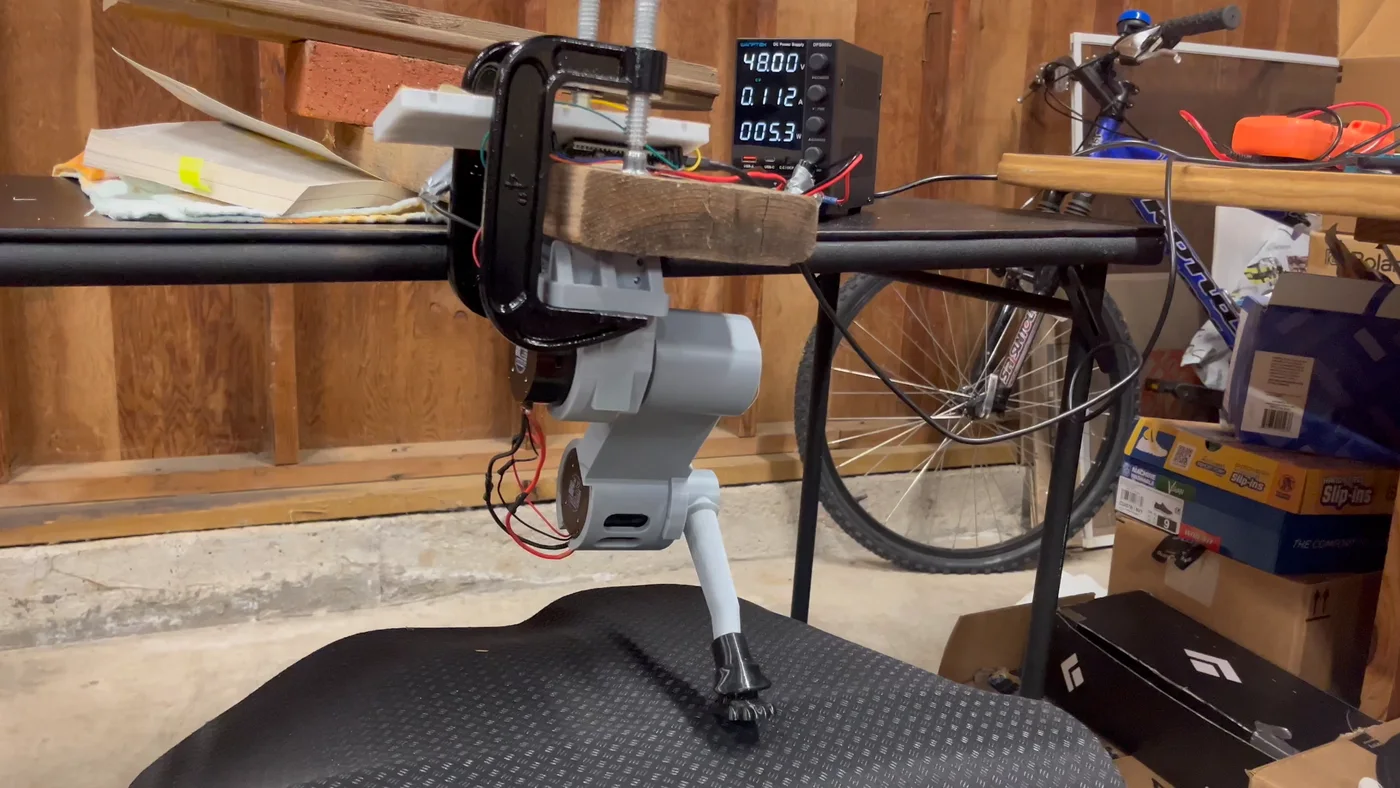
The beam rig: hip mount clamped under the beam, foot on a mat
Holding and bouncing
First, two 30-second holds: 11 N with the foot 224 mm below the hip, and 22 N at 245 mm, where the beam end rose 7.5 cm. Both were steady. Then four bounces, with the foot moving up and down in a smooth wave, from 10 mm once a second up to 20 mm twice a second. The knee never needed more than 2.3 N·m, and the motors stayed at 25 to 27 °C.
Single hops
A hop here means the leg pushes down fast enough that the foot leaves the mat, then catches the beam as it comes back down. I asked for faster and faster pushes, measured as the speed of the foot at the end of the push.
| Push asked for | What happened | Peak knee torque |
|---|---|---|
| 0.3 m/s | The foot barely left the mat | 2.1 N·m |
| 0.5 m/s | About 0.1 s in the air | 3.0 N·m |
| 0.7 m/s | First try stopped itself (see below), then 0.65 m/s | 4.5 N·m |
| 1.0 m/s | Launched at only 0.73 m/s | 5.9 N·m |
The first 0.7 m/s try was stopped by a safety check, because the top of the push came too close to a fully straight knee. Lowering the top of the push fixed that. For these hops I also used the higher current-loop gain from Log 9, and it made a clear difference. With the factory value the knee trailed its command by 10 to 14 ms during a push. With the new value that dropped to 2 to 4 ms.
The 1.0 m/s hop fell short, but the motor wasn't the reason. The knee reached 5.9 N·m with 8 allowed. The push only lasts about 54 ms, and my controller doesn't yet ask for enough torque early enough. That's a software fix.
Successive hops
Chaining hops is harder. Each landing has to be detected, slowed down and turned straight into the next push. Catching the beam with plain soft control let the knee sag up to 0.3 rad. So instead the leg follows a planned slowdown path as it lands, and the motor stiffness ramps back up during it. That kept the knee within about 0.1 rad of its path. Ten hops in a row at 0.7 m/s ran cleanly.
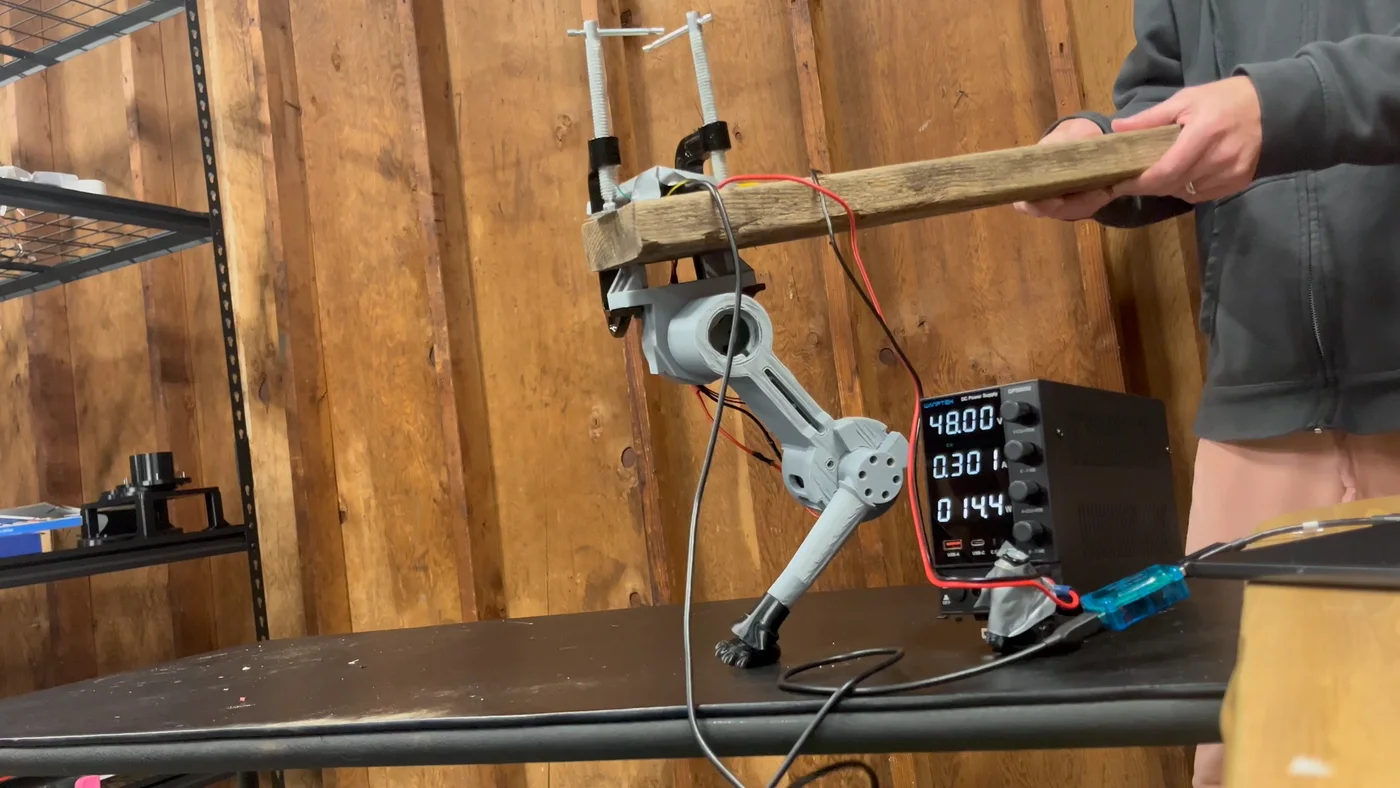
One of 20 hops in a row (watch the video)
At 0.8 m/s two new problems showed up. First, the beam pumps up. Each push lands while the beam is still moving, so with the same push every time the hops got higher and higher, from about 0.1 s in the air to as much as 0.25 s. The fix was to adjust each push based on how long the last hop stayed in the air. Second, the foot kept pushing about 50 ms longer than planned, because of the remaining lag. So the leg now times each hop from the moment the knee actually unloads. With both changes, 20 hops in a row at 0.8 m/s worked, twice. The second run aimed for 0.163 s in the air and averaged almost exactly that.
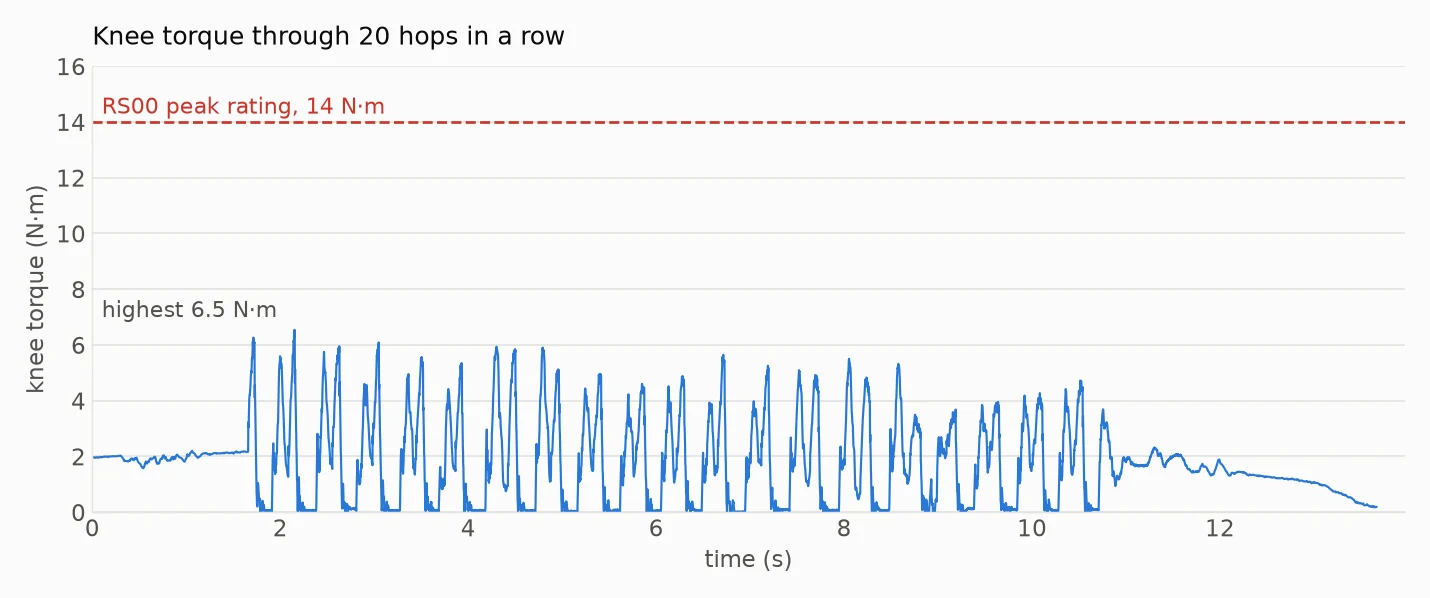
Knee torque through the 20 hops, against the motor's peak rating
What the motors showed
- Torque was never the limit. The hardest knee push was 6.5 N·m, about 46% of the RS00's 14 N·m peak rating.
- Speed and power have room to spare. The knee peaked at about 10.7 rad/s, around 40% of its rated speed, and about 65 W of its rated 140 W.
- Heat didn't matter in these short tests. Every run stayed at or under 26 °C, and 20 hops warmed the knee by only 3 to 5 °C. The big heat question is still long walks, which this doesn't answer.
- The hip worked harder than I expected on landings, up to 5.7 N·m. The foot often landed a bit off-center, and the hip dragged it back. Next time the leg should plan from where the foot actually lands.
The weak link: a power wire
The knee motor's 48 V wire pulled out of its plug twice during chained hops. I soldered it back on. The lesson is that the leg cables need strain relief before this leg walks or hops on a robot.
A spark from the capacitors
Later, when I moved the power supply, the capacitors fell out. When I put them back in, with the supply off, there was a spark. When I checked them with a multimeter, they showed over 3 V, even though they were unplugged from the supply. I discharged them through a resistor for a few seconds until they read under 1 V, and the next try had no spark. Both motors were fine afterwards. The lesson here is to tape the capacitors tightly to the power supply, and to check their orientation when putting them back in.
Next steps
Strain relief for the knee cable. A better push that actually reaches 0.9 to 1.0 m/s. Planning each hop from where the foot lands. Then a slow squat under the beam, stepping in place under load, and finally a long run to test knee heat.
Discussions
Become a Hackaday.io Member
Create an account to leave a comment. Already have an account? Log In.