NovaBot is an experimental, locally hosted AI droid project inspired by Star Wars.
To make the experience fit your profile, pick a username and tell us what interests you.
We found and based on your interests.
Project: Qwen / NovaBot Date: November 21, 2026 Status: Operational, with continued optimization planned
One of the biggest challenges in developing NovaBot has been finding a way to run a capable large language model entirely on local hardware without spending thousands of dollars on modern AI accelerators.
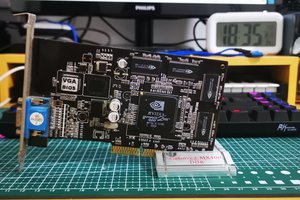
For this project, I decided to experiment with retired enterprise computing hardware, particularly NVIDIA Tesla P100 GPUs.
The Tesla P100 was originally introduced in 2016 for high-performance computing and scientific workloads. Although these cards are now considered obsolete for many modern AI applications, they still possess some interesting characteristics, including high-bandwidth HBM2 memory and substantial FP16 computational capability.
The question was whether three of these older accelerators could provide enough performance to run a modern 27-billion-parameter language model for an interactive robotic system.
After considerable experimentation, the answer has been yes.
More importantly, software optimization has allowed me to more than double the initial measured generation performance without changing the underlying GPU hardware.
This log documents the hardware, inference architecture, performance improvements, technical problems, and experiments that led to the current configuration.
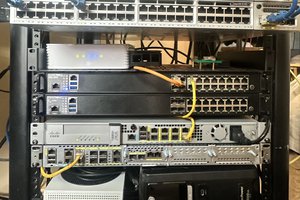
The primary AI system runs on a Dell PowerEdge R740 enterprise server.
Rather than dedicate the entire server to artificial intelligence, I use Proxmox VE to host several virtual machines and services. NovaBot's primary inference environment operates in a dedicated Ubuntu 26.04 virtual machine.
Server specifications:
| Configuration |
|---|
| Dell PowerEdge R740 |
| 2 × Intel Xeon Gold 6138 |
| 40 physical cores / 80 threads |
| 3 × NVIDIA Tesla P100 PCIe |
| 16 GB HBM2 per card |
| 48 GB across three GPUs |
| Proxmox VE |
| Ubuntu 26.04 |
| Qwen3.8-27B |
| Q6_K |
| Custom Pascal-optimized llama.cpp |
The Tesla P100 uses NVIDIA's Pascal architecture, specifically the GP100 processor with CUDA compute capability 6.0.
Each PCIe card has 16 GB of HBM2 memory with a theoretical peak bandwidth of approximately 732 GB/s.
The three cards provide 48 GB of total GPU memory capacity, but that memory is physically distributed across separate GPUs. It is not a single unified 48 GB memory pool.
This distinction matters because the inference engine must coordinate computation and memory access between the cards.
There is also an architectural limitation: the PCIe versions of the P100 do not have the same high-speed GPU interconnect capabilities available in newer multi-GPU AI platforms.
Consequently, communication overhead between GPUs becomes an important performance consideration.
The primary model currently used by NovaBot is Qwen3.8-27B, a 27-billion-parameter language model.
I selected the Q6_K quantized version as a compromise between memory consumption and preserving model precision.
The GGUF model occupies approximately 23 GB of storage and must share available GPU resources with runtime buffers, attention caches, and other inference requirements.
Although the model itself is smaller than the combined GPU memory, distributing it efficiently across three older cards is not straightforward.
The larger objective is also more demanding than simply running an isolated text-generation benchmark.
NovaBot needs to support conversations, technical reasoning, robotic interactions, memory retrieval, and eventually more sophisticated autonomous processes.
For that reason, I care about response consistency, latency, and reliability just as much as the highest possible tokens-per-second figure.
A configuration that produces impressive benchmark numbers but crashes during a conversation is not useful for a robot.
One of the major obstacles has been software compatibility.
Modern AI inference frameworks are increasingly optimized for newer NVIDIA architectures, particularly...
Read more »NovaBot: Current Hardware, Software, and Development Status
November 21, 2026
Before getting into future experiments, I wanted to document the current state of NovaBot and explain how the hardware and software fit together.
What originally began as an experiment with locally hosted language models has gradually evolved into a distributed artificial intelligence and robotics project.
The system now consists of three primary computing platforms, each responsible for a different part of the architecture.
The AI Server
The primary language model runs on a Dell PowerEdge R740 server equipped with two Intel Xeon Gold 6138 processors and three NVIDIA Tesla P100 GPUs, each with 16 GB of HBM2 memory.
The server runs Proxmox, with a dedicated Ubuntu virtual machine providing AI inference services.
The main language model is Qwen3.8-27B using a Q6_K quantization, accelerated through a customized llama.cpp deployment optimized for NVIDIA's older Pascal GPU architecture.
One of the more difficult parts of this project has been making modern inference software perform efficiently on hardware that was never designed for today's large language models.
That has involved CUDA compatibility work, GPU memory allocation, inference optimization, custom runtime builds, and extensive performance testing.
The most recent established performance baseline is approximately 38.7 to 38.9 generated tokens per second. My next optimization target is approximately 50 to 60 tokens per second without sacrificing the working configuration.
All primary language-model inference is performed locally.
The Robotic Interface
NovaBot's interactive hardware is built around an Arduino UNO Q with 4 GB of memory, running Debian.
The UNO Q provides the local interface for interacting with the AI server and controls the visible and audible aspects of the robot.
A 3.5-inch ST7796U SPI display provides animated eyes and facial expressions. The software supports several states, including idle, listening, thinking, speaking, and sleeping, along with blinking and mouth animation.
A Logitech C920e webcam provides camera input and microphone capture. Audio output is handled through USB speakers, with local speech synthesis currently provided by Kokoro.
The speech system is operational, although automatic microphone handling and speech recognition still require improvement.
Vision experiments have demonstrated that NovaBot can capture camera frames and use a vision-language model to interpret visible scenes in response to explicit requests.
This is not yet continuous environmental awareness. The current implementation is a foundation for more advanced perception rather than a finished real-time vision system.
I have also begun experimenting with an Intel RealSense D435 depth camera. Initial depth and 3D visualization tests have been successful in the RealSense software, but the camera has not yet been integrated into NovaBot's autonomous behavior.
Persistent Memory and Autonomous Processing
The newest development is a dedicated Raspberry Pi 5 with 8 GB of memory and a 256 GB NVMe SSD.
Instead of relying entirely on the main AI server or the robot's interactive computer, the Raspberry Pi serves as a separate, lightweight system for memory management, background supervision, and future autonomous processes.
This design separates several responsibilities.
The Dell server provides computationally expensive language-model inference. The Arduino UNO Q handles the robot's interface and connected hardware. The Raspberry Pi maintains persistent state and coordinates higher-level activities.
As of November 21, the first version of the autonomy supervisor has been installed and tested.
The supervisor runs as a persistent system service and uses SQLite-based storage for different categories of memory, development goals, reflection records, and proposed actions.
Initial tests have verified memory persistence across reboots, the ability to generate and review proposed...
Read more »One of the things that has fascinated me about artificial intelligence is the difference between a system that can respond intelligently and one that can maintain some degree of continuity over time.
Modern large language models can generate remarkably sophisticated responses, solve problems, write software, and interpret images. However, most implementations are still fundamentally reactive. You ask a question, the model processes the available context, produces a response, and waits for another request.
That raises a question I have wanted to investigate: What happens when we give a language model persistent memory, sensory input, long-term goals, and the ability to initiate its own activities?
The inspiration for this project comes partly from Star Wars. The droids in that universe are more than talking computers. They remember their experiences, recognize people, develop recognizable behaviors, interact with their surroundings, and appear to maintain a continuous existence between conversations.
Obviously, science fiction doesn't provide an engineering blueprint. But it does present a fascinating collection of capabilities to work toward.
My project, NovaBot, is an attempt to explore those capabilities using actual hardware and locally hosted artificial intelligence.
The central theory is that a language model alone is not enough. A more persistent artificial agent may require several cooperating systems: long-term memory, ongoing observation, a mechanism for setting and revisiting goals, a way to evaluate its own actions, and some form of recurring processing that continues outside direct conversations.
I'm particularly interested in memory. If a system can remember what happened yesterday, associate those experiences with ongoing goals, and incorporate them into future decisions, does that produce more coherent long-term behavior? Could a memory and reflection system reduce the feeling that every interaction is starting from scratch?
Another area of interest is the relationship between perception and cognition. A camera might allow an AI to identify objects, but recognizing an object once is different from maintaining an evolving understanding of a changing environment. I want to investigate whether observations collected over time can meaningfully influence future decisions and behavior.
Autonomy presents a separate challenge. Rather than allowing an AI unrestricted control, I want to begin with a system that can generate proposals, explain its reasoning, remember outcomes, and receive approval before taking consequential actions. That provides a framework for evaluating whether autonomous behavior is useful, reliable, and safe.
None of this demonstrates consciousness or subjective experience. Those are much larger questions, and I don't have a scientific basis for claiming to have answered them. What I can investigate is whether memory, perception, reflection, and independent task selection produce measurable improvements in an artificial agent's capabilities.
I intend to evaluate things like memory retention, consistency across conversations, successful completion of multi-step goals, appropriate use of observations, and the ability to learn from recorded outcomes. Failures, hallucinations, and incorrect assumptions will be part of the results rather than something to conceal.
Another important aspect of this project is accessibility. I'm not using a commercial AI cluster or an enormous research budget. Much of the hardware consists of refurbished enterprise equipment, inexpensive development boards, and components that can be purchased secondhand.
I want to discover how far that combination can go.
The ultimate ambition is to develop NovaBot into a physical, interactive machine with a recognizable personality, persistent memories, environmental awareness, and increasingly capable autonomous behavior.
Whether that leads to something resembling a science-fiction droid or simply exposes the limitations of...
Read more »
Create an account to leave a comment. Already have an account? Log In.
Become a member to follow this project and never miss any updates
By using our website and services, you expressly agree to the placement of our performance, functionality, and advertising cookies. Learn More
satbede
Rhea Rae
Po7mn1