 Anteneh Gashaw


Overview and origin
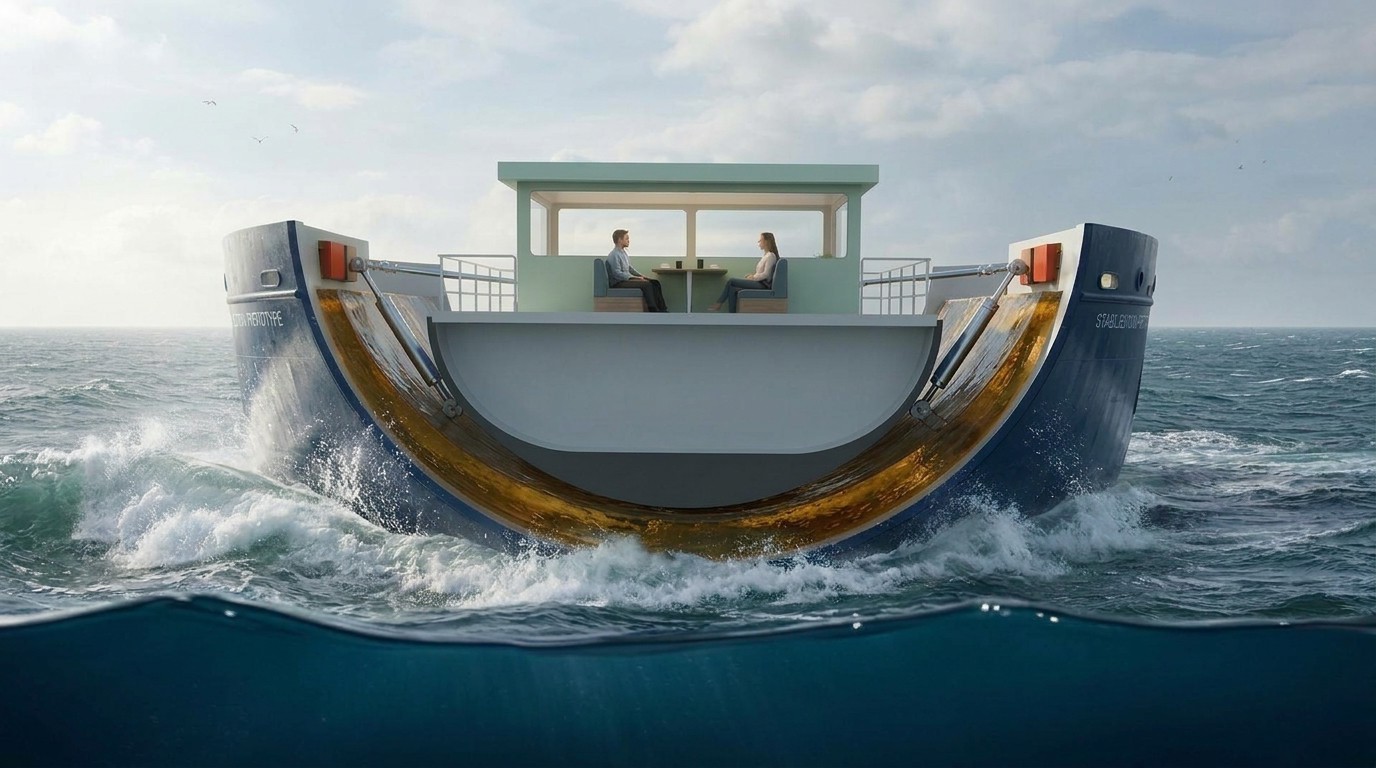
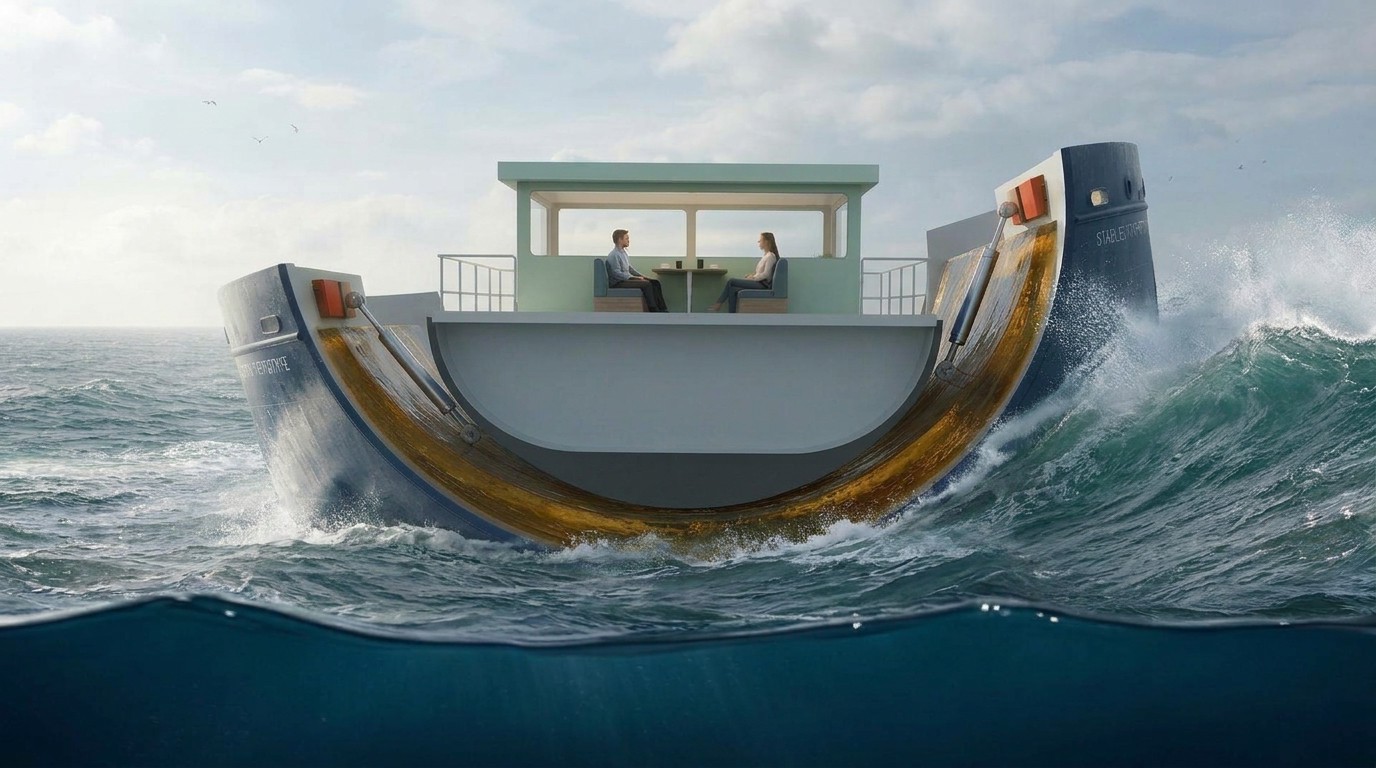
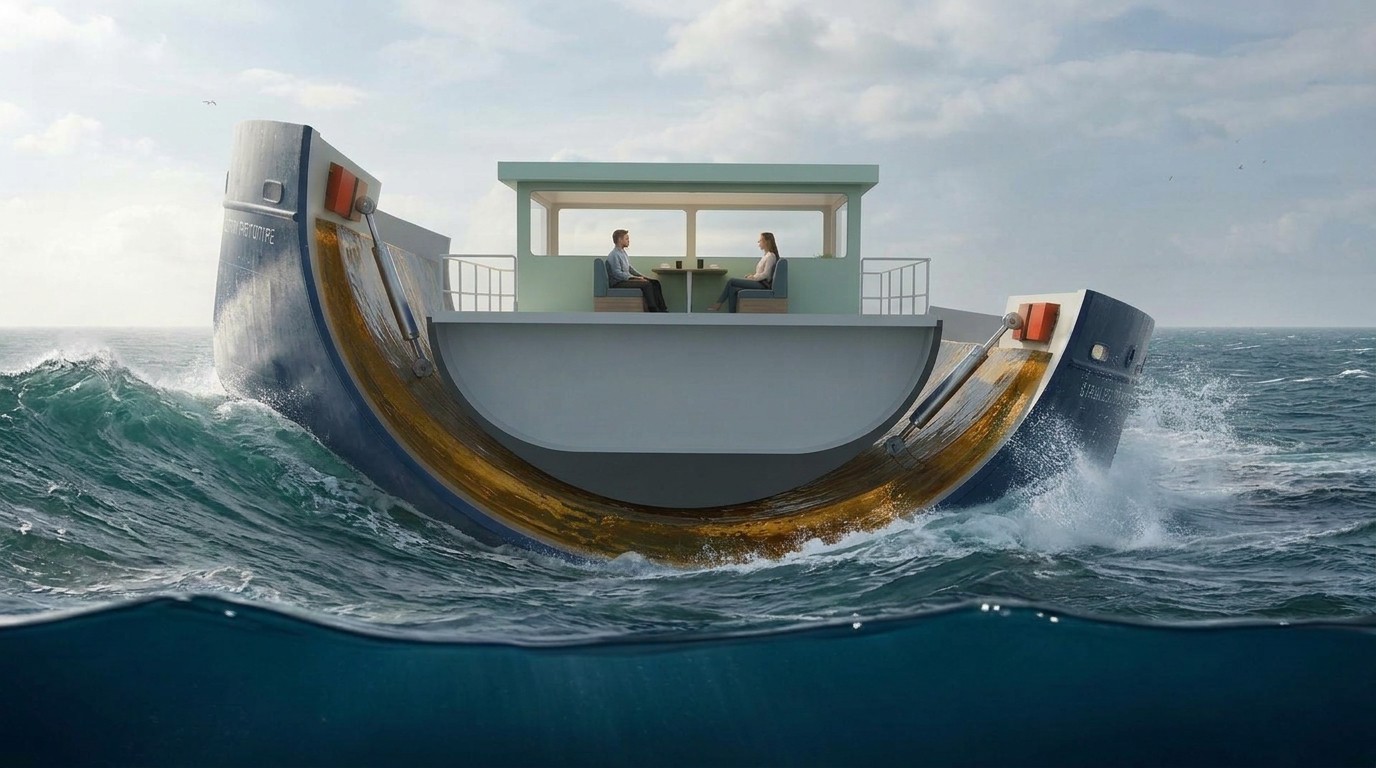
Equilibria is a concept design for a self-stabilizing ship, with the primary function of a stabilized vessel. It was conceived in November 2024 in Addis Ababa, Ethiopia, and the stability concept and technical documentation were completed at the same time. It has not yet been built or exhibited. The project began with a practical question: could a ship stay stable at sea without relying on engines or electronics? The discomfort and danger caused by rolling in waves motivated the search for a simple, passive answer.
Principle of operation
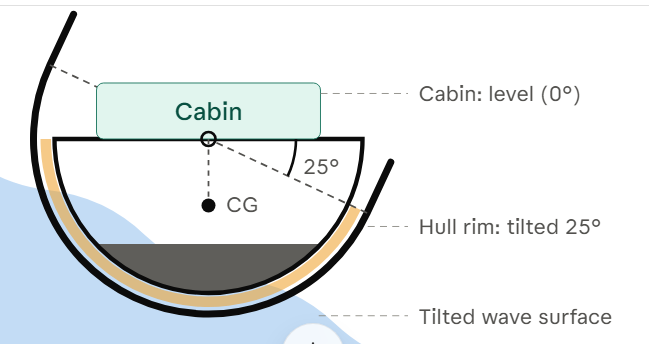
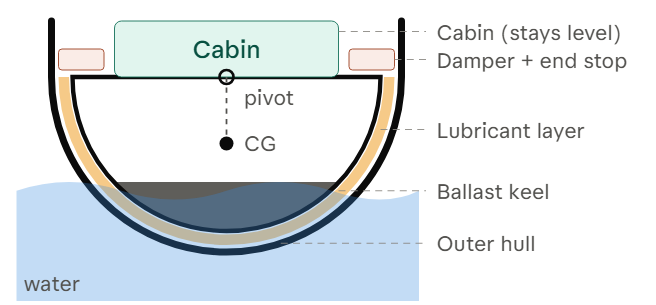
The design combines two well-established ideas. The first is the gimbal principle, used in ship compasses and marine berths, where an inner element rotates freely inside an outer frame. The second is pendulum stability, where a low centre of gravity pulls a body back to an upright position. Applied to a ship, this gives a rounded half-cylinder outer hull that follows the motion of the waves and a smaller inner bowl, carrying the cabin, that rests inside it on a thin lubricated layer. When a wave tips the outer hull, the inner bowl stays level, so passengers and cargo feel far less rocking.
The role of the ballast keel
The most important design decision was the ballast keel. In an early layout, the cabin rested in the bowl with its weight too high, which would have made the inner section unstable and likely to tip. A heavy ballast placed at the bottom of the inner bowl puts the centre of gravity below the pivot, which is the centre of curvature of the bearing surface. Gravity then acts as a restoring force, much like a lantern hanging from a hook. This lets the system work automatically, with no engines, sensors or active controls, which keeps the mechanism simple and low in maintenance.
Supporting components
Hydraulic dampers and padded end stops control the motion of the inner section. Without them it would swing back and forth like a pendulum in rough seas. Dampers absorb that energy, and the end stops protect the structure if the roll exceeds the normal range. The lubricated bearing layer, with the option of low-friction rollers, lets the inner bowl move freely while carrying the weight of the cabin. Edge seals keep water out of the bearing gap and keep the lubricant in.
Technical specifications
The indicative concept scale is 12,000 mm x 6,000 mm x 4,500 mm (length x width x height). The outer hull is a half-cylinder with a 3,000 mm radius and a length of 12,000 mm. The inner bowl has a 2,950 mm radius, which leaves a 50 mm lubricated bearing gap. The design provides roll compensation of ±25°, and the ballast keel places the centre of gravity at least 500 mm below the pivot. Both hulls would be built from marine-grade steel or aluminium. The ballast mass and damper capacity still depend on a full stability calculation, and the dimensions are scalable to other vessel sizes.
Research and development method
The work was conceptual design research. It began with a study of gimbal and pendulum principles, followed by stability reasoning and testing of the geometry with sketches, a cross-section diagram and a rolled-state diagram. These diagrams showed that the ballast keel is necessary for stability and that the bearing arcs must be longer than the roll range. There were no participants, and no physical experiments have been conducted so far.
Challenges
The main creative challenge was keeping the inner cabin level without engines or electronics, which was solved by adding the ballast keel. A second challenge is that, at large roll angles, a bearing arc that is too short leaves part of the inner bowl unsupported. This points to extending the outer hull’s arc or shortening the inner bowl’s arc, together with end stops that engage before the contact arcs run out. External factors also apply: maritime safety regulations, the difficulty of building and sealing large lubricated bearings, and the limited published data on similar vessels.
Impact...
Read more »