 lion mclionhead
Lions came to possess a spare 15V 200W meanwell after the failed inverter project. More importantly, the 15V had a ground. That could bring a meaningful improvement in noise. Of course, there are also some new USB-C bricks with 15V 3A that would use a lot less space but don't have ground.
Reviewing the prospects of upgrading to 15V, the LF353 for EQ maxed out at 18 & the caps maxed out at 16. The MAX412 for volume control maxed out at 10. STA540 maxed out at 20. The scavenged DAC used 5V & max 25V at high current. The virtual ground was 5V. The 12V rail would switch over to direct 15. It was using noisy LM7805's to get the 5 & 10V.
Would convert the STA540, DAC, LF353's to direct 15. The MAX412 would be replaced with another LF353. The formerly 12V LM317 would supply a 5V virtual ground & DAC. Just 2 voltages for the whole thing.
SUBWOOFER NOTES:
Lions came to desire a subwoofer. This would need the average of the 2 channels coming from the volume stage & probably another gain step. The STA540 needs much less than line level while the subwoofer needs line level. A voltage divider could go after the EQ to match the volume control to the subwoofer. All the EQ pots could be replaced by fixed resistors. It's basically a fixed EQ like mega bass.
The original HTR-5230 had separate volume pots for all 6 channels inside the volume control. It was documented in June 2014.
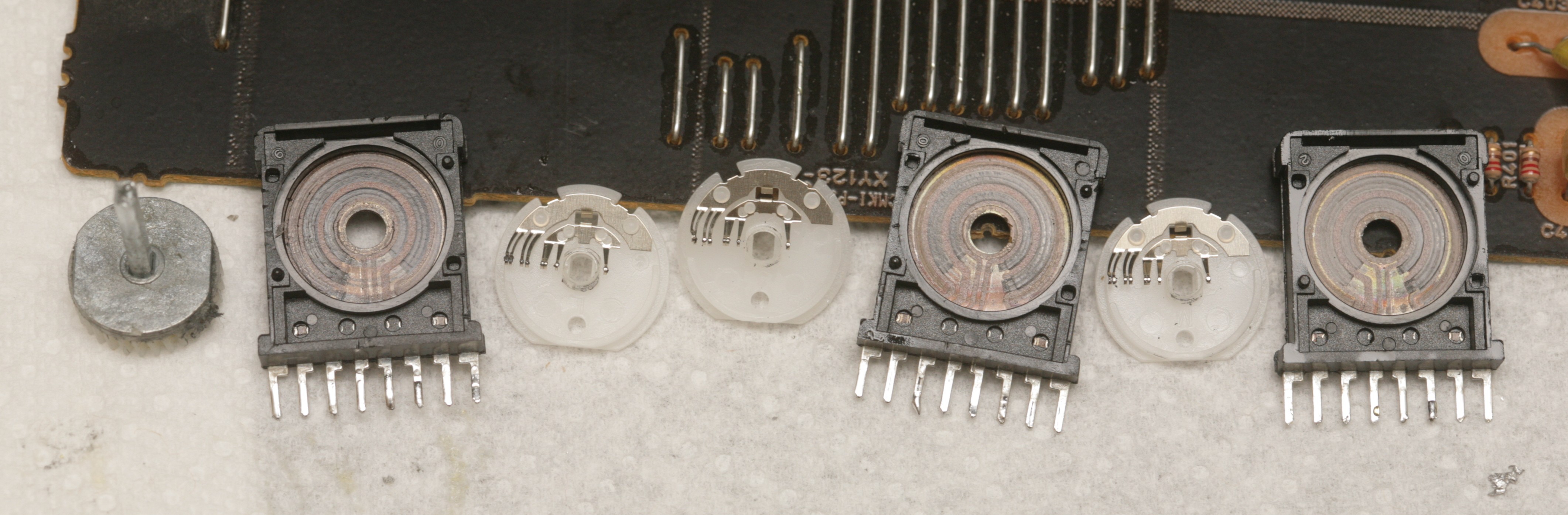
Each layer of a 3 layer pancake had a stereo pot.
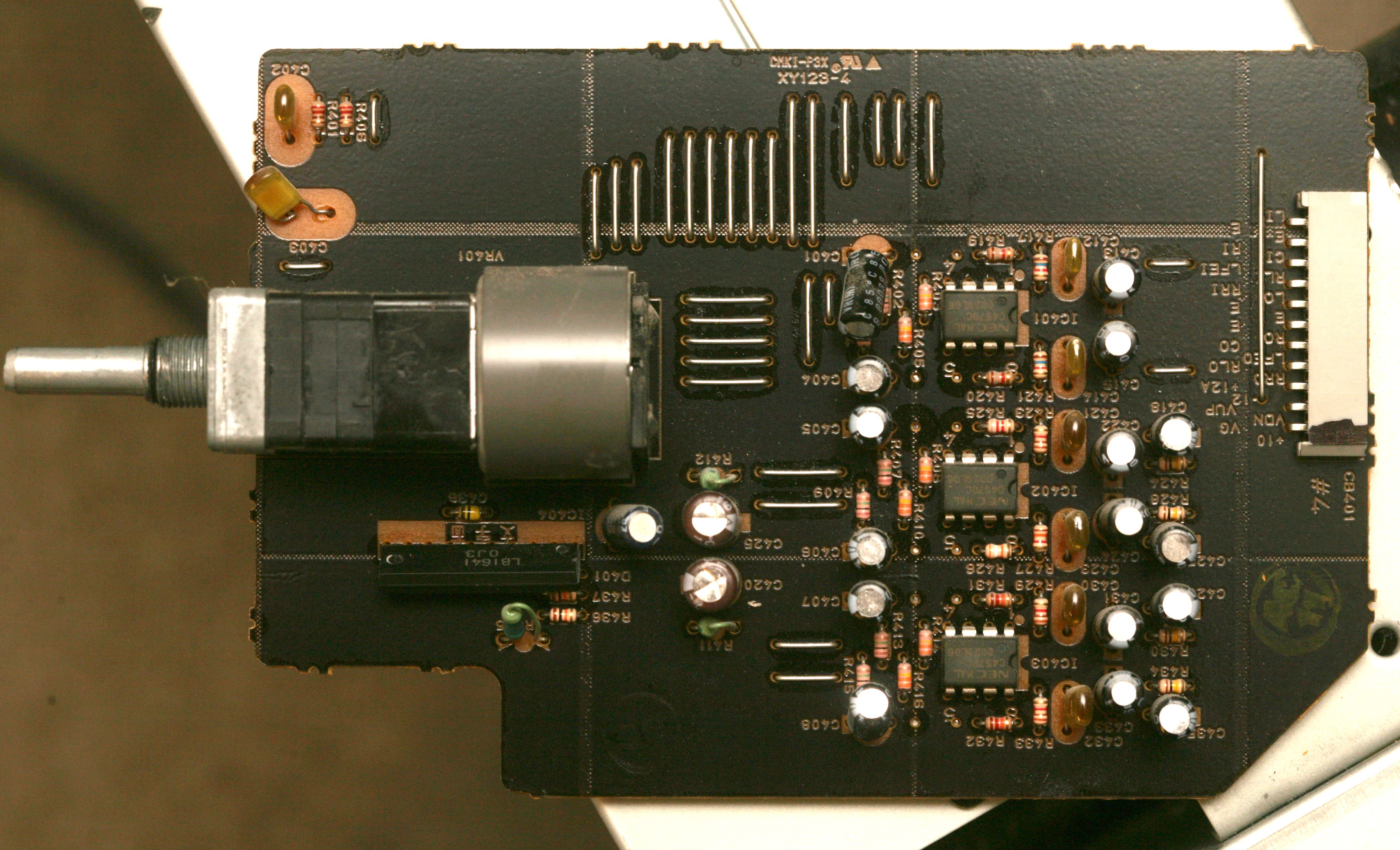
Each pot was a feedback resistor in a non inverting op amp. Modern volume controls use a VCA.
The home made amplifier attenuates DAC output in an op-amp with the 2 channel volume control. This feeds the EQ, which feeds the STA540. The EQ could read from a fixed voltage divider to get the STA540 input & the subwoofer could read a fixed voltage average from the volume control. Seem to recall the EQ came between the volume control & STA540. There's no memory if the HTR-5230 applied EQ to the subwoofer channel though lions are inclined to believe it didn't. There could be a test circuit for developing a subwoofer tap. The 100k trimpots in the EQ or the volume control could be repurposed to attenuate the STA540 input, since those controls are dialed in.
Lions lost interest in capturing I2S or 96khz. The reliability & lack of noise since grounding the switch panel ended any interest in USB. It had some residual resets from the other boards not being grounded, but these would hopefully get fixed by the meanwell.
The effort would entail going several days without any amplifier or possibly using the monitor's speakers. There's no record of what was being used when the current amplifier was being built. The apartment might have gone silent when the HTR-5230 died.
------------------------------------------------------------------------------------------------
Of course, the dream system would go back to the 6 channels of lion youth. It's no longer practical to have a center speaker on top of a monitor. The center speaker could be the speakers built into the monitor. It would use a dolby pro logic implementation to expand 2 channels to 6. That would be a ground up build, probably based on USB, multiple chip amplifiers, digital EQ, digital compression. It could present a 2 or 6 channel sound card. It also is impossible to fit the rear speakers in the apartment. Those days are over but it could be a form of future proofing.
Note the pro logic encoding only provided a single rear channel.
Young lion really thought he would eventually have more space & maybe a single family home one day. The silicon valley thing wasn't going to be forever. It wasn't a very serious vision. The vision now is to rely on the fact that neighbors turn over a lot more than they did 20 years ago & hope some of them aren't complainers.
----------------------------------------------------------------------------------------
Power meter testing showed it burning 7.7W powering the LED in standby or 3.5kw hours every month. Popular music at typical volumes & compression goes to 8.5W. 20Hz test tones can get it to 34W at the same volume level. Bass heavy lion music can get it to 11W at normal volume levels.
Lion ears now max out at 14.5khz & the minimum audible level burns 20W. Old CRTs squealed at 15.7khz. Lions remember hearing that squeal 40 years ago, but can't hear it anymore.
The original notes had most of the standby current feeding the vintage DAC. The savings by directly converting to 15V instead of dropping 19V to 12V in a linear regulator would be negligible. The DAC should just be replaced by some cheap 24 bit 192khz deal. Young lion dreamed of such things.
https://www.amazon.com/Digital-Converter-Optical-Adapter-Coaxial/dp/B0CKYWFQ65/
The motherboard has a Realtek s1220a. A useful exercise would be to sniff the data coming from the optical receiver for what the motherboard can actually output over TOSLINK. It's supposed to support 8 channels 32bit 192khz & the internet says it does.
https://www.audiosciencereview.com/forum/index.php?threads/realtek-alc1220-a-look-on-pc-sound.24019/
The original amplifier came about because every commercial one burned out. That would stay.
Discussions
Become a Hackaday.io Member
Create an account to leave a comment. Already have an account? Log In.