To make the experience fit your profile, pick a username and tell us what interests you.
We found and based on your interests.
A lot of time has passed since I started this.
My vision and philosophy changed. I moved away from Drone to Ornithopter. But I consider a system like this can still be a transition.
The modern drone industry surrounds the age old concept of a propeller. Such a design doesn't appear in nature. Right now I am more interested in working with Ornithopter designs. That includes synthetic muscles.
Each of them costs 1€ + 38¢ shipping (I bought 5 of them, altogether i paid 1.90€ for shipping which means 38¢ per piece)

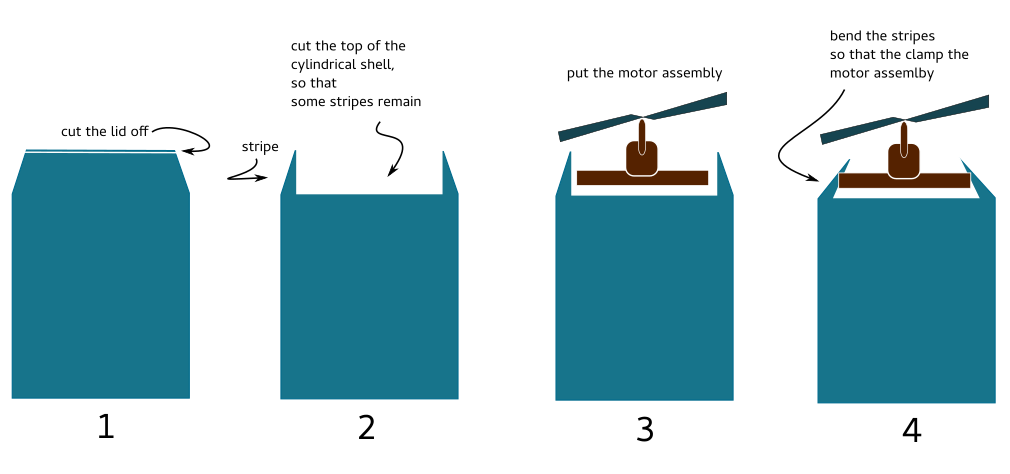
I am going to use the 330 ml soda can as the first structural basis of the system. I have highlighted in the image how I plan to do this.
Question : what is the best shape of the petals?
Answer: This is dependant on the amount of vibration. In order to answer that, we need to know how fast the motor is spinning, the static mass of the motor + rotor, and then the amount of unbalance that appears in the rotor, so that we can create a kinamatic model.
So I first need to calculate what kind of a rotor I need.
My motor details are (I will upload as soon as I get the motor) :
I ordered cheap DVD motors, I will update as soon as I find some info on them. The worst case scenario is 1800 RPM.
I do not know how massive they are.
The Betz law on rotorcrafts says that the Force exherted on the air by the rotor ( = the force acting on the craft as a reaction from the air) is given by
Assuming windstill, this would mean, the lift is given by the rotor pitch and Rotor Area. The actual amount of lift generated by a propeller is very complex. Nonetheless there is another way to compute the same :
ω is the angular velocity, L is propeller width, l is the depth of the helix the propeller describe. So now I can look in ebay, and find a propeller.
Create an account to leave a comment. Already have an account? Log In.
Become a member to follow this project and never miss any updates