
-
Sustainable Success: Why Reliable Homework Help is the Best Defense Against Undergraduate Burnout
03/22/2026 at 07:13 • 0 commentsThe academic landscape of 2026 is faster, more digitized, and more demanding than ever before. For the modern undergraduate, the standard workload often feels like a relentless sprint. Between rigorous credit requirements, the pressure of maintaining a perfect GPA for graduate school, and the necessity of internships, many students find themselves hitting a burnout wall long before graduation. Burnout isn't just feeling tired; it is a clinical state of emotional and physical exhaustion that can derail a promising career before it even begins.
To combat this, savvy students are shifting their mindset from doing it all to managing it all. They recognize that their mental bandwidth is a finite resource. This has led to the rise of strategic academic support, where the choice to pay someone to do my assignment is viewed as a vital wellness tool. By offloading high-volume or highly technical tasks, students are building a model of sustainable success that allows them to excel without sacrificing their mental health.
![]()
1. The Anatomy of Academic Exhaustion
Burnout in the undergraduate years is often the result of decision fatigue. Every day, a student must decide between sleeping, studying for a midterm, or finishing a complex technical project. When this state of constant high-stakes decision-making persists for months, the brain’s ability to regulate stress collapses. This leads to a decline in creativity, a loss of motivation, and a significant drop in academic performance.
Utilizing reliable homework help acts as an immediate intervention for this cycle. When a student decides to pay someone to do my assignment for a non-essential elective or a repetitive data-entry task, they are reclaiming cognitive space. This space is essential for recovery. By removing just one or two massive stressors from the weekly calendar, a student can lower their baseline cortisol levels, allowing them to return to their core major subjects with renewed focus and energy.
2. High-Stakes Precision: The Lab Report Hurdle
In STEM fields, the primary driver of burnout is often the technical documentation burden. A student may spend six hours in a physical lab conducting an experiment, only to face another ten hours of data processing and formal writing. The requirement for absolute precision in these documents is exhausting. A single error in a calculation or a formatting slip on an APA-style citation can result in a failing grade, regardless of the student’s actual understanding of the science.
This is where specialized lab report help becomes a defensive strategy for mental health. Writing a professional-grade report requires a level of clinical detachment and technical mastery that is difficult to maintain when you are already sleep-deprived. By delegating the heavy lifting of report formatting and data visualization to an expert, students ensure that their hard work in the lab is reflected in their final grade. This support prevents the perfectionism trap that leads many science students to quit their majors out of sheer frustration.
3. Quality Over Quantity: The 2026 Academic Standard
The modern university system often rewards volume over depth, burying students in busywork that adds little to their long-term professional skills. A student might be asked to write three 1,000-word reflection papers a week for a class that has nothing to do with their career goals. This volume-heavy approach is the fastest route to undergraduate burnout.
Strategic delegation allows a student to prioritize quality where it matters most. By choosing to pay someone to do my assignment for these peripheral tasks, students can dedicate their best hours to Deep Work—the kind of intense, focused study required for their senior thesis or professional certifications. This balanced approach ensures that the student is not just busy, but is actually productive. It aligns their daily effort with their long-term goals, providing a sense of purpose that is the ultimate antidote...
Read more » -
The 20-Hour Work Week: Why Savvy Students Use Homework Help to Balance Internships and Academics
03/22/2026 at 04:02 • 0 commentsThe traditional image of a college student—someone whose only responsibility is to attend lectures and study in the library—is rapidly becoming a relic of the past. In 2026, the most ambitious students are essentially working two jobs. They are balancing a full-time academic load with high-stakes internships, part-time professional roles, or entrepreneurial ventures. The "20-hour work week" is now a standard requirement for those who want to graduate with a resume that actually competes in a global job market.
However, there are only 168 hours in a week. When you subtract time for sleep, commuting, and professional responsibilities, the math for a 4.0 GPA often doesn't add up. This is where savvy students are changing the game. By utilizing professional college homework help, they are effectively "buying back" their time. They recognize that their future employer cares more about their internship performance than a repetitive elective essay, and they are managing their resources accordingly.
1. The Shifting Value of the Undergraduate Degree
In the current economy, a degree is the baseline, but professional experience is the differentiator. A student with a 3.9 GPA and no experience is often overlooked in favor of a student with a 3.6 GPA and two years of relevant internship experience. This shift in the hiring landscape has forced students to prioritize "real-world" output over academic busywork.
When a student seeks online assignment help, they aren't trying to skip the learning process; they are performing a cost-benefit analysis. If spending ten hours on a mandatory general education paper means missing a crucial networking event or a project deadline at their internship, the "cost" of doing that homework is too high. By delegating these peripheral tasks to experts, students can focus their intellectual energy where it yields the highest return on investment: their professional development.
2. Strategic Delegation: A Core Professional Skill
One of the most important lessons in the corporate world is that you cannot do everything yourself. The most successful CEOs and managers are masters of delegation. They focus on their "zone of genius" and outsource everything else. Savvy students are applying this same principle to their education.
Using college homework help is an early exercise in this professional mindset. Instead of burning out by trying to be a "perfect student" and a "perfect intern" simultaneously, these students identify which tasks require their personal touch and which can be handled by a specialist. By using online assignment help for repetitive problem sets or standard reports, they ensure that every requirement is met at a high level without sacrificing their physical or mental health. This ability to manage multiple high-priority workstreams through external support is a skill that will serve them well throughout their entire careers.
3. Maintaining Academic Excellence Under Pressure
The pressure to "have it all" can lead to a dangerous decline in quality across the board. When a student is exhausted from a 20-hour work week at an office, their academic performance naturally suffers. They start turning in "good enough" work, which can slowly erode a hard-earned GPA. For students on merit scholarships, this decline isn't just a matter of pride—it is a financial risk.
Professional college homework help acts as a quality-control mechanism. It ensures that even during the busiest weeks of an internship—such as during a product launch or a quarterly review—the student's academic standing remains unshakeable. Platforms like AssignmentsWallah provide the expert backup needed to maintain a consistent "A" average. By leveraging online assignment help, students ensure that their academic foundation remains solid, providing them with the security they need to take risks and excel in their professional roles.
4. Preventing the "Burnout Wall" Before Graduation
The most significant threat to a young professional's...
Read more » -
Stop Guessing, Start Solving: Why Specialized Homework Help is the Secret to Mastering Advanced Calculus and Physics
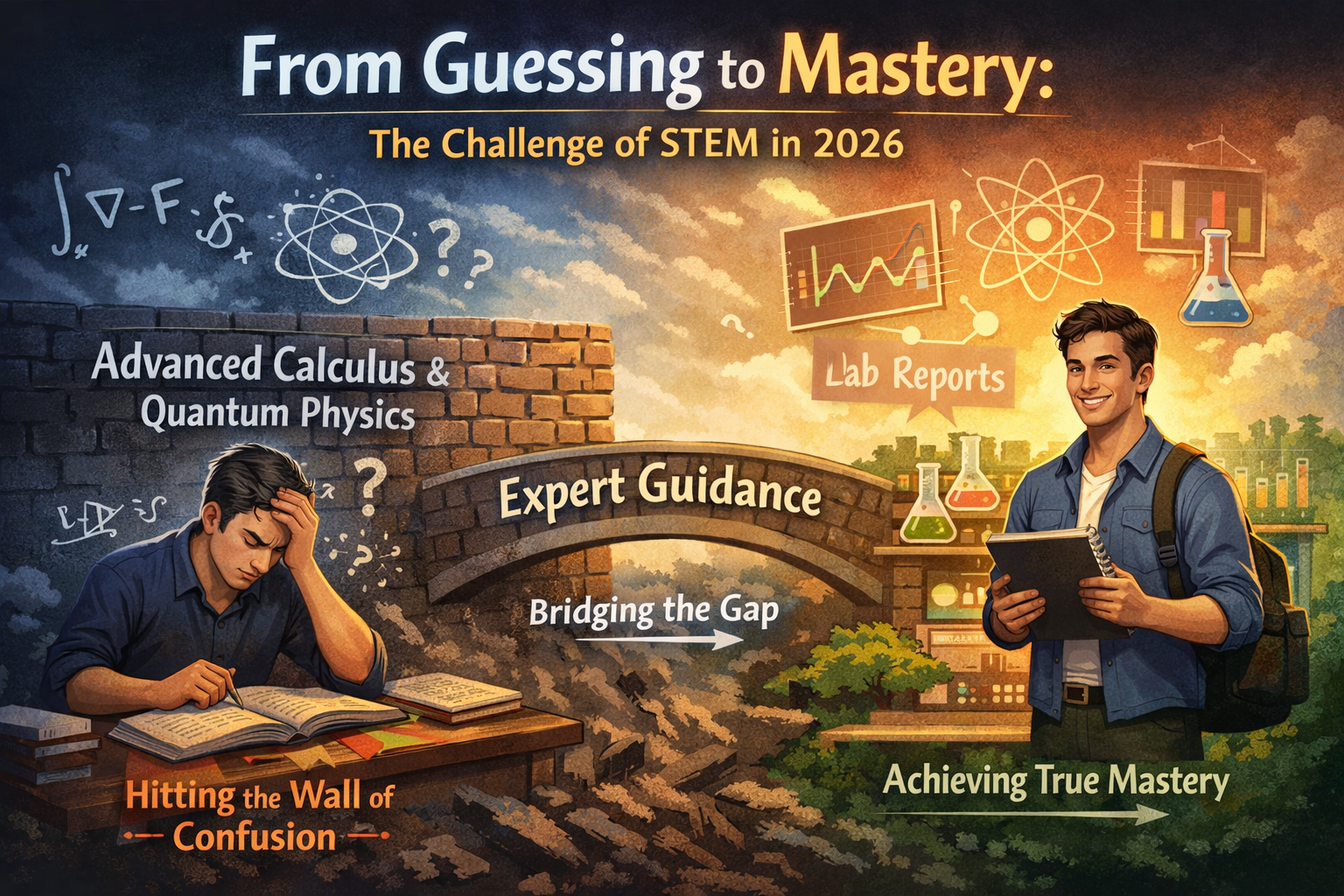
03/22/2026 at 03:30 • 0 commentsFor many STEM students in 2026, the transition from high school mathematics to university-level advanced calculus and physics feels less like a step up and more like hitting a wall. The abstract nature of multivariable calculus and the counterintuitive principles of quantum mechanics often leave even the brightest students staring at their textbooks in a state of "educated guessing." In these high-stakes subjects, a single misunderstood theorem can lead to a cascade of errors that derail an entire semester.
The reality of modern STEM education is that the classroom environment—often consisting of hundred-person lecture halls—is rarely conducive to mastering these intricacies. This is why specialized homework help has moved from being a luxury to a strategic necessity. By accessing expert guidance, students are moving away from the frustration of trial-and-error and toward a model of true mastery.
![]()
1. The Gap Between Theory and Application
In advanced calculus, the leap from understanding a formula to applying it in a complex, three-dimensional problem is massive. Professors often explain the "what," but the "how" is frequently left for the student to figure out during late-night study sessions. This gap is where most academic frustration resides. When a student is stuck on a Stokes' Theorem problem for four hours, they aren't learning; they are spinning their wheels.
Specialized homework help bridges this gap by providing a "cognitive bridge." Unlike generic AI tools that might provide a flat answer without context, a subject-matter expert provides the logical scaffolding. They show how to decompose a complex problem into its foundational parts. This structured approach allows the student to see the "path to the solution" clearly, transforming a confusing set of symbols into a logical sequence of steps. This clarity is the first step in moving from guessing to solving.
2. Precision in the Laboratory: Beyond Raw Data
Physics and chemistry students face an additional hurdle: the formal laboratory report. A student might excel at the mathematical side of a physics experiment but struggle to document the results in a way that meets 2026 academic standards. Lab reports require a specific type of technical writing—one that balances data analysis, error propagation, and scientific argumentation.
This is where professional lab report help becomes an invaluable asset. Writing a report that correctly accounts for systematic errors and uncertainties requires a level of precision that many undergraduate programs fail to teach explicitly. By working with an expert who understands the nuances of scientific documentation, a student learns how to present their data with the authority of a professional researcher. This doesn't just improve the grade for a single assignment; it trains the student in the professional standards of their future career in science or engineering.
3. Reversing the "Ebbinghaus Forgetting Curve"
The Ebbinghaus Forgetting Curve suggests that humans forget nearly 70% of new information within 24 hours if it is not reinforced. In a fast-paced calculus or physics course, the "reinforcement" usually comes in the form of massive weekly problem sets. However, if a student spends that time guessing or using incorrect methods, they are essentially "learning" the wrong habits.
By utilizing reliable homework help early in the week, students ensure that their practice is perfect. When you learn a concept correctly the first time, you are building the neural pathways required for long-term retention. Expert guidance ensures that your study hours are high-impact. Instead of spending the night before an exam trying to un-learn mistakes, the student who sought help early is already in the "mastery phase," where they are refining their speed and accuracy.
4. Psychological Resilience and the STEM "Filter"
Advanced calculus and physics are often used as "filter courses" to weed out students from competitive engineering or medical...
Read more »

 Lutetium