 likorne30
-
The geometry of ohmic resistances
09/23/2024 at 15:01 • 0 commentsThis is an open source project.
Winding a wire makes a coil.
A coil is an element that allows you to build objects like a transformer, motor, etc.Here I am only talking about purely ohmic resistance.
The question is how to wind it?
This question seems stupid, but it is not!
This allows you to build objects and have new effects.Due to lack of technical and financial means, I am limited.
I do my experiments in my living room.
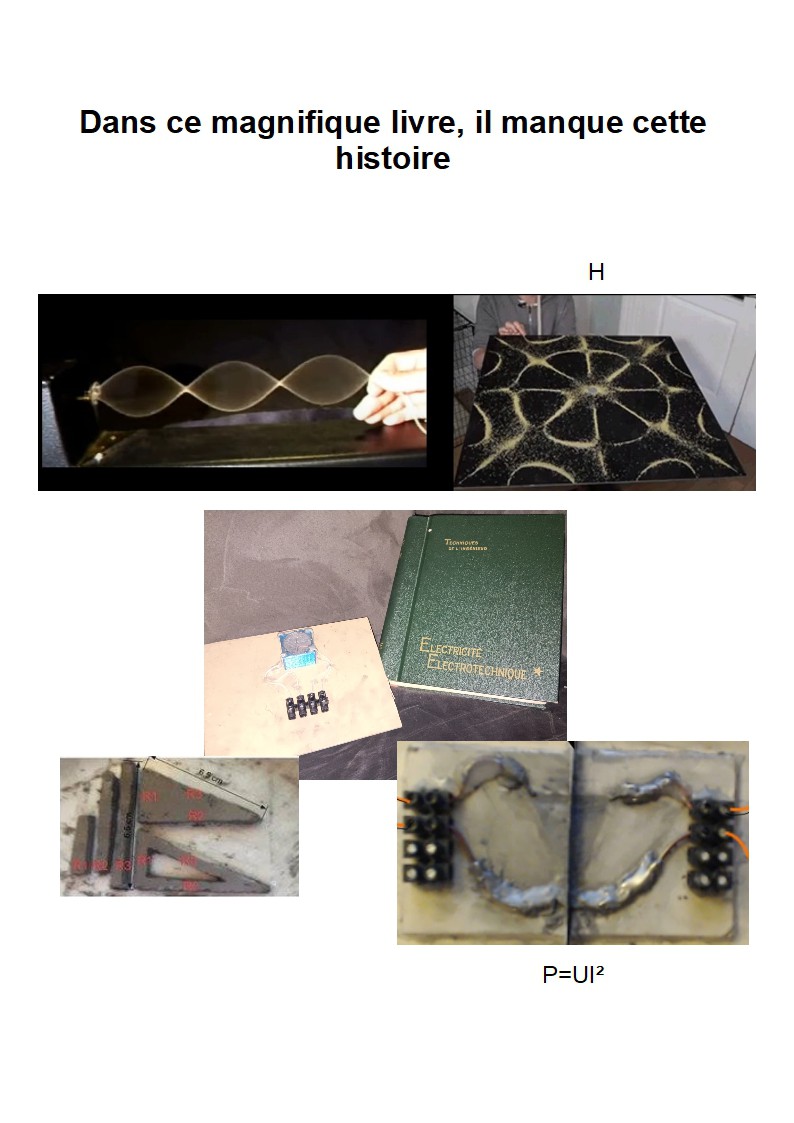
3 simple experiments that you can reproduce at home.
So, just like me, you can see the differences between a classic resistance and a geometric resistance.To be as clear as possible, it is an Ohm's law in 3D.
The resistance and its shape are based on couplings, these couplings are directed in space.At the end of my studies in electrical engineering, I asked myself this question:
How to connect a resistive cone?
If it's something electrical, it's because it connects.
2 power points and as many connection points as atoms on the surfaces of the cone.
That is: 2 power points VS an astronomical number of connection points.
I repeat my question:
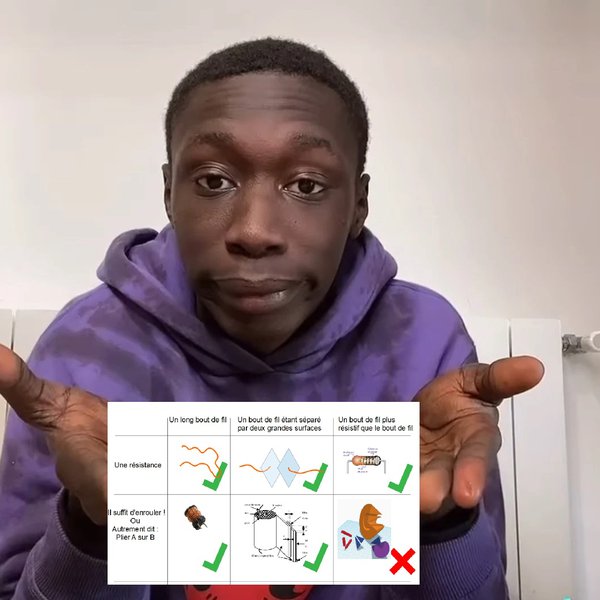
How to connect this resistive cone?This electrical project is exciting, since I'm talking about ohmic resistance, it's as if I were taking you back to the first year of technical school, here I change one thing, I remove the metal tips that touch the entire surface of the sides of the resistors, so I only have contact points which creates equivalent couplings in a single resistor.
I think we underestimate the magnitude of ohmic resistances.
![]()
This user joined on 09/22/2024.
 Lutetium