 Geo
GeoBrowser-Based Embedded Hardware Tools
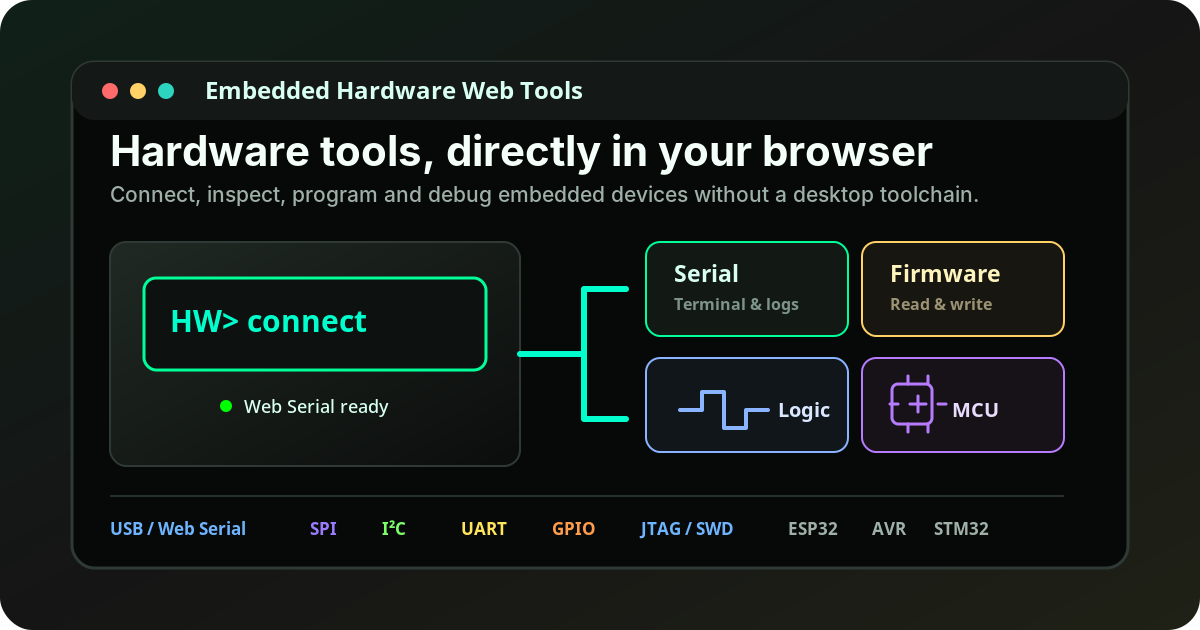
Embedded debugging tools that run directly in your browser
A free collection of Web Serial and WebUSB tools for serial consoles, firmware extraction, chip flashing, logic analysis, protocol exploration, and quick hardware debugging workflows.
Why browser-based tools?
Embedded development often requires many small tools: a serial terminal, a flash reader, a programmer, a logic analyzer, or a low-level protocol interface. Installing a full desktop toolchain for every quick task can be unnecessary friction.
The goal of these Web Tools is simple: open a page, connect a compatible USB device, and start working. The tools run locally in the browser and communicate with hardware through browser-supported interfaces such as Web Serial and WebUSB when available.
Use cases: serial consoles, SPI flash dumps, logic analysis, chip flashing, GPIO / I2C / SPI testing, and firmware research.
Tools included
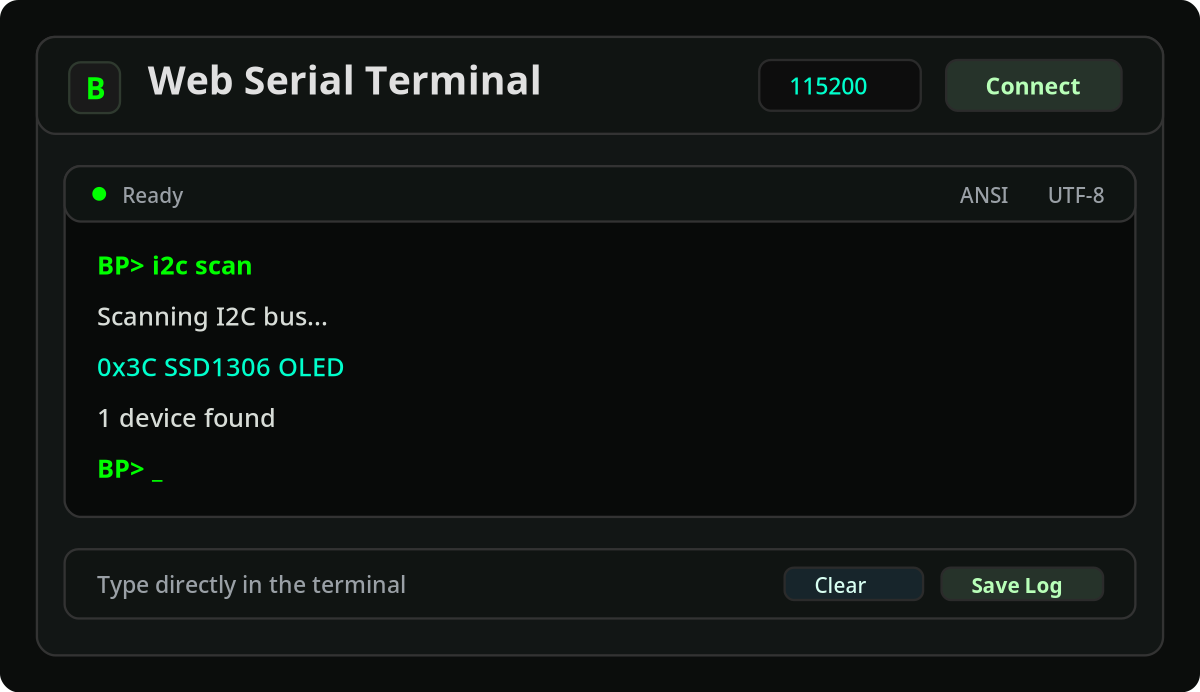 Web Serial Terminal A browser-based serial console for USB UART and CDC devices. Useful for board bring-up, firmware logs, bootloader consoles, AT commands, interactive shells, and quick debugging. |
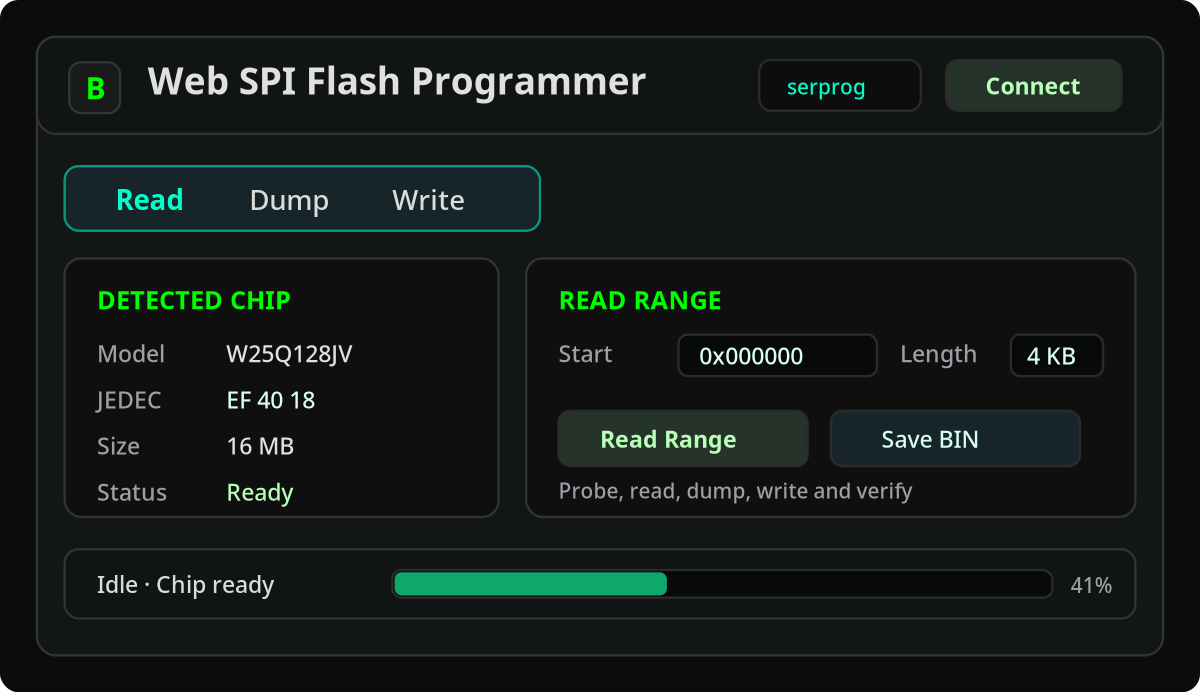 Flash ProgrammerA browser workflow for probing, reading, writing, and saving SPI NOR flash chips through compatible adapters. Useful for firmware backup, recovery, extraction, and reverse engineering. |
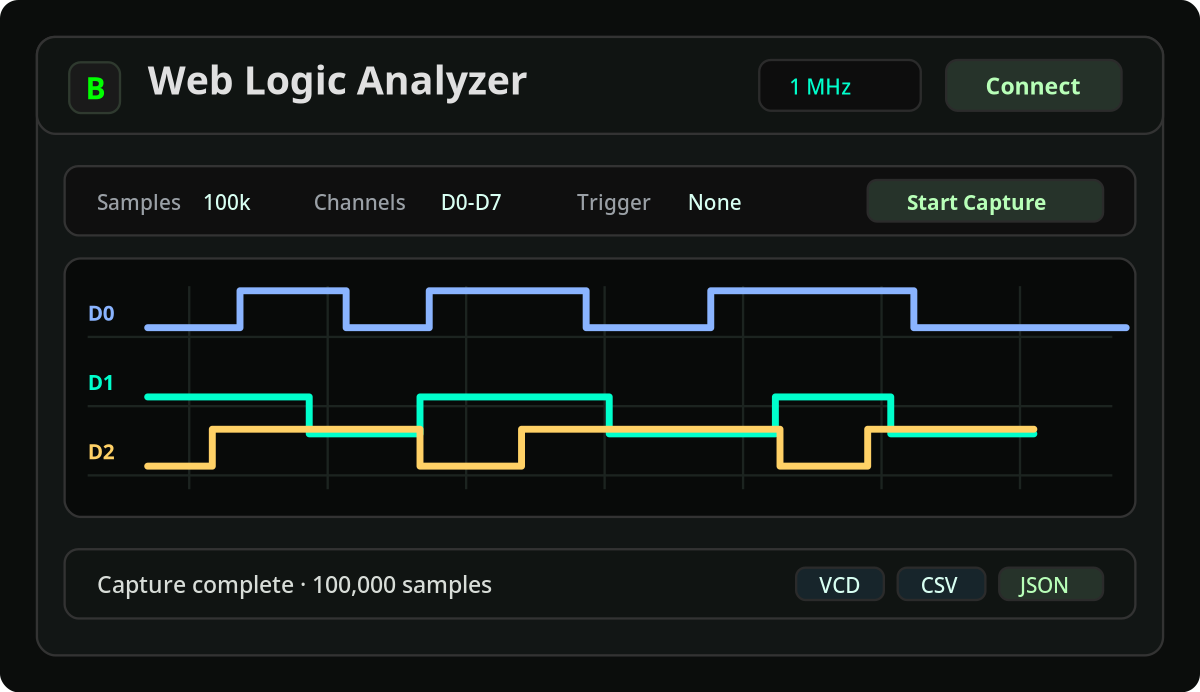 Logic AnalyzerA browser interface for SUMP-compatible captures. Useful for checking GPIO activity, SPI/I2C/UART timing, and verifying that a board is actually communicating on a bus. |
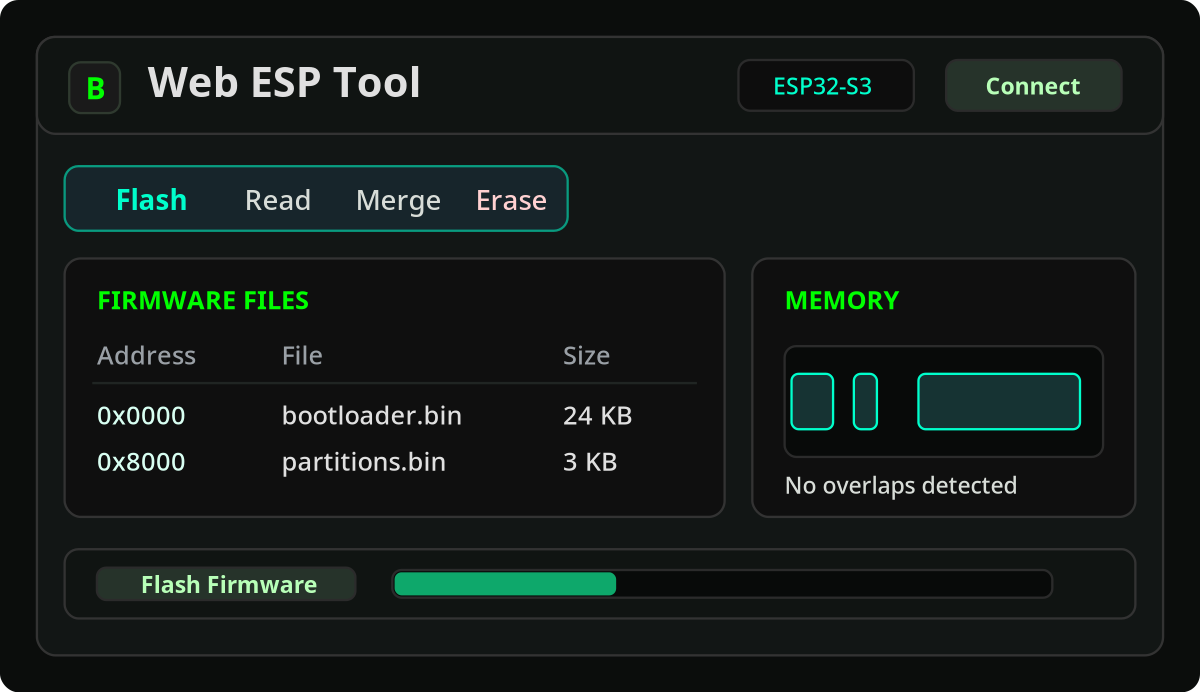 ESP Tool A browser-based workflow for ESP32-family devices. It can help with flashing firmware, reading flash, and working with merged firmware images without manually installing command-line flashing tools. |
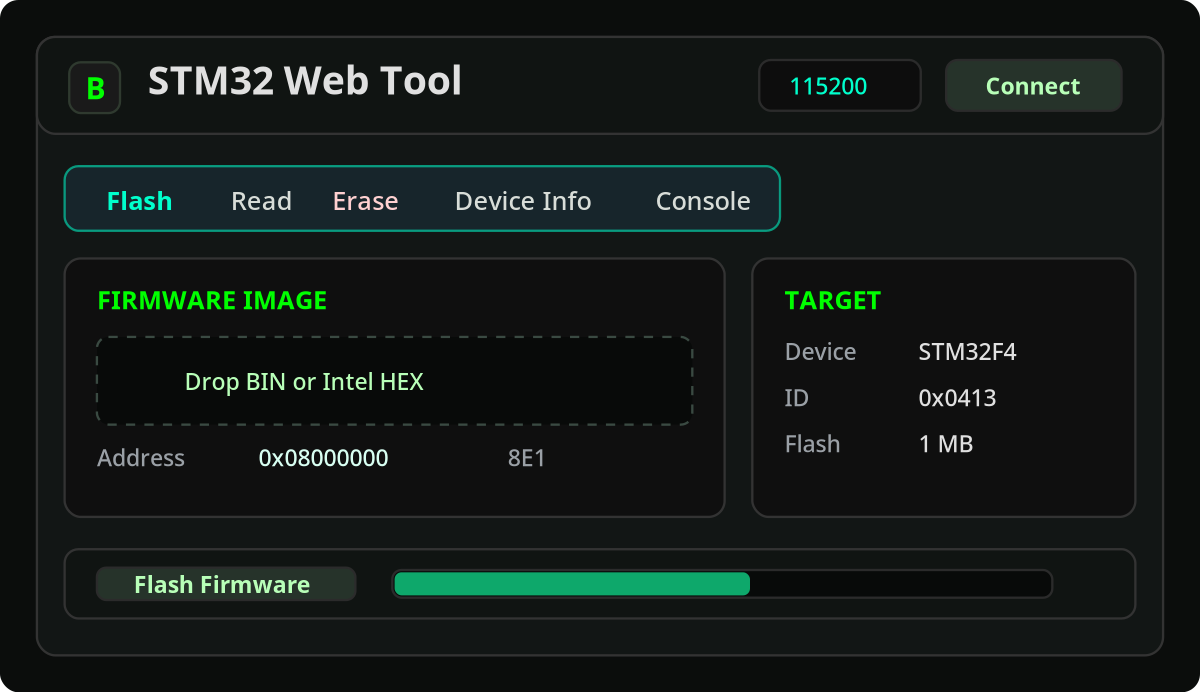 STM32 ToolA browser workflow for STM32 targets using supported interfaces such as ST-Link or UART bootloader modes. Useful for quick board recovery, firmware testing, reading, flashing, and inspection tasks. |
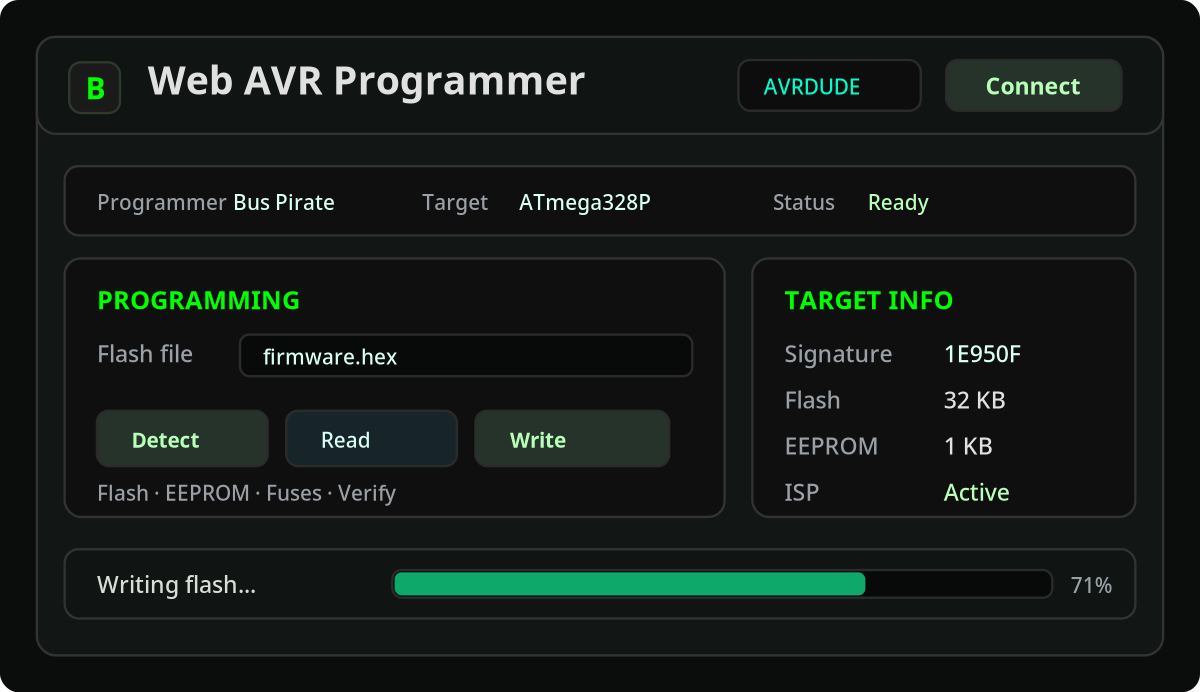 AVR ProgrammerA browser-based AVRDUDE-style workflow for AVR targets through compatible adapters. Useful for programming classic AVR microcontrollers, Arduino-style boards, and workshop-friendly firmware upload flows. |
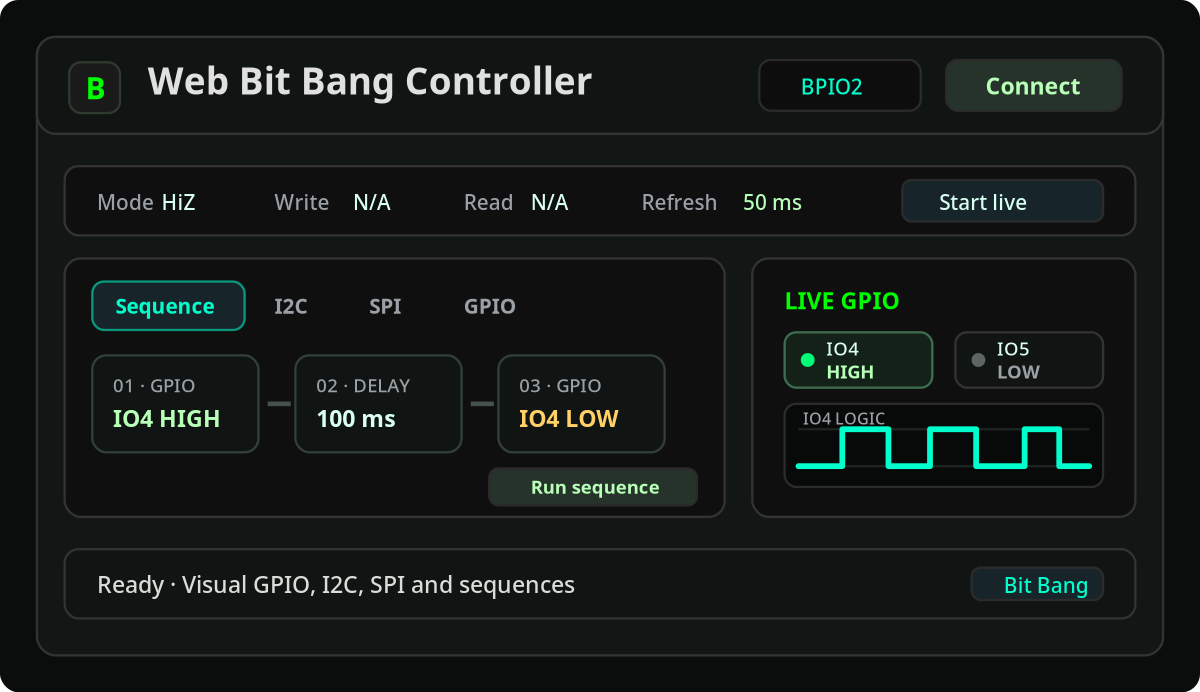 Bit Bang ToolA low-level interface for GPIO, I2C, SPI, and simple command sequences. Useful for protocol exploration, quick electrical tests, pin toggling, and interacting with unknown or partially documented hardware. |
|
Example workflow: dumping a SPI flash chip
One practical use case is firmware extraction from a SPI NOR flash chip. Instead of asking the user to install flashrom, configure an adapter manually, and run commands from a terminal, the browser tool can guide the process.
|
1. Connect a compatible SPI adapter Use hardware that exposes a supported SPI flash programming interface. |
|
2. Probe the flash chip Detect the chip and verify that communication is working. |
|
3. Read the memory Dump the flash contents directly from the browser workflow. |
|
4. Save the firmware image Download the dump and analyze it later with external tools. |
Example workflow: checking digital signals
Another common task is checking what is happening on a digital bus. With a SUMP-compatible adapter, the browser logic analyzer can capture signals and display waveforms directly in the browser. This can help confirm whether an I2C device is responding, whether a SPI clock is present, whether a UART line is active, or whether a GPIO signal has the expected timing.
Designed to stay versatile
The tools are not meant to be locked to a single board or firmware. Where possible, they rely on existing protocols and ecosystems:
Web Serial, WebUSB, USB CDC, serprog, SUMP, AVRDUDE, and ESP flashing workflows.
This means the tools can be useful with different adapters, boards, and projects. The long-term goal is to provide practical browser-based tools for embedded developers, hardware hackers, reverse engineers, and open-source hardware projects.
Where ESP32 Bit Pirate fits in
These tools were also created as a companion ecosystem for ESP32 Bit Pirate, an open-source firmware that turns an ESP32-S3 into a multi-protocol hardware debugging tool.
ESP32 Bit Pirate can expose several USB adapter modes, allowing the same low-cost ESP32-S3 board to act as different tools depending on the workflow.
|
USB UART bridge Serial consoles, boot logs, shells, and device bring-up. |
SPI flash adapter Browser-based probing, reading, writing, and firmware extraction. |
|
SUMP logic analyzer Digital captures for GPIO, UART, SPI, I2C, and custom signals. |
AVR programmer Programming AVR targets through compatible browser workflows. |
|
ESP flashing helper Assisting ESP flashing and recovery workflows. |
GPIO / I2C / SPI bridge Low-level protocol exploration and custom sequences. |
This creates a useful loop: the web tools make embedded hardware workflows easier to access, and ESP32 Bit Pirate provides an affordable open-source adapter that can drive many of those workflows.
You can use the web tools with compatible hardware, or flash ESP32 Bit Pirate on an ESP32-S3 to turn it into a versatile USB hardware adapter for debugging, firmware extraction, protocol exploration, and reverse engineering.
Discussions
Become a Hackaday.io Member
Create an account to leave a comment. Already have an account? Log In.