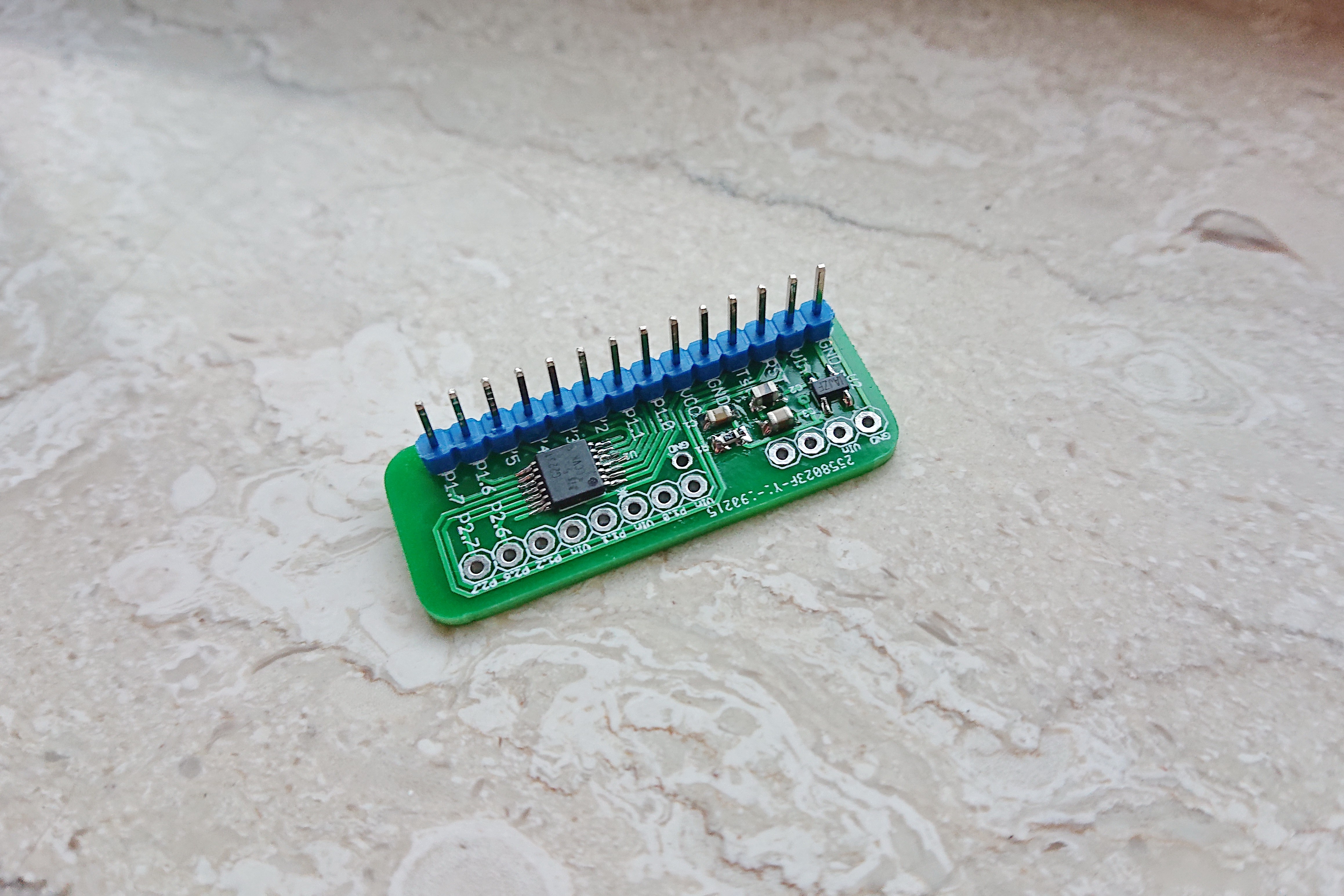
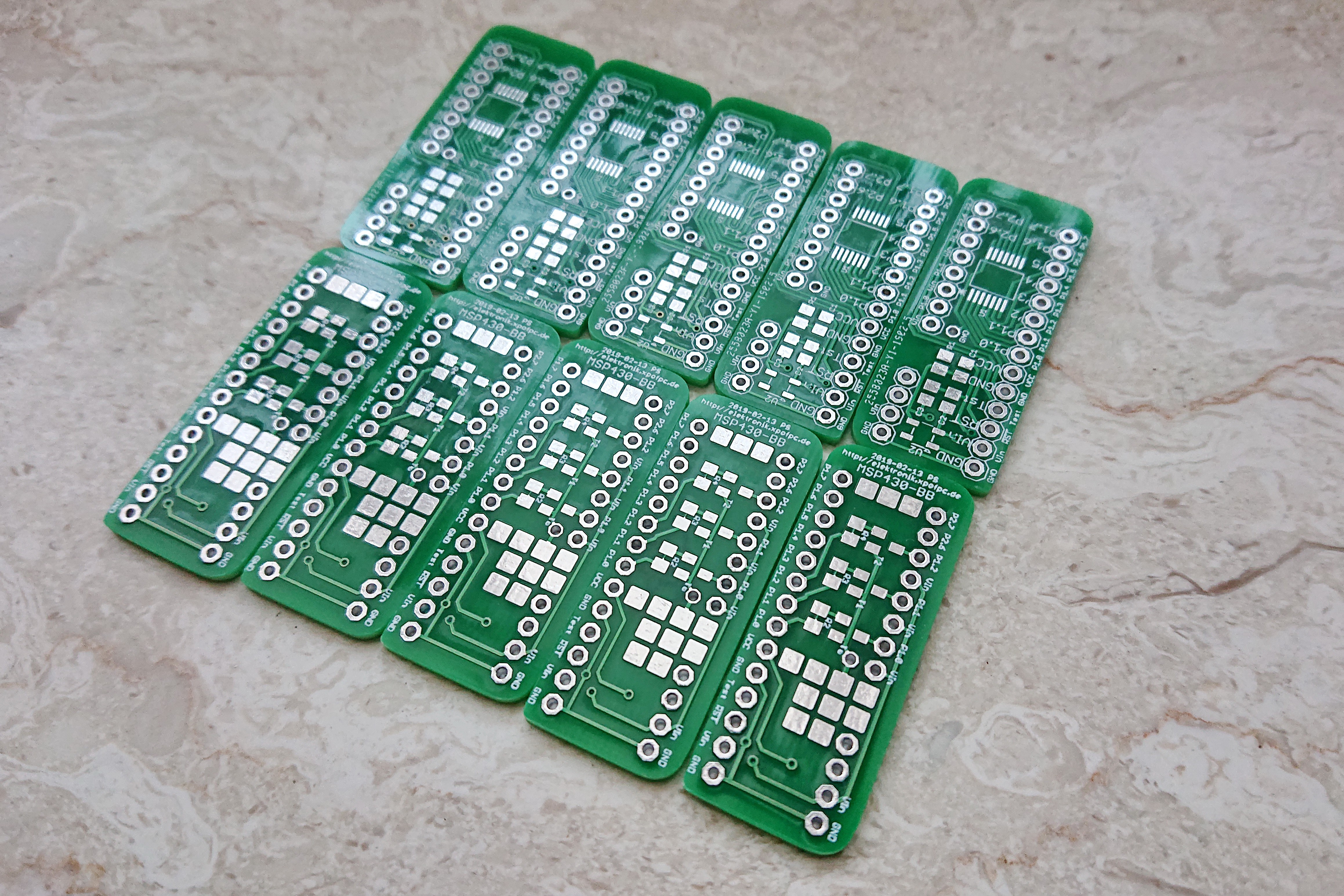
I ordered the PCBs via JLC PCB on 2019-02-15. They might have been delivered yesterday - but unfortunately, I wasn't at home...
Next Time I have to pay attention to not order more than 22€ ... so that in Germany there will be no taxes. And also need to pay attention, that the DHL Express doesn't take care of customs. Please note this if you consider to order 😉
Regarding the prices:
10 pcs = €1.78
+ Shipping Charge: €16.14
+ Customs €22,51
I also ordered some more Stuff at the LCSC.COM and an other PCB. If you balance your Order a bit better, I think it is a great resource for custom pcbs.
At the purple Company 9 pcs = $14,40 with free shipping. Considering the “Shipping Charge” and Taxes It is not a big gap.
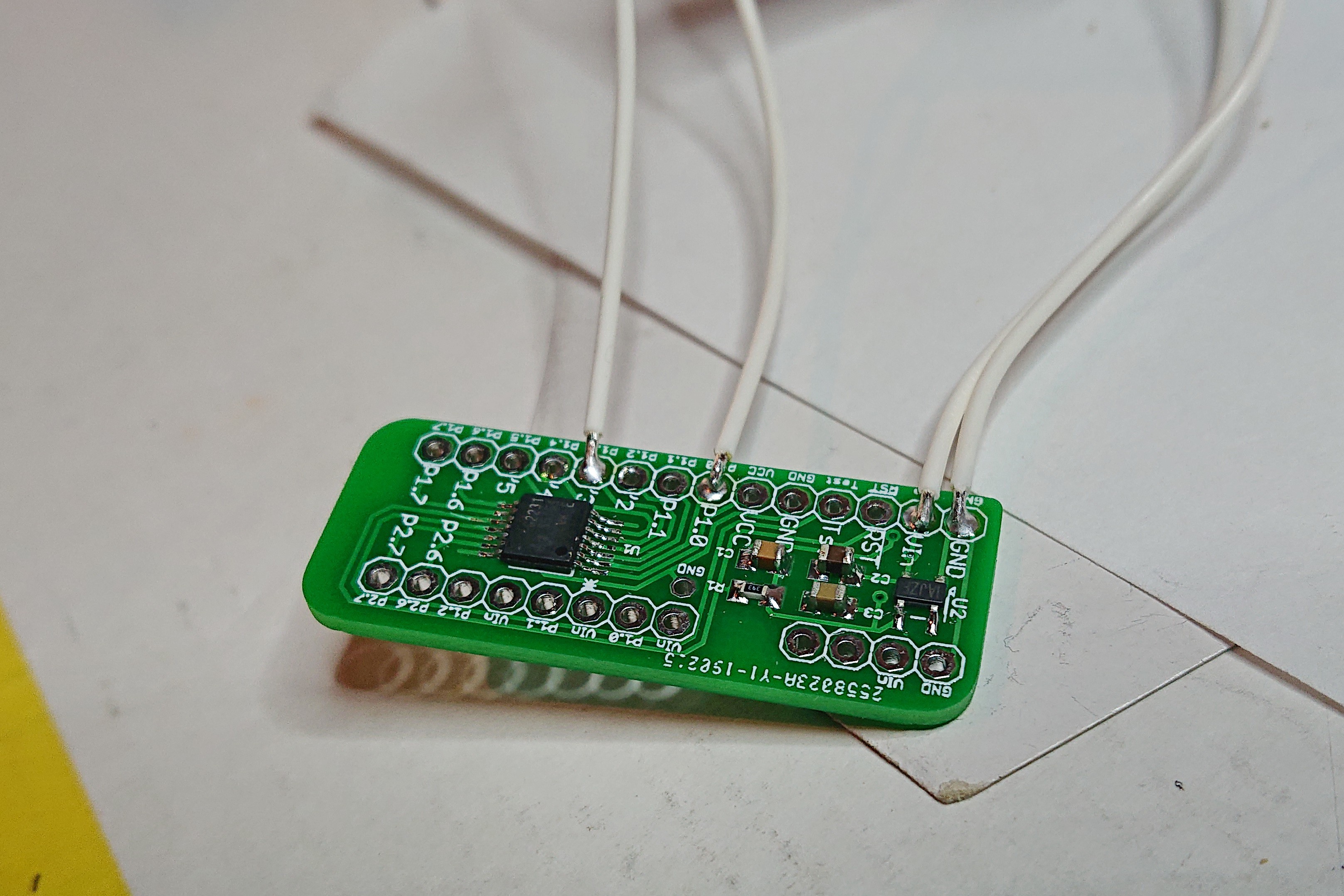
To realize the "Hack" for 5 lamps i just did a small PCB Design which should be sufficient to cover this project on a budget.
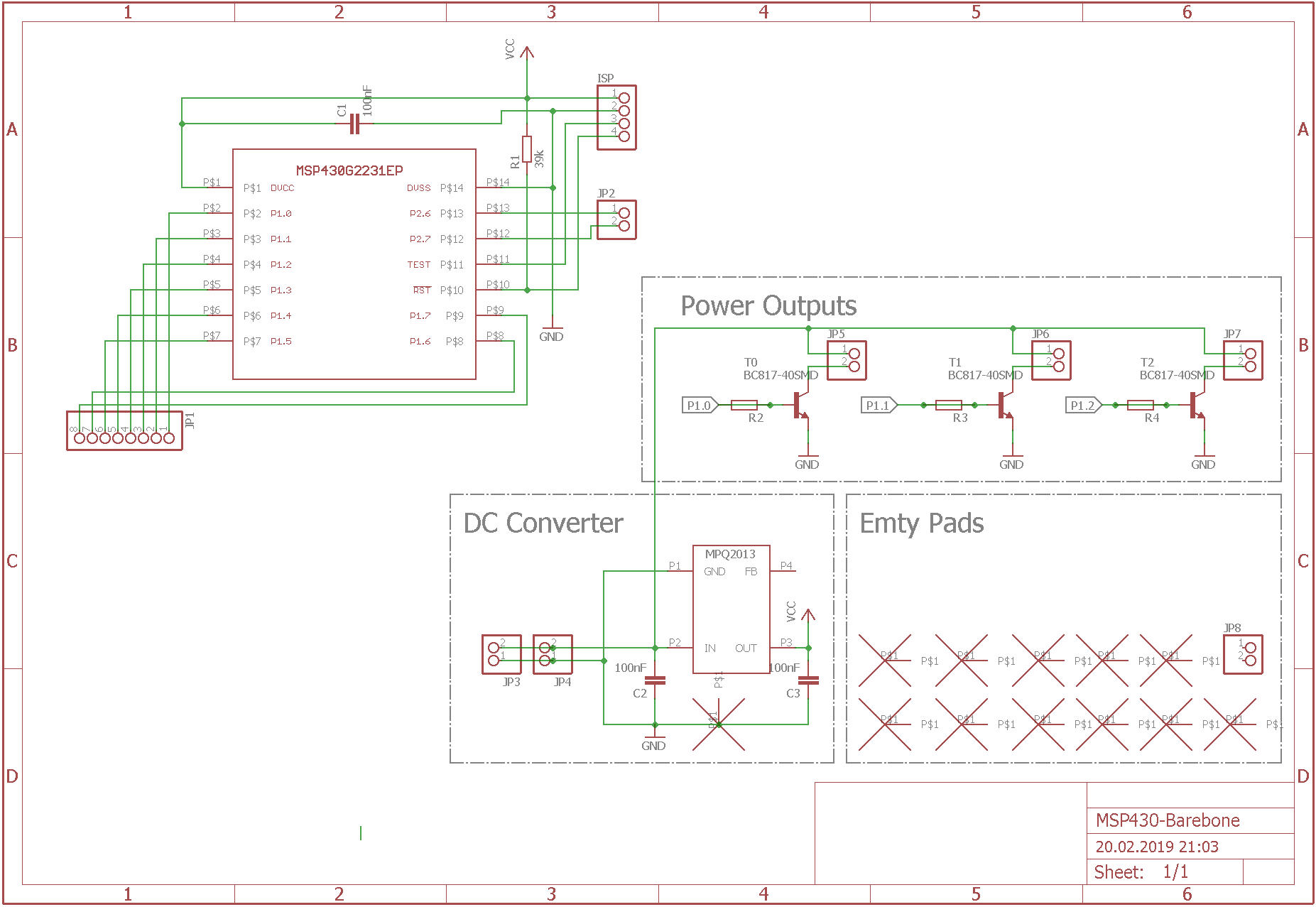
The Schematic is in General only a Breakout for the MSP430G2231EP. Therefore i call it the MSP430 Barebone PCB. I added a DC Converter for the µC and 3 Outputs which may feature a BC817 NPN Transistor:
There are also some emty Pads because of having is better than needing ;-)
This is how the Desing looked like in Eagle :-)
This is how the board house rendered it from top side:
They also promised, that it will arrive this week ^^ (It is already shipping) Stay tuned.
As I had luckily a MSP430 Launchpad and a custom MSP430 Breakout board laying around i thought I should give this one a Try. With the help of the Internet I created a really simple program.
Initialize all GPIOs as INPUT_PULLUP to conserve energy
Initialize 3 GPIOs as Outputs to control LEDs (I added additional 2 for Debug Purposes
Attach Interrupt to One Input if the Voltage is pulled down.
If a falling etch is detected, wake up and continue main loop.
If the Output is High, set it Low, if it is Low, set it High. (Toggle 3 Outputs with delays)
Continue Loop
Its a really small programm. I added it to the project.
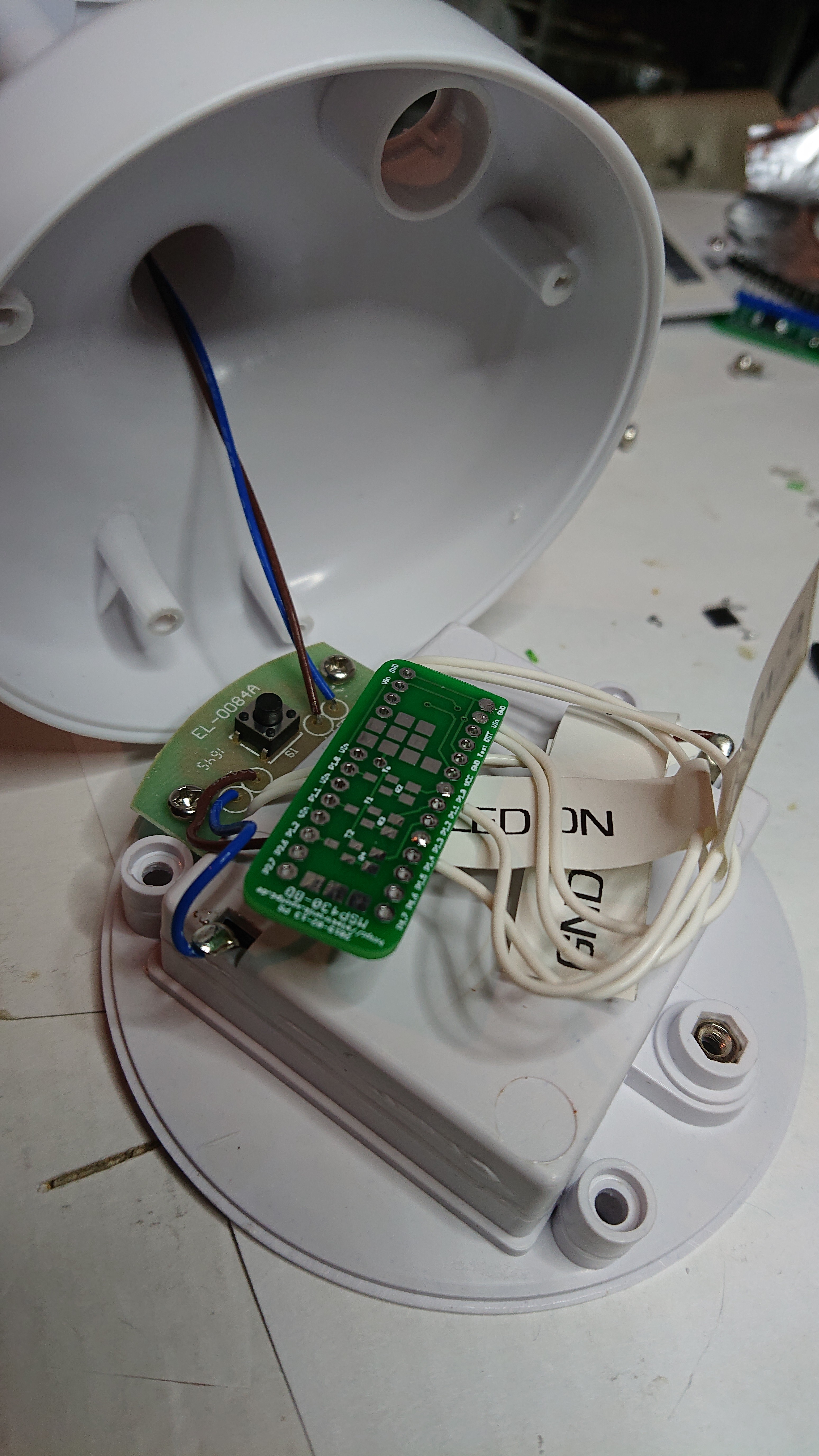
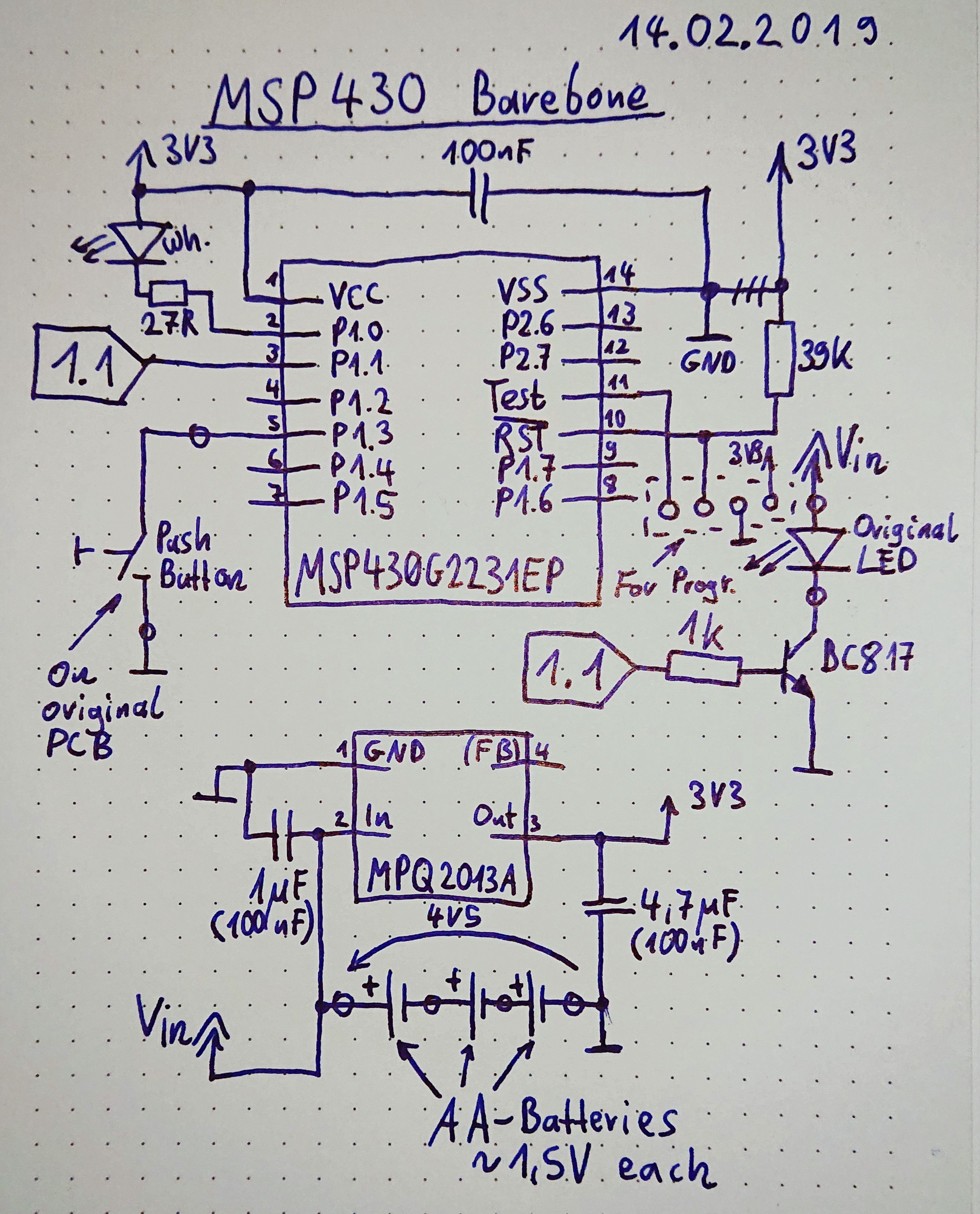
Here is a quick schematic (I added some circles on the attachement points to the lamp):
This circuit has a sleep current of ~ 4.5µA. (So i get hypothetically >60 years of Battery life. Since it is really likely, that the lamp might be on > 60h in the next 60 Years, it is a ok tradeoff (don't take the self discharge in account). The µC is capable of sleeping at ~ 0,5µA but the voltage regulator has a 3,3µA Quiscent Supply Current.
Here you can find a proof of concept (150x Speed):
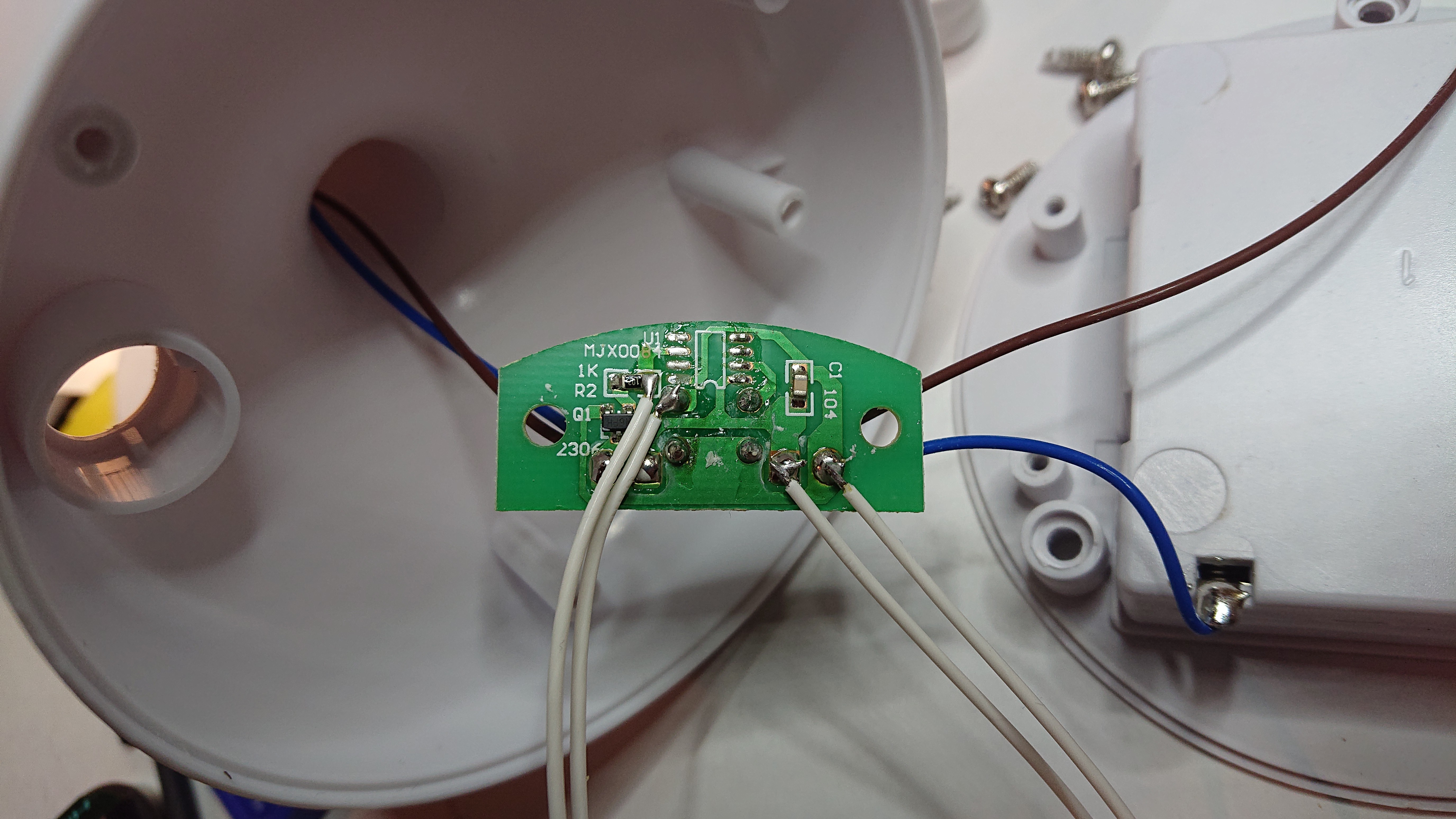
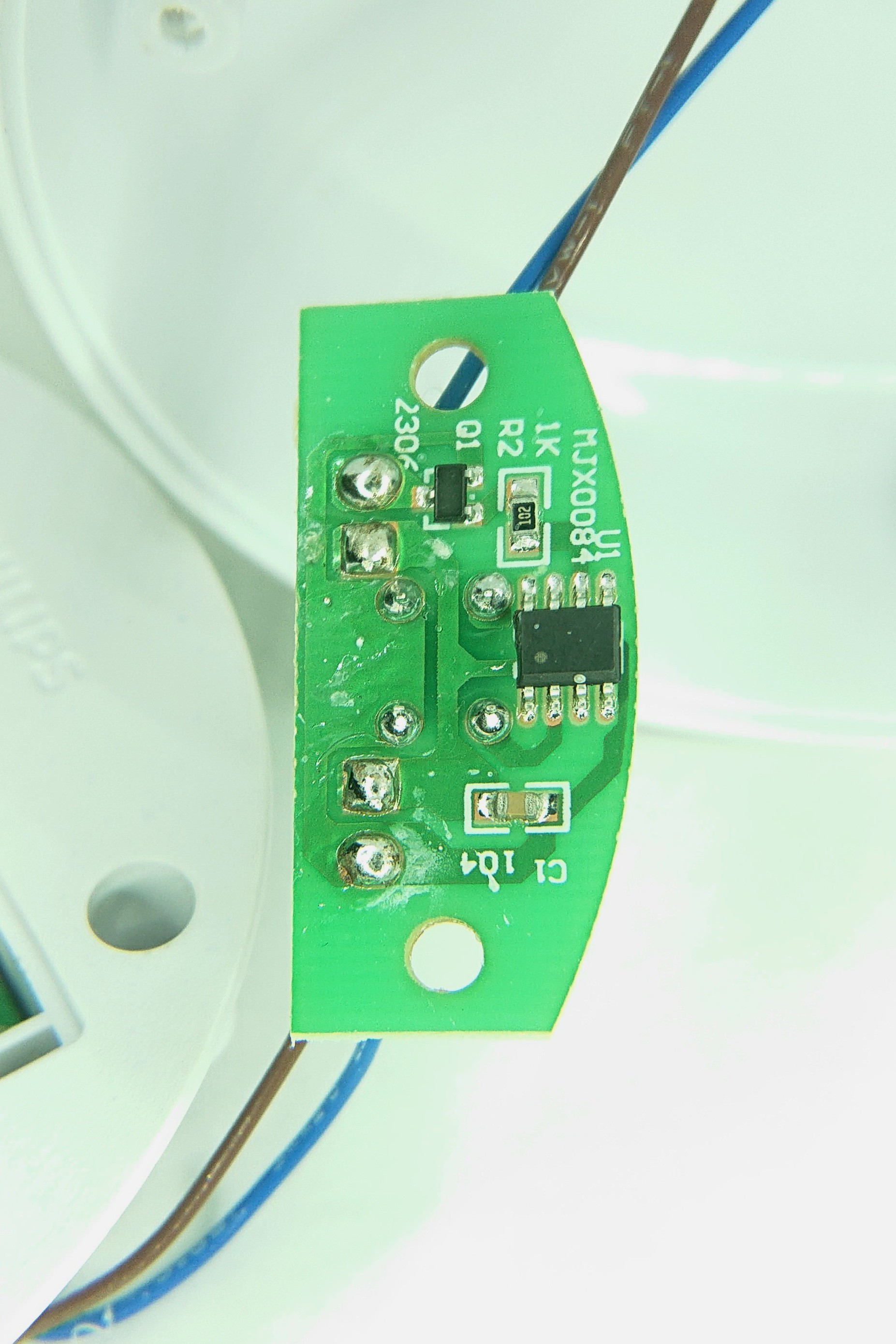
So the U1 is a "black box" there is AFAIK not much to do with the existing pcb.
The "Sleep Current" is about < 0,2µA @ 4,8V.
So there are some possible solutions:
Using of a physical On/Off Switch
Pro: Really Easy
Pro: Idle Power Consumption: ~0µA
Con: Hard to gain a WAF > 1.
Con: Outer Mechanics need to be Modified
Con: Low Nerd Cred
Using a CMOS circuit which toggles between On and Off
Pro: May be easy to store it inside the lamp socket
Pro: Its no black magic
Con: Medium Nerd Cred
Con: Power Consumption of > 8µA *.
Using a MSP430
Pro: High Nerd Cred
Pro: Easy programmable Features (Can be adjusted later easily..)
Pro: Can be made to turn on/off every Day
Pro: Can be Made to turn off after a programmed time
Pro: Can be extended to a general purpose pcb
Pro: The LED could be PWM dimmed
Con: Power Consumption in Power Save: ~8,5µA - 85µA* depending on Voltage
Con: Needs a 3.3V Voltage Regulator
* Maybe there would be a possibility to enable the Power only after press of the Button?.. if not it would definitely break the energy rating (Battery Life).
I'm still open for further Ideas. Please let me know in the comments.
Haha, I also came across the same problem, but used a simpler solution: a switch.
I also noticed that the LED sinks ~130mA, so I looked for other alternative powering methods: I added a micro USB port to the side.
I wanted to maintain the battery operation so I came up with a circuit which automatically switches between USB and battery powered operation without sacrificing power drop on diodes and accidental charging from battery.
I did it on a test board with wire soldering, and unfortunately I have not taken any pictures.
I only have an LTSpice simulation screenshot in the case if anyone is interested in the solution:
@Miklos Marton : Thank you for your comment. One restraint was to keep the Lamp unharmed on the outside ;-) But the micro USB port came also to my mind :-D
I also thought about chaining the lamps... but was also outside of scope ;-)
Haha, I also came across the same problem, but used a simpler solution: a switch.
I also noticed that the LED sinks ~130mA, so I looked for other alternative powering methods: I added a micro USB port to the side.
I wanted to maintain the battery operation so I came up with a circuit which automatically switches between USB and battery powered operation without sacrificing power drop on diodes and accidental charging from battery.
I did it on a test board with wire soldering, and unfortunately I have not taken any pictures.
I only have an LTSpice simulation screenshot in the case if anyone is interested in the solution:
https://i.imgur.com/3gC9Kxs.png