 Peabody1929
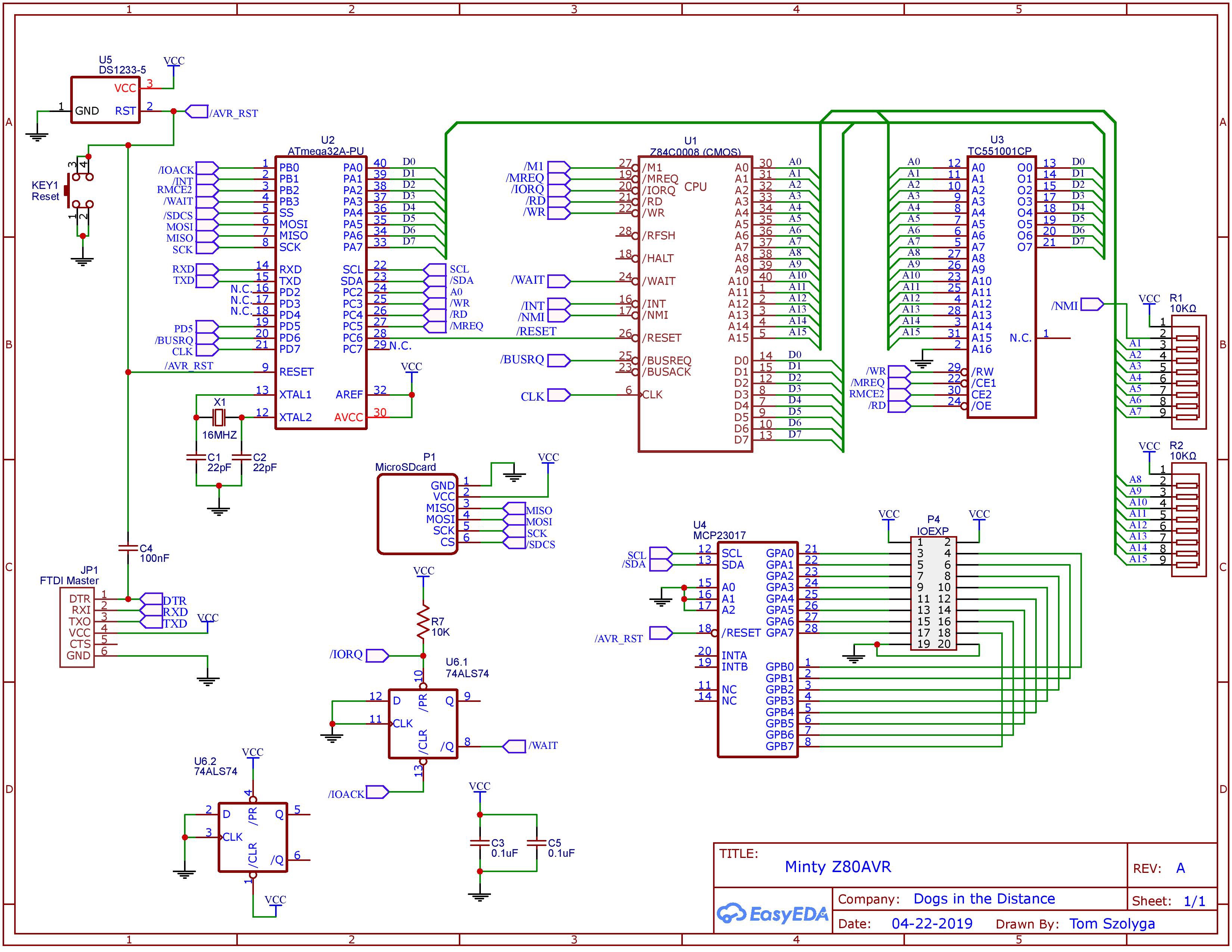
I have completed updated the schematic. The board went out to FAB today. I am using EasyEDA for schematic capture, board layout and PCB Fab. I will mark the project "Public" when it is stable.
Minty Z80 is a system with virtualized I/O and minimum component count in an Altoids Tin.
Already have an account? Log in.
To make the experience fit your profile, pick a username and tell us what interests you.

I have completed updated the schematic. The board went out to FAB today. I am using EasyEDA for schematic capture, board layout and PCB Fab. I will mark the project "Public" when it is stable.
- Finished new schematic, component placement and PCB routing.
- Board went to FAB


It appears that a ATmega1284P could be used instead of the ATmega32A and get more memory and a second serial port.
I imagine that there is enough RAM to store a disk image of a CP/M disk with a few files like MBASIC, ZORK, STARTREK, etc.
I have also been interested in a project like this one. I like that it fits in an Altoids Tin. I like the use of an ATMega to do all the I/O.
Will you be able implement Mode 2 interrupt support?
Will you attempt emulate CTC, SIO, disk controller chips will you simply implement your own interface with your own BIOS routines?
I was thinking that by using an AS6C4008 SRAM giving 8 banks of 64K. With some care, it would be possible to implement a multi-user system.
The ATmega vitrualizes all of the Z80 I/O space. The CP/M BIOS makes function calls to the ATmega firmware package. Floppy discs are not emulated as such. Instead, all discs are treated as hard discs and vitualized to directories on the SD card. For example, CP/M drive A: is mapped to directory A on the SD card. Disc reads and writes work on the corresponding SD card directory.

Cool project, I was also toying with the idea of how many chips exactly are needed for a most basic CP/M computer? Turns out essentially 3 - CPU, RAM, all the glue in Arduino. But I am not clear how does Arduino present to CP/M the floppy format from the SD card? Does it emulate some of the well known FDCs of the era (for example: https://www.smbaker.com/z80-retrocomputing-part-14-rc2014-floppy-controller-boards ) or some other way? It would be cool to add software components (and/or github links) too.
Hi! I working on a robotics project... Check it out! Do drop a like too :P
next fuzix computer