 Yann Guidon / YGDES
To implement on-the-fly MRU, it's simple:
- if A!=S then B <= A (and enable update) (else B)
- S goes to A.
That's it.
This takes precedence over the rest so adds a layer of MUX and some latency...
.
preliminary interactive playground here.
.
The added MUX layer is quite OK for the A output:
A <= S when MRU='1'
  else B when A=S
     else A;
Easy !
If MRU='1' then
  if A=S then
    B <= A;
  else
    B <= B;
  end if
else
  if ... then
    B <= newB;
  else
    B <= B;
  end if;
end if;
This "folding" else is not obvious to redesign. Ideally only a pair of MUX2 should exist.
And let's not forget the WB output.
Here is another temporary version.
.....
But I have finally found a trick by swapping the MUX, giving more time for the decoding logic and reducing redundancies. The current version is there:
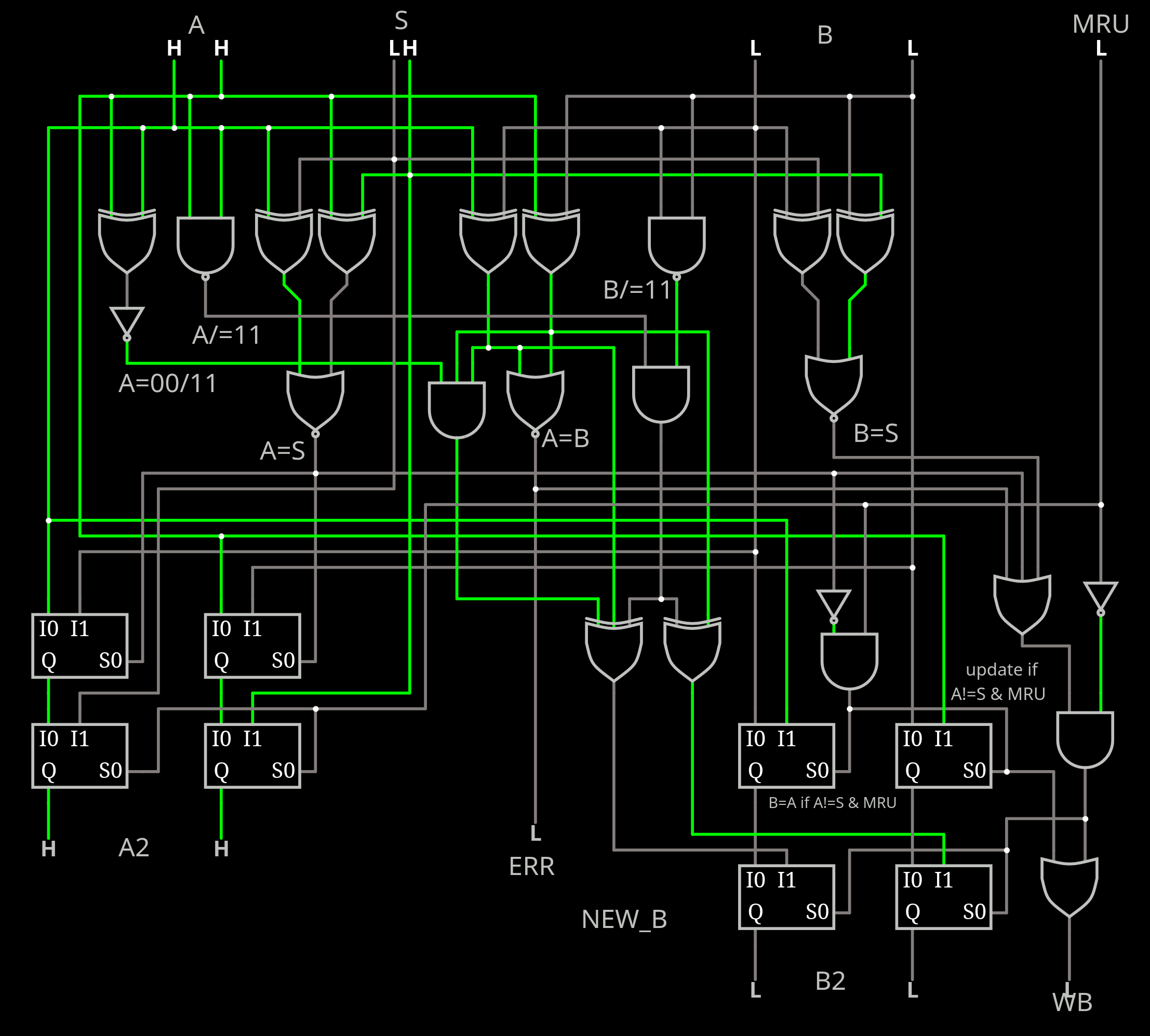
The logic depth is about 5 gates and it supports both LRU and MRU modes. The approximate number of CMOS gates is 30, though going down to NOR/NAND logic could bring some enhancements, by sharing inverters for example.
Can I consider the case closed ?
I don't think so because I'll have to transcribe it to VHDL and then stress-test it with simulated worloads.
That will come later :-P
Discussions
Become a Hackaday.io Member
Create an account to leave a comment. Already have an account? Log In.