 Jake Wachlin
MetaShunt V1 has been functional and available for a while now, and while it is still a wonderfully effective tool for examining the current consumption of a project across a wide range of operational modes, there were several improvements I wanted to make. This led me to develop MetaShunt V2! Thank you to my early customers on Tindie - your feedback and bug finding has helped make the original MetaShunt and now MetaShunt V2 that much better!
Goals and Updates of MetaShunt V2
MetaShunt V2 was developed to fix or improve a few key features of the original MetaShunt, as well as to add a key new feature:
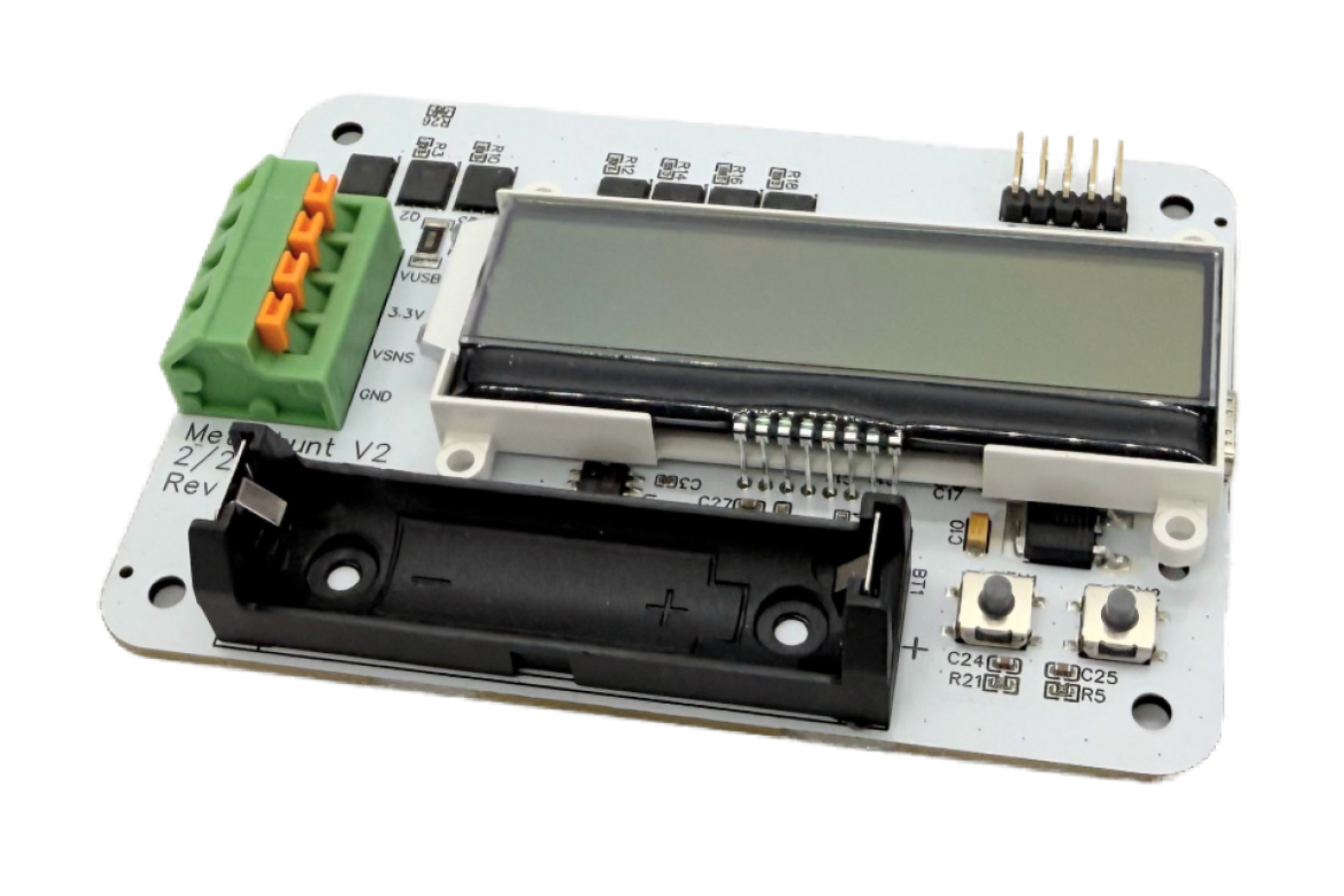
- The MetaShunt V2 LT Version can operate as a standalone unit, continually monitoring the total energy used by your product, project, or prototype.
- Once powered by USB, it continually measures current at the usual high rate and high accuracy used when streaming data to your computer over USB. At approximately 1Hz, it updates the onboard LCD display with the current *ahem* current, and displays the total on time in seconds and the total "current x time" in nAh, uAh, or mAh. Care is taken in the accumulation and math to ensure no overflow or underflow occurs across such a wide range of power levels.
- The accumulated data can be reset with the touch of a button.
- MetaShunt V2 provides a major step up in performance across the board.
- The internal sample/loop rate is nearly doubled to >700 kHz.
- The ADC resolution is 4X better, going from 12-bit to 14-bit.
- The burst measurements can be made 5X faster, and more data is saved during the burst read than could be before.
- The continuous data outputs are about 20% faster.
- The shunt MOSFETs have lower on-state resistance, leading to better accuracy.
- The gain stage has higher gain-bandwidth product, improving sensing bandwidth and reducing burden voltage.
- The calibration approach is very different.
- A fixed, high accuracy 50:1 amplification stage is used in the measurement path, so there are no resistors in the amplification stage that must be measured accurately and configured.
- High accuracy resistors are used in all shunt stages, to reduce the need for individual calibration of MetaShunt devices (although calibration can be performed to improve accuracy beyond a baseline).
- The physical form factor is improved.
- More care was taken on the aesthetics of the design, as well as making the outer dimensions and mounting holes fit a desired pattern. This makes it easier to incorporate into an enclosure or mount onto a test bench.
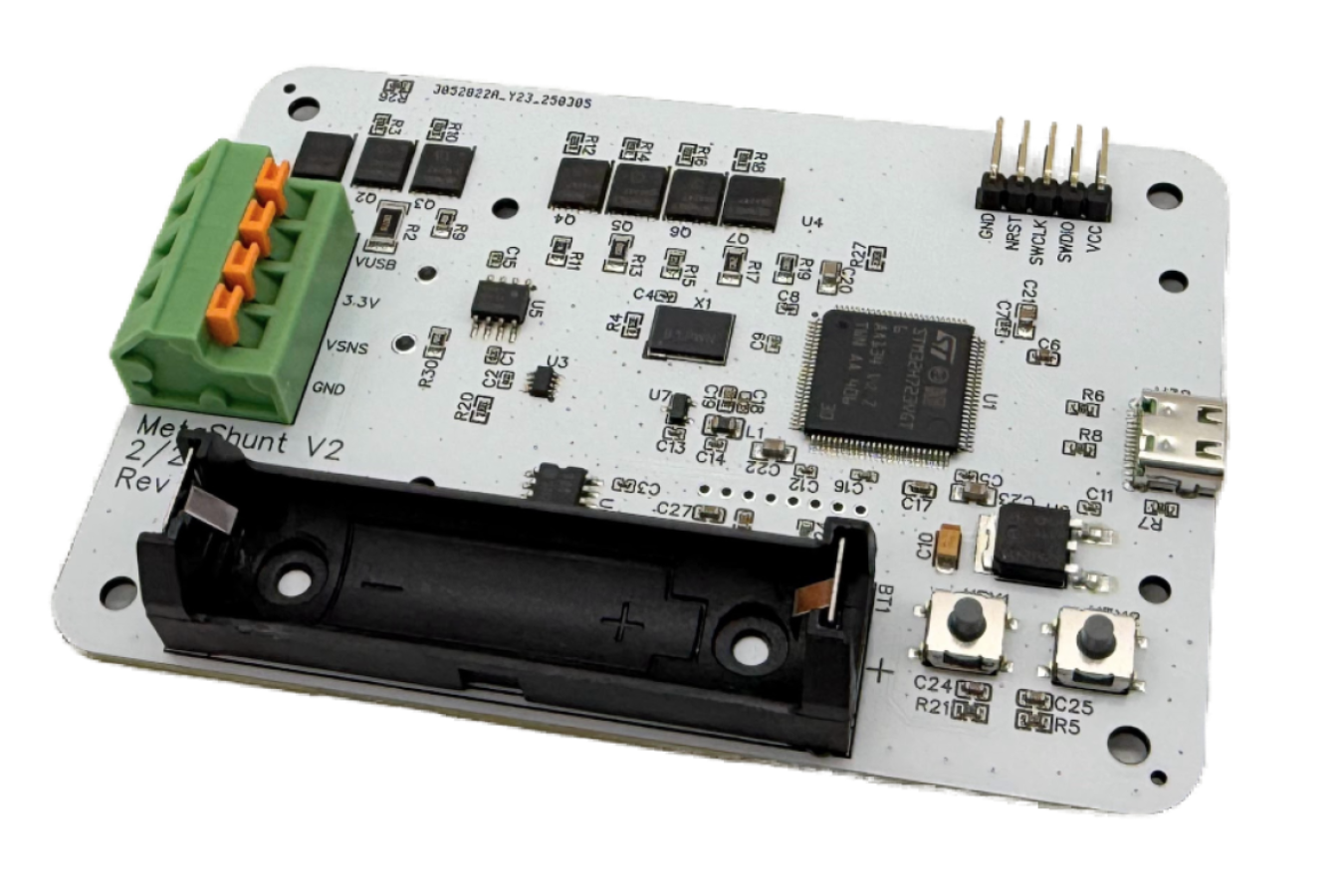
- The screw terminals are replaced by spring-pin terminals, enabling the user to swap in and out the DUT without tools.
- The programming pins are more accessible and labeled better.
- A button has been added which can be used to manually trigger burst measurements.
First Look at the Hardware
MetaShunt V2 LT is shown below, with its new LCD display. Note also the additions of spring-lock connectors for the DUT, an improved shape, and two buttons. One button is used to reset long term data and the other is used as a trigger for burst measurements.
The base version of MetaShunt V2 is shown below. It has all of the features of the original MetaShunt along with significantly improved performance.
Interface Updates
Updates have been made to the open source MetaShunt Interface on GitHub. MetaShunt V2 is mostly backwards compatible with the original interface, but some changes were needed to support new capabilities. Specifically, check out the new realtime interface at Realtime Interface/metashunt_v2_realtime_interface.py. Also, check out the V2 version of the user guide for updates on how to use MetaShunt V2.
Available Now!
MetaShunt V2 is available now on my Tindie store here! Thank you for all the support from this community!
Discussions
Become a Hackaday.io Member
Create an account to leave a comment. Already have an account? Log In.