 Jake Wachlin
I recently purchased a Nordic PPK-2 development kit in order to compare its performance with the MetaShunt V2 and the Otii Arc Pro. These three products compete but have very different price points, and each has its own unique feature set. The table below compares the three on high-level specs. All specs are accurate at the time of writing.
| Product | Price | Performance | Unique Features |
| Nordic PPK-2 | $89 | Up to 100 ksps output, 200nA-1A range | Highest continuous output data rate, digital input sampling, SMU capability |
| MetaShunt V2 | $199-$249 | Up to 6 ksps output continuous, 127 ksps burst, 50nA-1.5A range | Optional long-term computer-free coulomb counting, highest burst data rate |
| Otii Arc Pro | $949 | Up to 4 ksps, "nA to 5A" range | SMU capability, (paid) battery simulator, NIST traceable calibration |
Test Setup
The device under test was my ultra-low power development board, the Nanosleeper. Firmware was set up on the Nanosleeper to busy wait with the two onboard LEDs on for 2s, then busy wait for 1.5s with the LEDs off, then enter the STOP0 sleep mode for 5s, then enter the shutdown sleep mode for 5s. This cycle then repeats. Data was captured using each of the Nordic PPK-2, MetaShunt V2, and Otii Arc Pro, respectively. The data was output to CSVs, and then compared using the log comparison tools on the MetaShunt interface repo. Prior to testing, MetaShunt V2 went through its normal production calibration process, which actually only calibrates the high current ranges, and therefore did not effect this test. The Otii Arc Pro calibration process using the Otii 3 software was performed. The PPK-2 was not calibrated, since I was not able to find anything online about it or any way in their software to calibrate it. For each test, 3.3V was provided into the BAT pin on the Nanosleeper.
Results
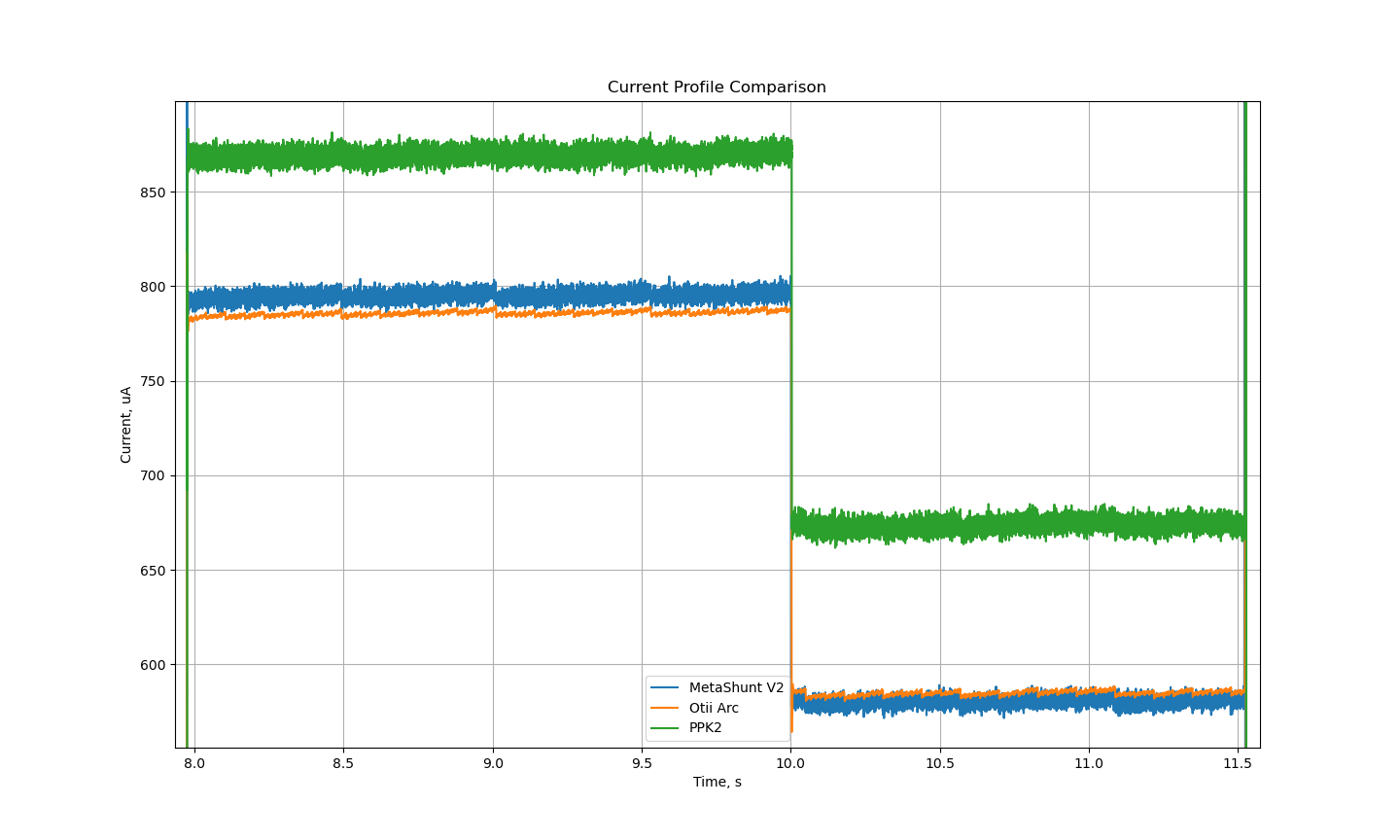
The plot below shows the measurements for the three tools on top of each other. Even in this zoomed out view, it can be seen that the Otii Arc and MetaShunt V2 agree closely at the higher currents. The plots at lower currents in the sleep modes appear to be on top of each other at this scale, so later plots will show the accuracy of those.

The plot below shows the measurements in the two higher power conditions. For reference, a cheap multimeter in ammeter mode measured the current as 787uA and 583uA, indicating that the Otii Arc and MetaShunt V2 measurements appear to be far more accurate than those from the PPK-2.
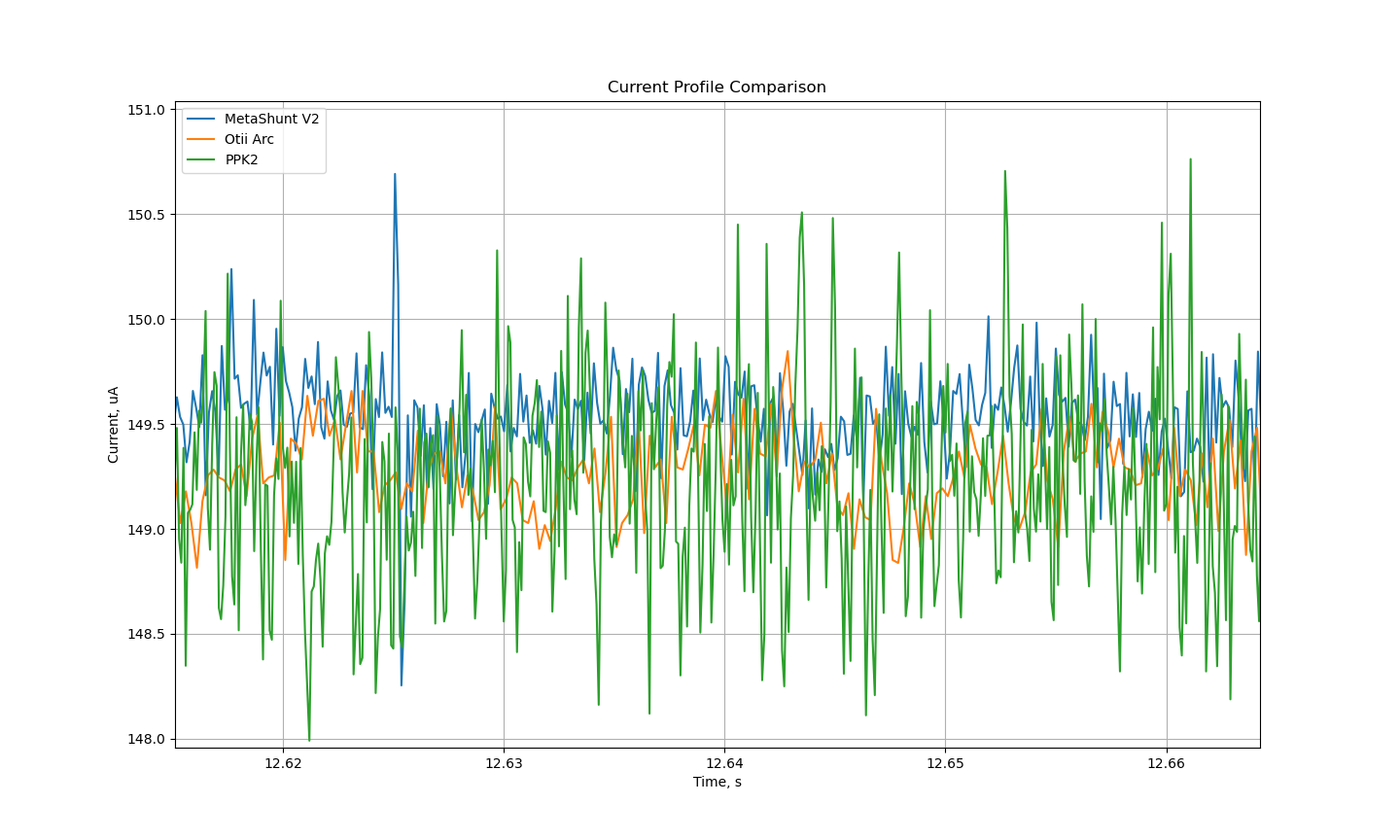
Interestingly, the current measured in the STOP0 sleep mode was very similar for all devices. The low-cost multimeter measured 146uA, for reference.
In the lowest power shutdown mode, I expect the current to be on average just below 100nA. This is below the spec of the PPK-2, but MetaShunt V2 and Otii Arc should be able to measure it. However, at this low current the noise level on the Otii Arc Pro nearly drowns out the signal.

The energy plot below shows the cumulative energy use over time. The Otii Arc and MetaShunt V2 lines track each other almost perfectly, while the PPK2 plot diverges fairly significantly. If using these tools to predict battery life, this would lead to significant uncertainty in expected lifespan of your device!

If we assume the NIST-traceable calibrated and ~5-10X more expensive Otii Arc Pro is the gold standard here, we see errors of the following:
| On, LEDs On | On, LEDs Off | |
| MetaShunt V2 Error | +1.2% | -0.8% |
| Nordic PPK-2 Error | +10.8% | +15.5% |
Conclusion
The Nordic PPK-2, MetaShunt V2, and Otii Arc Pro are all useful tools in low power and battery powered systems development and testing. They come in a range of price points from $89 to $949, and while they have a varied feature set, all three focus on a core capability of measuring current across a very high dynamic range. The MetaShunt V2 performed within about 1% of the accuracy of the Otii Arc Pro at about 1/5th the cost. The Nordic PPK-2 was the lowest cost tool of the three, but had poor accuracy (up to 15.5% measurement error) that would limit its usefulness in practice.
Discussions
Become a Hackaday.io Member
Create an account to leave a comment. Already have an account? Log In.