mihai.cuciuc
-
Circuit two – microphone amplifier
04/06/2024 at 05:21 • 0 comments![]()
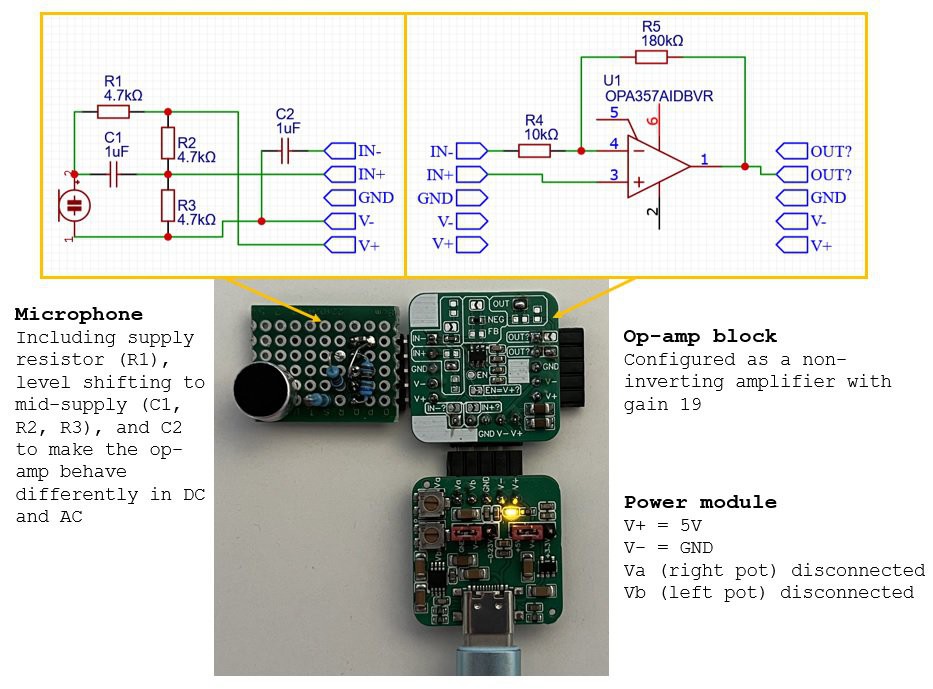
An electret microphone fed from 5V will supply a signal on the order of 100mV. To boost it up to a few volts (to feed it into an Arduino, for example) it needs amplification. We can do that with the op-amp block.
The microphone board contains the circuitry to generate a signal centered around 2.5V and also capacitor C2 which decouples the op-amp feedback network (R5 and R4) from V-. This makes the op-amp behave like a voltage follower at DC (R4 disconnected from V-) and as an amplifier with gain 19 at AC. So, it will amplify the audio waveform, but not the 2.5V that it rides on.
![]()
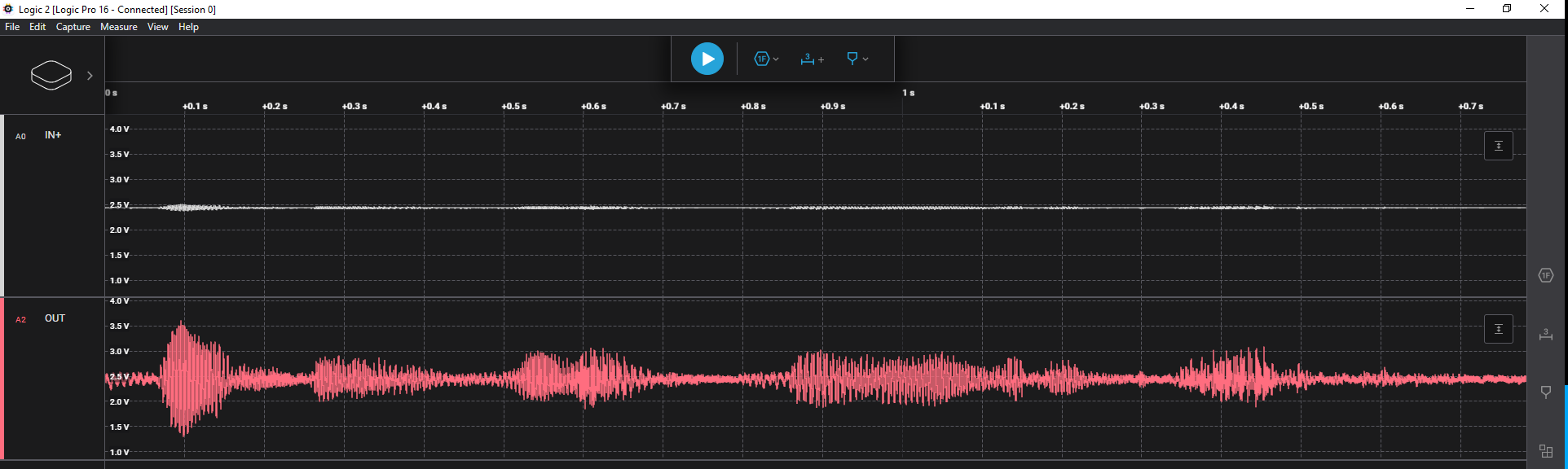
Top trace is microphone output and bottom one is op-amp output.
-
Circuit one – comparator
04/02/2024 at 04:35 • 0 comments![]()
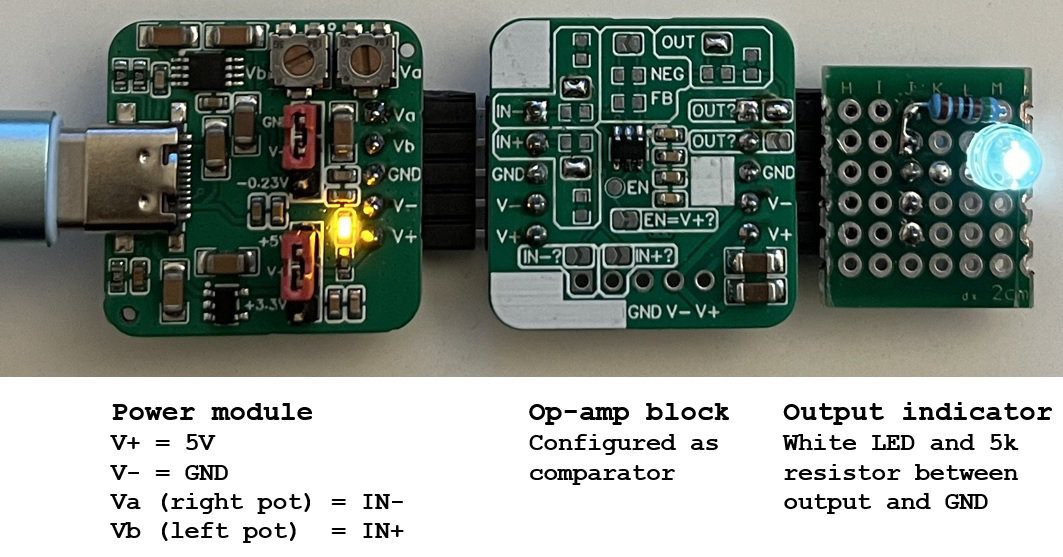
The huge open-loop gain of op-amps (at least one billion in the case of the OPA357) makes them virtually unusable as amplifiers without some form of feedback network to lower the gain to a reasonable and predictable value. There is one exception where are used in open-loop mode, and that is as comparators. Any minute difference between IN+ and IN- gets amplified so much that it saturates the output either close to the positive rail or to the negative one.