 Leonardo
Hi everyone!
It’s been a long two years since my last update. Between university and work, this project stayed on the shelf, but I’ve learned a ton of new engineering and maker skills in the meantime. Recently, I looked back at my radio telescope and realized that with what I know now, I could build something way better than my old setup.
The first thing I did was actually measure that old CanAntenna feed you see in my previous logs. Back then, I just followed the theoretical dimensions and hoped for the best because I didn't have the tools to test it. Well, I finally hooked it up to a VNA and found out it was barely tuned at all. I had an S11 of only -5dB at 1421MHz. In plain English, the feed was basically "deaf" to the Hydrogen Line. No wonder my 1.2m dish wasn't performing like it should have.
So, I decided to start from scratch and build a Biquad antenna. I chose this design because it’s not crazy complicated to build, it performs better than a simple dipole, and it’s a much better symmetric illuminator for my parabolic dish. I also used it as an excuse to learn how to simulate antennas in MatLab. I have to tell you though, the simulation only gave me a rough starting point. In the real world, almost every dimension changed. Simulations usually assume ideal conditions with air, vacuum, and materials that just don't exist in a garage.
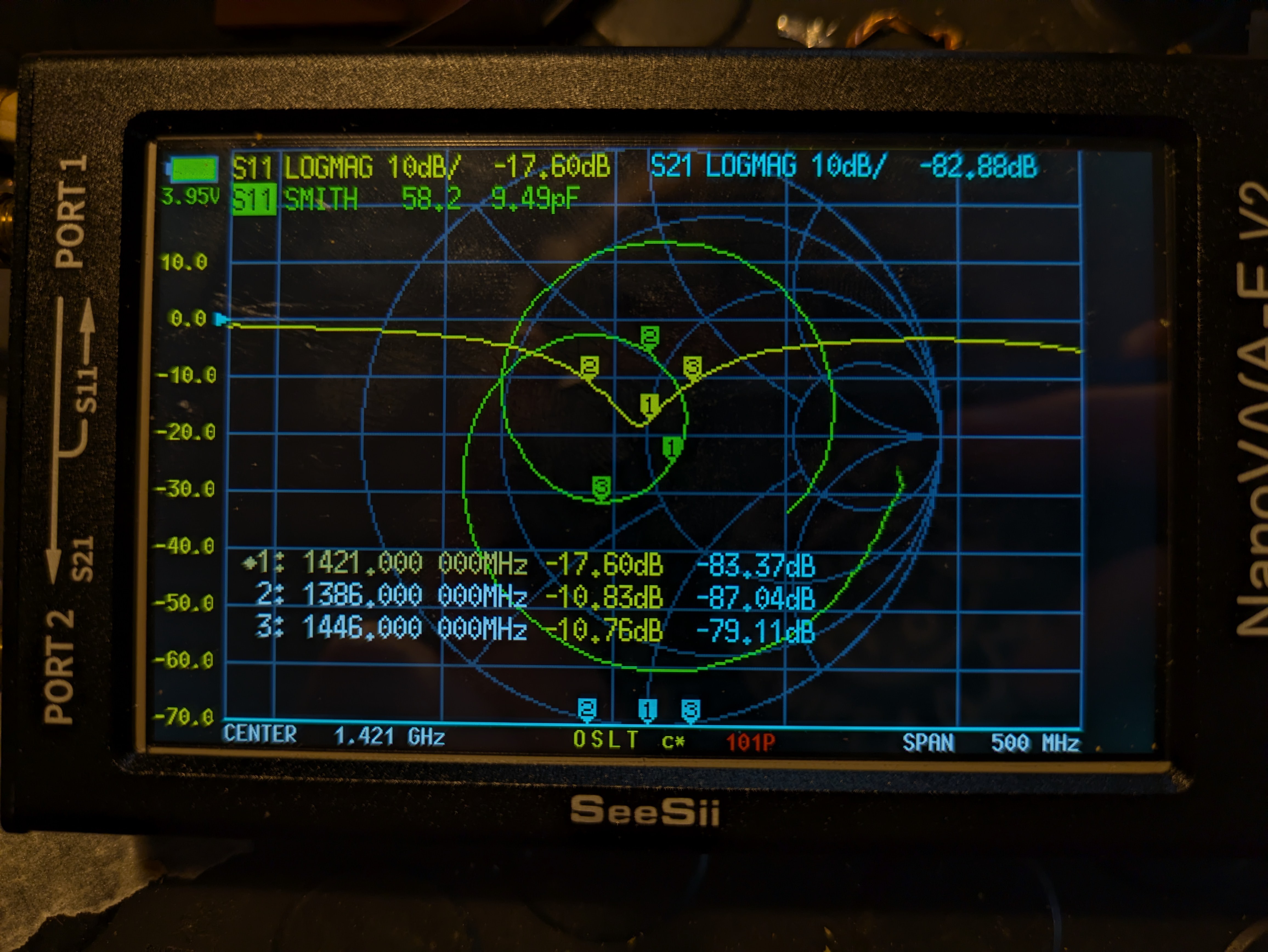
I ended up building at least six different versions of this Biquad before I finally hit the right resonance frequency. It was a total grind. Some were too long, some were too short, and every time I adjusted the distance from the reflector plate, it threw the resonance off again. This whole manual, experimental process was only possible thanks to a NanoVNA. Without a tool like that for spectrum analysis, you’re just guessing. I learned that the hard way with my first antenna.
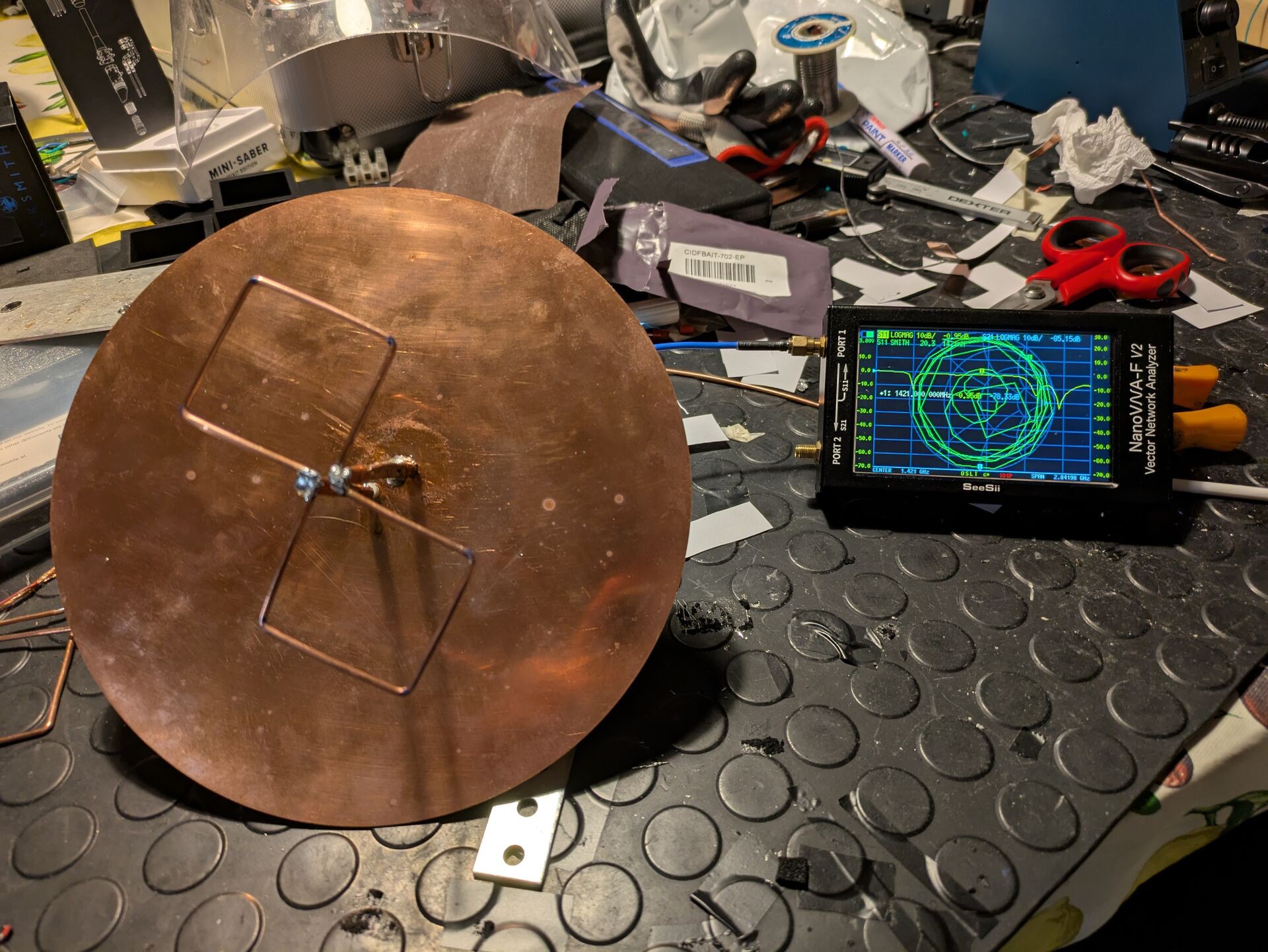
Once I finally got the Biquad resonant at 1420MHz, I added a small microwave circuit on the back. It’s just a strip of copper acting as an impedance transformer to get the antenna to 50 ohms. This makes a massive difference because it stops signal reflections caused by impedance mismatch, meaning more signal actually makes it into the system.
PRACTICAL CONSIDERATIONS
If you're thinking of building one of these, here is my advice from the trenches. I started with the theoretical square shapes and just kept rebuilding them bigger or smaller depending on if the frequency was too high or too low.
Don't underestimate the distance between the Biquad and the reflector plate; moving it even a tiny bit changes the entire behavior of the antenna.
Also, don't bother 3D printing jigs to bend the copper wire perfectly. I tried that at first, but since I had to make so many versions, it was a waste of time. A simple ruler and some pliers work just fine if you're patient.
Discussions
Become a Hackaday.io Member
Create an account to leave a comment. Already have an account? Log In.