 Yann Guidon / YGDES
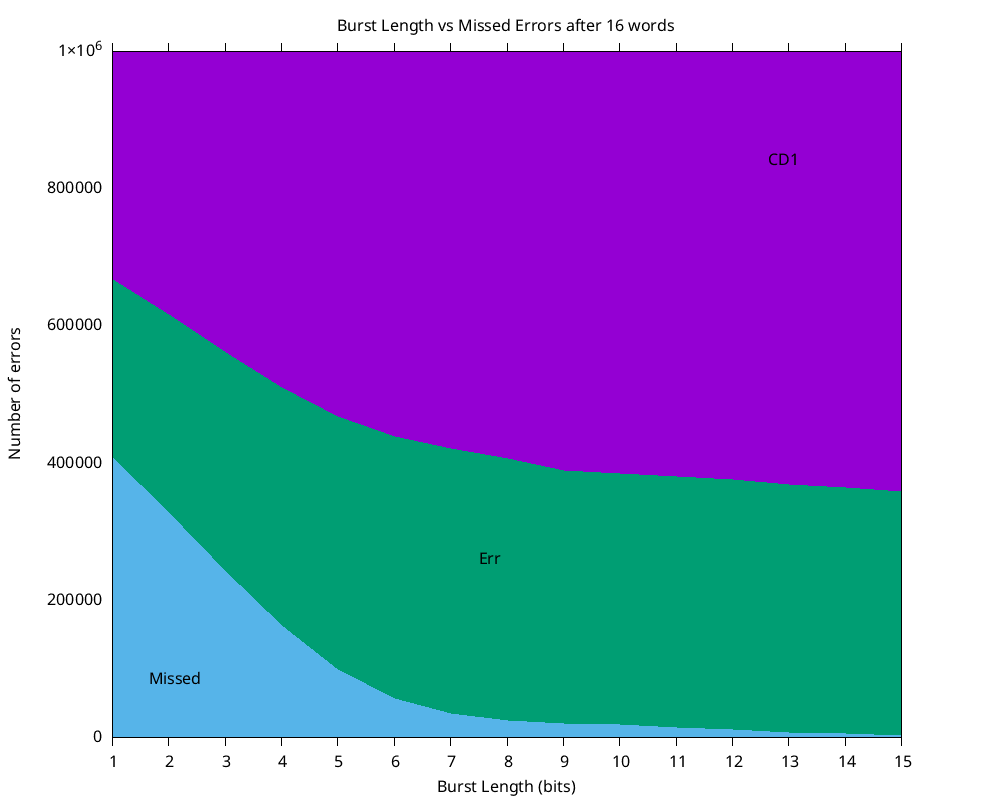
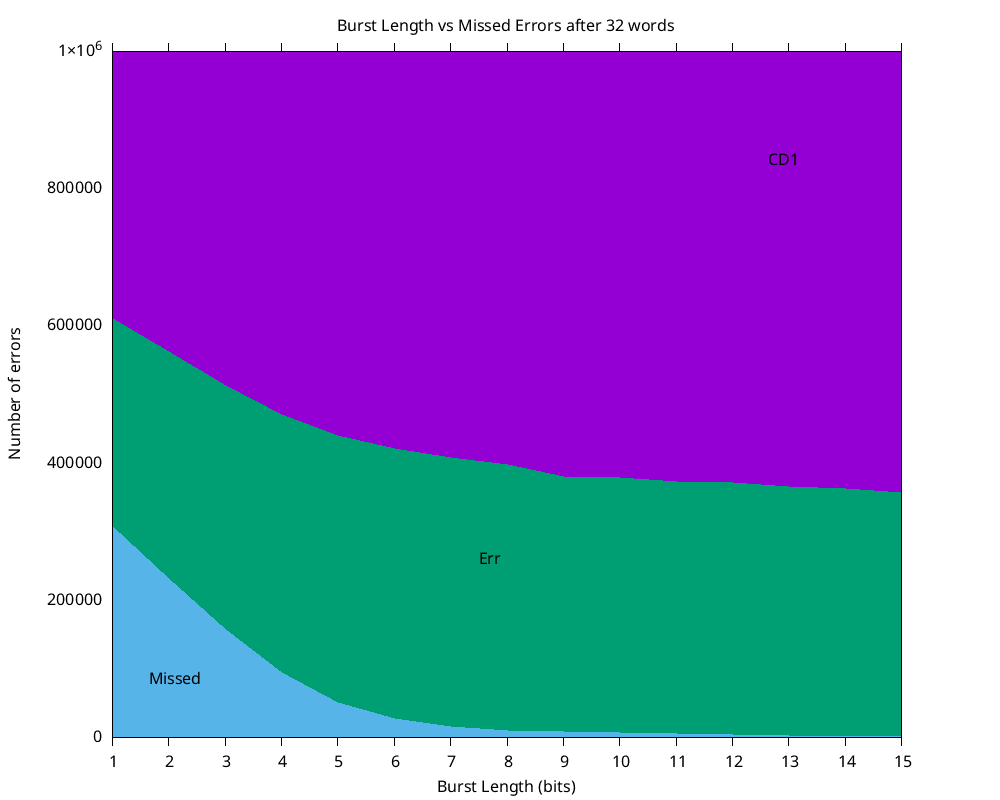
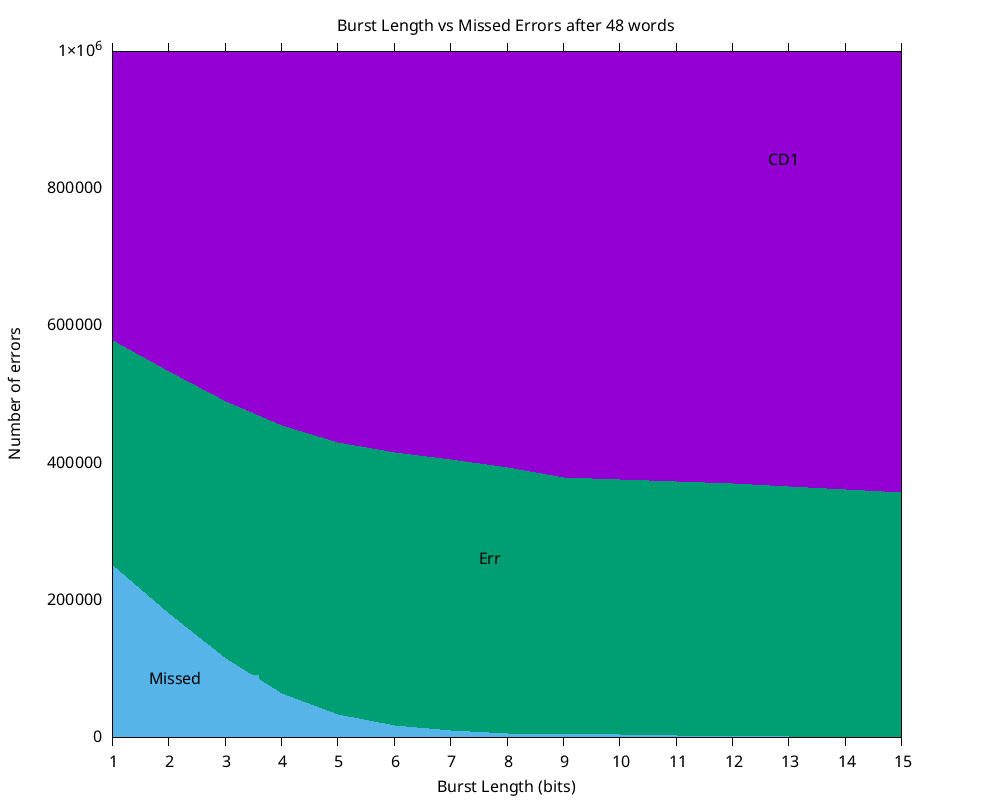
I fixed the signal generators (data as well as fault), with a better PRNG. The curves are smoothed but the major problem remains: the rate of missed errors after 16, 32 or 48 words is still unbelievable.
After 16 words:
After 32 words:
After 48 words:
Many conclusions can be drawn:
- The ratio of missed errors depends heavily on the number of affected bits: the more the better. But even with all the efforts, the performance is not great and this is a mystery. The missed errors can be as high as 25 to 40% (for 1 bit) => ratio of 1/2.5 to 1/4, but even with most bits swapped, the error rate is about 1/100...
A lot of discussions will come. - The ratio of CD1 vs Err (error from the CD bit vs errors detected by the modulus) remains roughly 2:1, converging to approx. 66% vs 33%. The C/D bit is clearly a major driver of error detection.
- The CD0 errors (where by miracle, the CD turns to 1 but the first 16-bit word is valid=0) remain few, pretty stable, falling slowly. This is the type of error ratio I expected, and the 0-overhead is kept low, the 2nd check word (to get full 36-bit checksum) is added at the protocol level in the end of the Control sequence. So actually the 0-word covers 2 consecutive message types.
- The big variable that affects the missed ratio is the number of invalid bits => this puts pressure on the GreyPar circuits, which would also include aspects of ParPop to increase avalanche. Errors should affect at least 8 bits, the Hamming distance must be maximised.
- Really: the depth of the buffer has a pretty small effect on the error misses, compared to the number of flipped bits.
...
Stats for 16 loops:
bits  CD0     CD1     Err  Missed
  1    39  332079  259138  408744
  2    29  383135  288954  327882
  3    30  438323  319817  241830
  4    29  489391  347593  162987
  5    20  531425  369363   99192
  6    23  561524  381666   56787
  7    24  579368  385955   34653
  8    18  592796  382114   25072
  9    10  610942  368068   20980
 10    19  614852  366836   18293
 11    22  619874  365386   14718
 12    17  624048  364910   11025
 13    22  631186  361004    7788
 14    16  635755  359142    5087
 15    14  642032  354627    3327
.
For 32 loops:
  1  53  389515  302662  307770
  2  48  437467  330242  232243
  3  45  486295  356146  157514
  4  24  528756  376952   94268
  5  25  559156  389902   50917
  6  24  579121  393798   27057
  7  22  591900  392525   15553
  8  16  602327  387123   10534
  9  15  618858  372582    8545
 10  16  621701  371270    7013
 11  14  626560  368182    5244
 12  15  628185  368048    3752
 13  15  633763  363982    2240
 14  20  637123  361492    1365
 15  16  642805  356398     781
.
For 48 loops:
  1  72  421096  327935  250897
  2  54  466379  352575  180992
  3  50  509896  374730  115324
  4  25  545602  390146   64227
  5  28  569483  397240   33249
  6  26  584830  397991   17153
  7  21  595248  395133    9598
  8  21  605975  387822    6182
  9  22  621211  373927    4840
 10  15  623979  372117    3889
 11  24  626966  370253    2757
 12  10  629013  369103    1874
 13  21  634440  364573     966
 14  21  637976  361422     581
 15  14  643278  356416     292
.
One notable increase is the number of CD0 (39 - 53 - 72), as there are more opportunities of generating bad data. This is easily filtered by a second check word.
Discussions
Become a Hackaday.io Member
Create an account to leave a comment. Already have an account? Log In.