 Yann Guidon / YGDES
It didn't go as expected.
The comparator doesn't use NAND/NOR because it actually makes it larger and/or bigger, and what matters is the critical path along the cascade. Fortunately A21OI is here and helps! the 4 gates are not in the critical datapath so over-optimising for speed is less interesting than optimising for area.
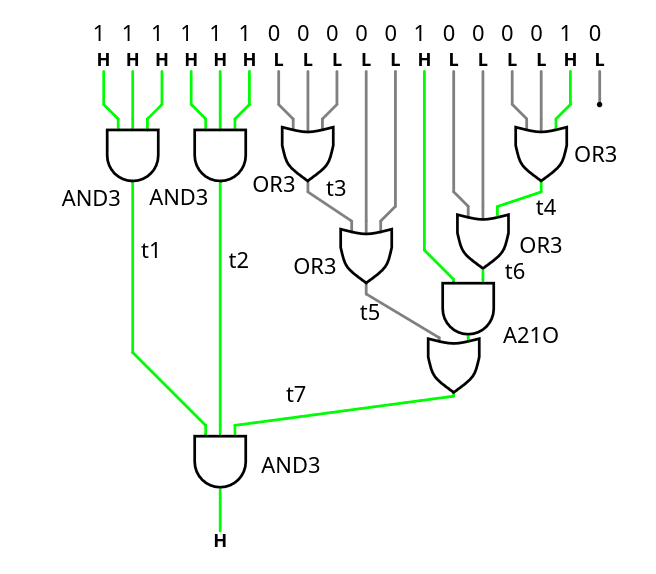
The tested source code is there : https://github.com/YannGuidon/miniMAC_tx/blob/main/src/gPEAC18.v
/* This module compares a 18-bit number to the modulus.
   Compare a bitvector with the constant 258114 = 0x3F042 = 111111000001000010
   Any number equal or above raises X */
module Compare_modulus(
    input wire [17:0] A,
    input wire En,
    output wire X
);
  wire t1, t2, t3, t4, t5, t6, t7, _unused;
  assign _unused = A[0]; // The LSB has no effect.
  // first layer
  (* keep *) sg13g2_and4_1 L1a3_1(.X(t1), .A(A[17]), .B(A[16]), .C(A[15]), .D(En));
  (* keep *) sg13g2_and3_1 L1a3_2(.X(t2), .A(A[14]), .B(A[13]), .C(A[12]));
  (* keep *) sg13g2_or3_1  L1o3_1(.X(t3), .A(A[11]), .B(A[10]), .C(A[ 9]));
  (* keep *) sg13g2_or3_1  L1o3_2(.X(t4), .A(A[ 3]), .B(A[ 2]), .C(A[ 1]));
  // 2nd layer
  (* keep *) sg13g2_or3_1  L2o3_3(.X(t5), .A(t3),    .B(A[ 8]), .C(A[ 7]));
  (* keep *) sg13g2_or3_1  L2o3_4(.X(t6), .A(t4),    .B(A[ 5]), .C(A[ 4]));
  // 3rd layer
  (* keep *) sg13g2_a21o_2 L3ao_1(.X(t7), .A1(t6),   .A2(A[6]), .B1(t5));
  // Last stage
  (* keep *) sg13g2_and3_1 L4a3_3(.X( X), .A(t1),    .B(t2),    .C(t7));
endmodule
.
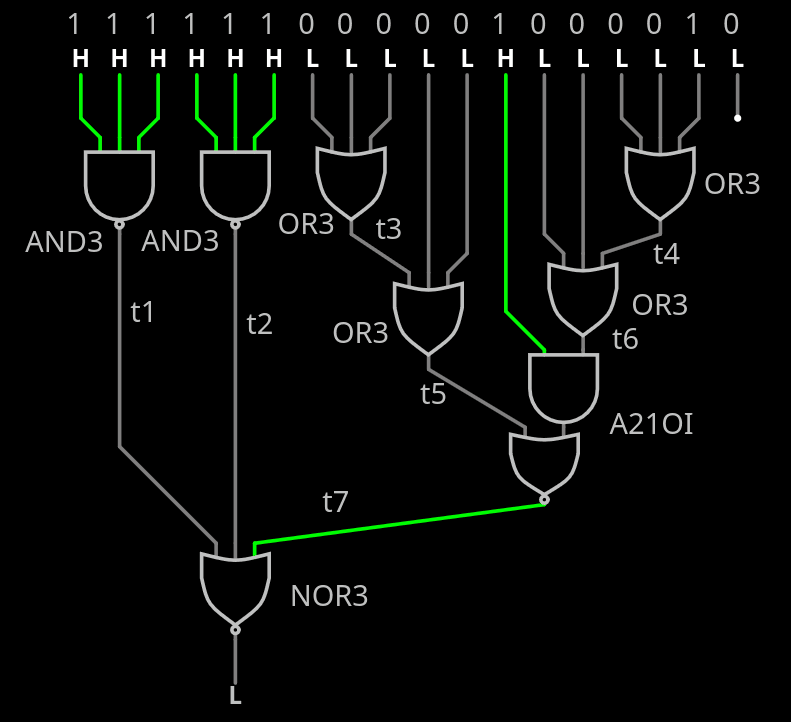
I just realised I could do some bubble-pushing and shave a bit...
The A21O can be turned into A21OI then feed to the AND3 turned into NOR3.
The other AND3s are turned to NAND3s.
.
Discussions
Become a Hackaday.io Member
Create an account to leave a comment. Already have an account? Log In.