Zachary Murtishi
-
Update: received PCBs
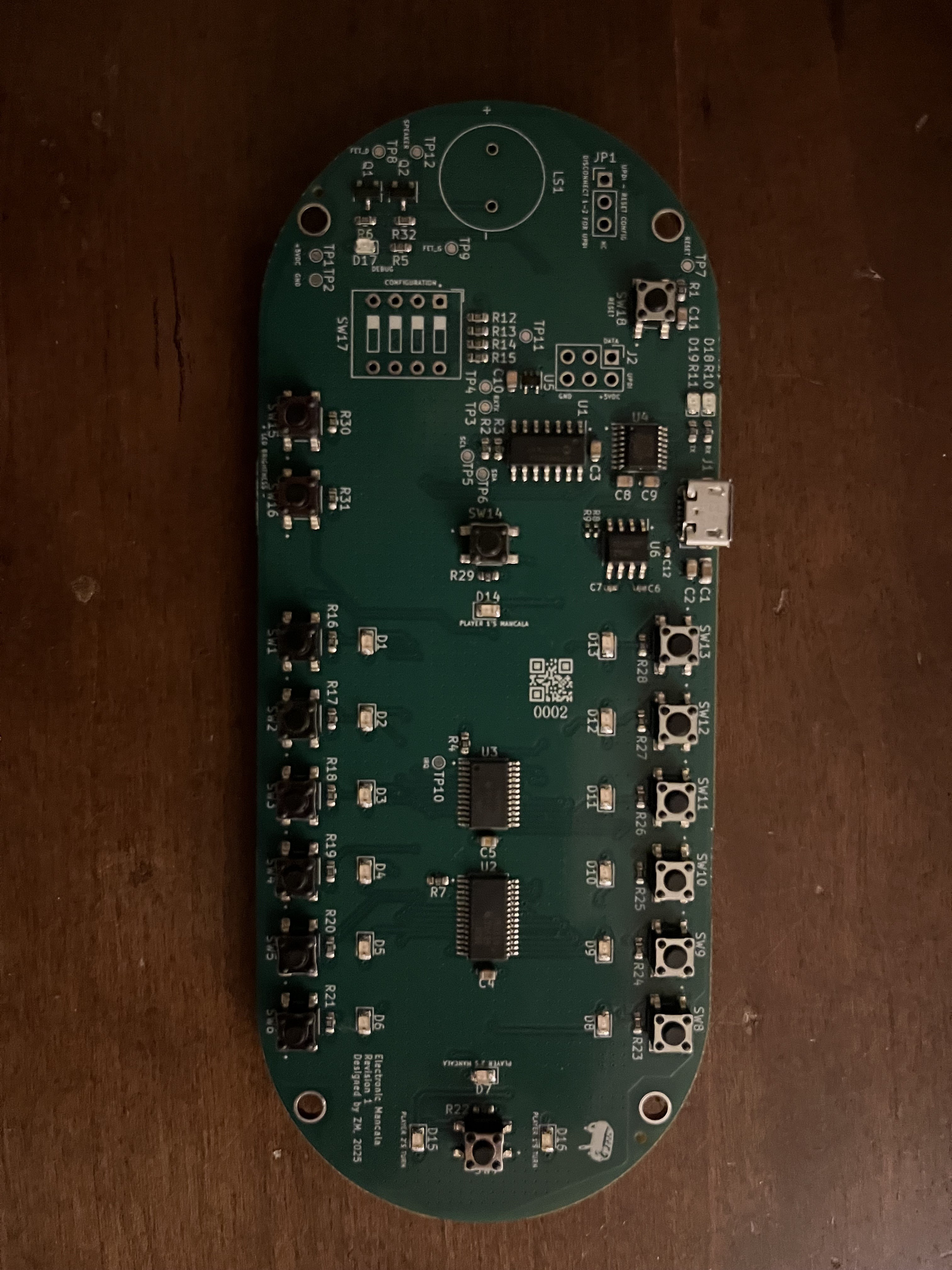
01/22/2025 at 00:00 • 0 commentsI've received the PCBs and I'm pleased with the product. So far, everything appears to function. I'm able to detect the FT230X from my ThinkPad and my PICkit 5 can detect the ATtiny3224 through UPDI using MPLAB IPE. I'll start development on the software when I decide that it's a good time to go through the PIC18 code for the original mancala board and port it to this application.
![]()
-
Update: Schematic finalized
01/08/2025 at 01:10 • 0 commentsAfter checking product availability, I made some changes to the schematic:
- The MCU is now an ATtiny3224. I don't need a lot of GPIO as I am using I2C components to interface with the buttons and LEDs.
- I've added a piezo and a 2N7002 driver FET for sound effects. I'm going to allow this to be disabled through a rocker switch
- I've switched the CP2102 to a FT230X. I tend to prefer FTDI's product portfolio and application notes.
- After some consideration, I've decided to switch everything to run off of 5V (as all chips on this board are 5V-compatible).
- As a result, I've had to add a 74AHCT1G125 buffer as a level shifter to ensure that the 3.3V UART output from the FT230X can be read by the ATtiny (the ATtiny's Vih is 3.5V @ 5V, which requires level shifting).
- I've decided to remove the graphic display from the design. I thought it would take away from the goal of the game - to be a simplistic version of electronic mancala.
-
Update: MCU change
01/05/2025 at 22:00 • 0 commentsI decided to downgrade the MCU for this project from a SAM device to an ATtiny3217. I realized I wouldn't need all that much computing power for my effort - after all, I plan on using I2C devices for I/O (buttons, LED, etc.) anyway, so I don't really need a crazy fast CPU.
Still working on the PCB design for this effort. I'm throwing in a SiLabs CP2102 USB-to-UART bridge to allow for some real-time debugging as the ATtiny3217 does not have native USB support.
Electronic Mancala++
Updated version of my Electronic Mancala Board that uses a ATtiny3224 microcontroller