 Tony Francis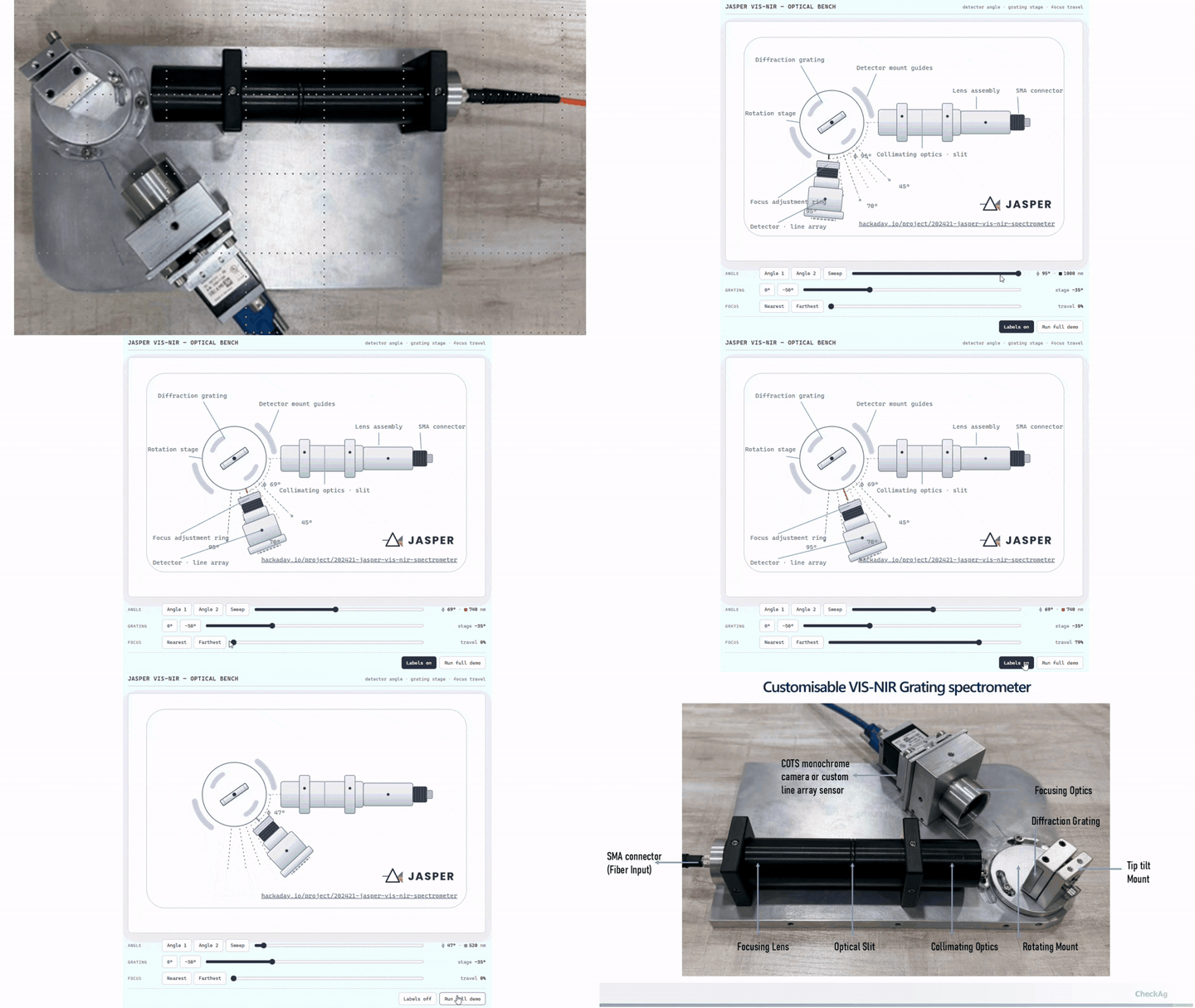
Most VIS-NIR spectrometers designed for specific applications require fine customization of spectral span, optical resolution, or Signal-to-Noise Ratio (SNR).
For instance, the Zemax spectrometer design guide highlights a system tailored for Optical Coherence Tomography (OCT) in retinal imaging. That specific application demands a narrow 50nm bandwidth (855 nm to 905 nm) optimized for deep, non-invasive imaging within the near-infrared biological window.
However, standard optical simulation software (such as Ansys Zemax OpticStudio) often falls short when modeling physical diffraction efficiency curves, real-world blaze angles, and practical mounting tolerances. For researchers, optical engineers, and hardware builders, having a physical, reconfigurable benchtop setup is indispensable.
We are building a truly customizable, open-source optical benchtop for reflective-grating spectrometers that allows you to easily swap and tune key hardware parameters:
- Slit Sizing: Interchangeable mechanical slits to balance optical throughput against spectral resolution.
- Optics Selection: Modular lens mounts to evaluate different collimating and focusing focal lengths.
- Grating Geometry: Independently adjustable incident (α) and diffracted (β) angles to test custom blaze conditions and spectral dispersion profiles.
- Sensor Versatility: Flexible detector positioning to evaluate COTS camera modules or specialized high-speed linear CCD/CMOS array sensors.
To help refine the optical layout and clear aperture tolerances for the JASPER VIS-NIR Spectrometer, we built a lightweight, interactive simulator that models our optical bench mechanics directly in the browser!
You can try out the live tool here:
https://checkag.github.io/jasper-bench-sim/
What the Simulator Models
When designing compact Czerny-Turner or transmission-grating VIS-NIR optical benches, balancing detector arm placement against grating rotation is always a trade-off between spectral range and focus depth.
This simulator lets you interactively adjust and test:
- Detector Angle (Φ): Sweep the detector arm continuously from 45° to 95° across reference markers to see the central wavelength (λ) shift across the line array.
- Grating Rotation Stage: Rotate the primary diffraction grating stage (0° to 50°) independently of the detector arm.
- Focus Travel Calibration: Slide the sensor along its own optical axis (0% to 100% travel) to evaluate focal distance tweaks relative to the focusing optics.
- Real-time Ray Tracing: Visualizes how the diffracted spectral band maps across the active sensor plane.
Built for Open-Source Transparency
Rather than relying on heavy desktop CAD packages or proprietary optical simulation software for quick spatial checks, we built this tool with pure, self-contained HTML5, CSS, and inline SVG. It requires zero external assets or dependencies, making it instantly scannable and accessible on desktop or mobile.
Feel free to run the "Run full demo" loop on the page to see the automated mechanical sweep sequence in action, or turn off labels for a clean visual view!
The repository is fully open-source under the MIT license:
📁 GitHub Repo: checkag/jasper-bench-sim
Give it a try and let us know your thoughts on the mechanical geometry
Discussions
Become a Hackaday.io Member
Create an account to leave a comment. Already have an account? Log In.