 Steph
StephWhile many objects at the Vintage Computer Festival are valuable collectors items, the vintage electronics in our home tend to be durable workhorses that we bring home intending to use with regularity. I'm fortunate to live in Los Angeles, where a great quantity of odd items originating from places like the aerospace, film, and tech industries flow constantly through the second hand markets and into the hands of oddballs like me. The downside being that these objects don't come to me in any particular order. Sometimes I have to acquire an appealing, but useless, item on the basis that I will probably think of a compelling use for it, someday.
Camera
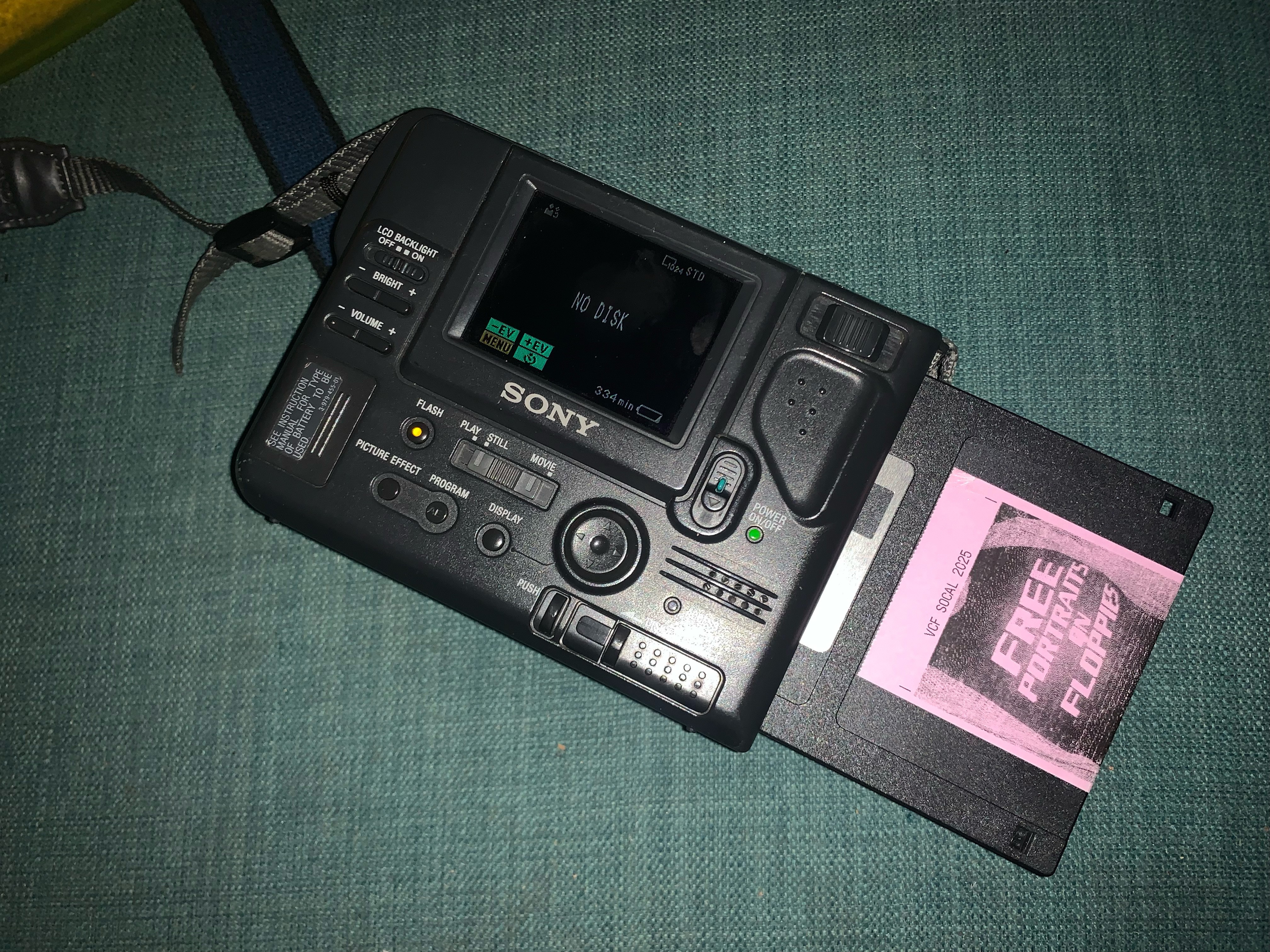
Such was the case with the Sony Mavica floppy camera used in this project, which came to us around 2022-ish. It was sitting very forlornly at a flea market for five bucks, and at the time I didn't know what I would use it for, just that it gave me a sense of nostalgia, and that I would almost certainly find a use for it eventually. The camera looked to be in good condition, but I did need to buy new lithuim batteries (AND a charger for them) in order to test it. It powered on like it was 1998 again, we took a few pictures, and then put it on a shelf.
Printer
The cute bluetooth PeriPage thermal printer which makes the labels came from a Savers thrift store outside Pasadena, and, like the camera, we've had it for some years now. Unlike the camera, we use that printer all the time. We already had all the sticky label paper we'd need, left over from other projects.
Computer
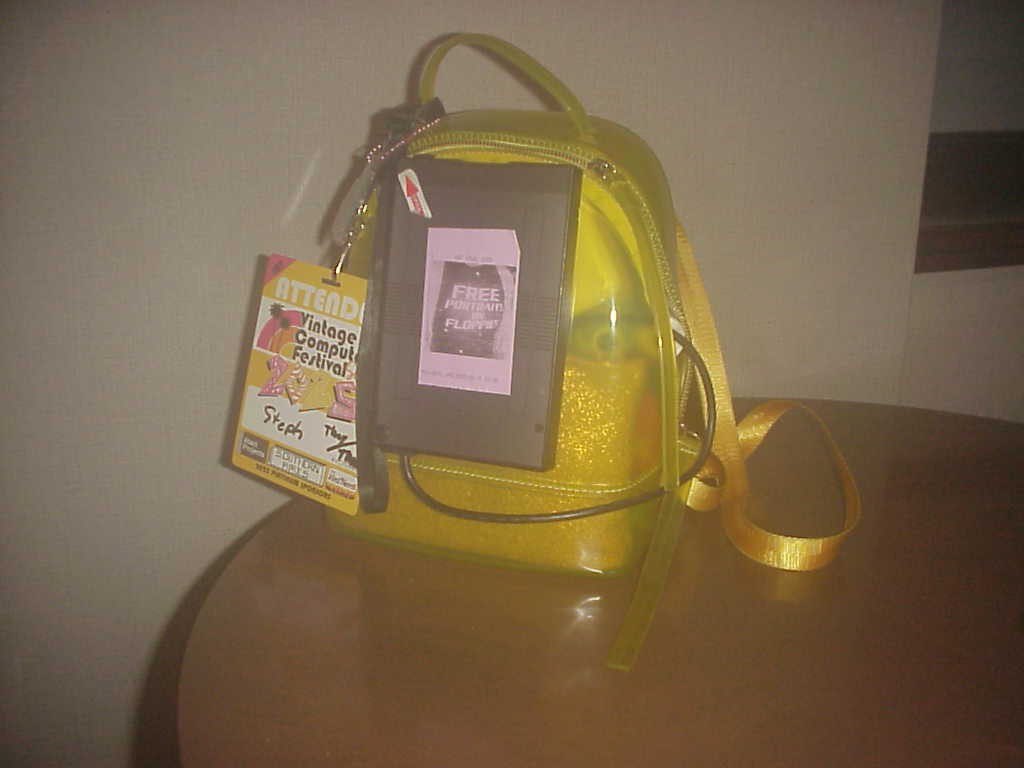
The Raspberry Pi 5 *was* bought new a few months ago, just not for this project, so technically it is a reused item. The battery bank powering it came from a flea market, and both will surely be reused in some future project.

The USB floppy reader is a genuine vintage article owned by Jack since sometime in the early 2000's. I wish I could say the same for the amazing transparent yellow backpack, but it was another more recent thrift store find.
Media
The final important aspect of this project is, of course, the floppy disks themselves. I do buy them whenever I notice floppies at the flea market, so I already had a small collection of disks on hand. My plan was to format and overwrite these disks, but upon looking closer at my collection, I couldn't bear to erase someone else's important data:
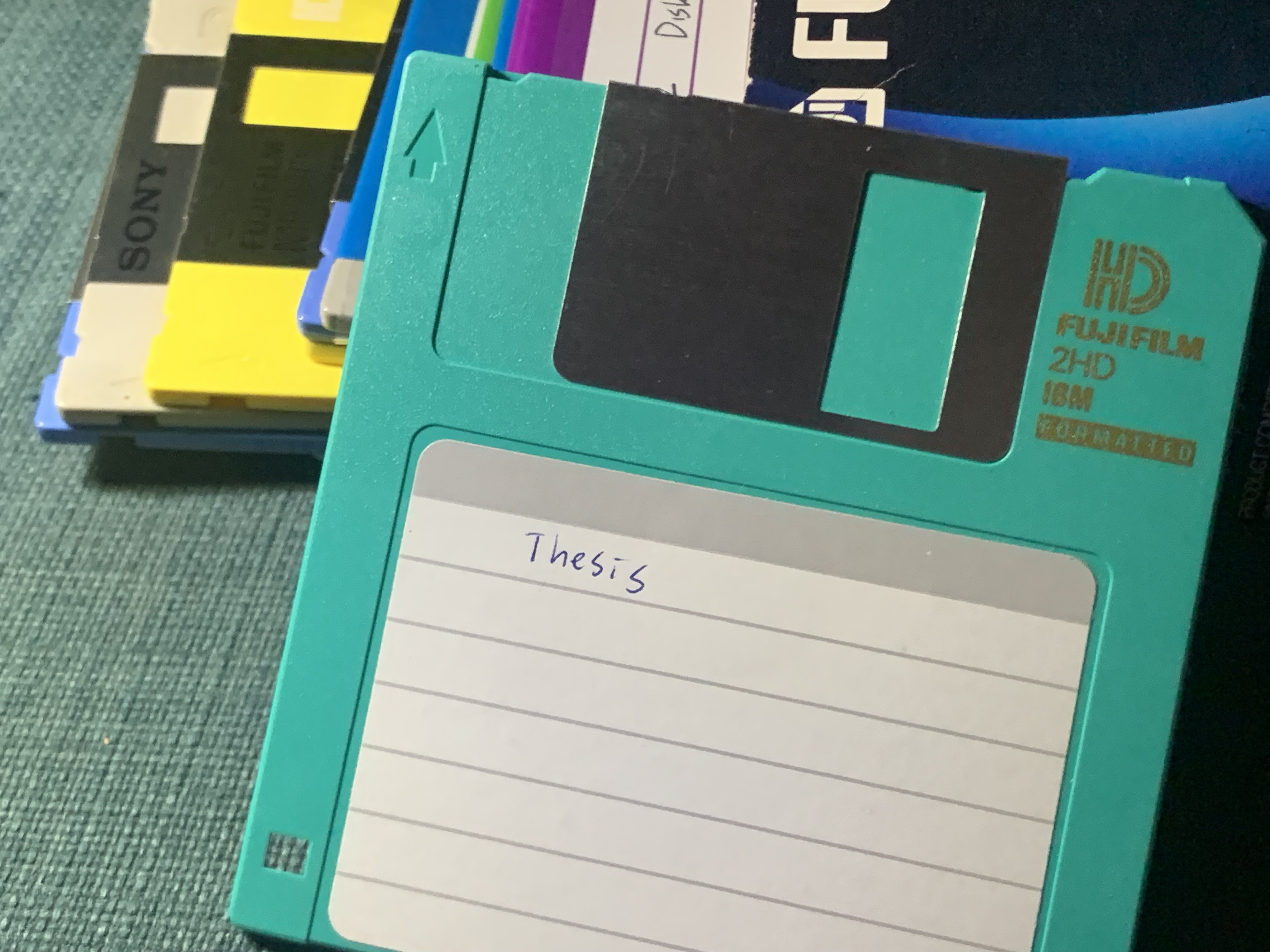
An unexpected aspect of working with vintage stuff is that the majority of these items have lived a full life once already, with somebody else, and sometimes they carry a lot of that last owner with them. What does it mean to erase a (probably) dead person's thesis? That data must have been a large part of that person's life, so much so that erasing it feels akin to burying them a little deeper.
I am the age of person who carried a floppy disk in my backpack all throughout school. This floppy was given to us by the school, and we were only given one. They taught us to write our name on it so that if we lost it, it could be returned to us. The disk was cheap, of course, but in the pre-cloud, pre-internet, physical media days of the early 90's, even in the low stakes environment of an elementary school computer lab, it was somehow obvious to all of us that data is sacred. The floppy disk represented all of our effort; all of the human thoughts and feelings we had each poured into the computer. There weren't backups, there weren't even local copies, because the computers didn't have hard disks.
There were only floppies.
Without your name on the label, your work, your hours, and in a sense, some part of you, were at risk of being lost. Back in '92 a floppy could have had my worst enemy's name on it and I still wouldn't have erased it without asking first, no matter how badly I needed to save a file.
What about the work of a stranger, resurfaced in 2025 after having been forgotten for unknown decades? Since the era in which floppies were popular dictates that backups are unlikely, any file erased from a floppy is probably gone forever, along with some part of the person that created it. On the other hand, the era also dictates that most files were ultimately meant to be printed out, so it's possible that the ideas still exist somewhere in physical form.
In the end I decided to surf the information superhighway a couple days before the event and buy a few boxes of NOS (new old stock) floppy disks, with fast shipping. That decision doesn't exactly align with my values for this project, but it did allow me to respect another person's floppy one more time.
Wardrobe
In preparation for making the shirts we drove to the craft store, at the last minute, and bought several rolls of heat transfer vinyl. My plan was to buy something from the discount bin, because when I can't get something used my next favorite option is to buy what nobody else wants, but when I got to the store I became enamored of the glitter options. This is especially worthy of a certain degree of shame, considering that I bought them with the full knowledge that glitter is microplastics.
Appallingly, I actually spent more on glitter vinyl than I spent on floppy disks.
In my own defense, the rest of the t-shirt project was thrifted, including the shirts themselves, the plotter we used to cut out the vinyl lettering, and the iron we used to apply it.
Deals with Other Devils
There were other compromises as well, most significantly the need to buy new lithium batteries for the camera (I needed two so that one could be charging while the other powered the camera). That meant engaging not only with big ecommerce and shipping companies, but ultimately with the lithium mining industry, which is probably an even larger offense.
Totals
That brings the total non-thrifted purchases to:
- 3 boxes of extra floppies,
- 2 lithium camera batteries,
- 1 armload of glittery heat transfer vinyl.
I feel pretty ok with that list. The lithium battery purchase could have been avoided by modding the camera, but that would have risked bricking the camera. I could have skipped the heat transfer vinyl by scrawling my "free portraits" message on a white shirt with black sharpie, but that option also had a chance to ruin the project by giving the (possibly accurate?) impression that I am mentally unstable. I also decided that I'll probably archive that thesis somewhere, but some thought will need to be put into how, and where to store it. Until then, I'm glad I bought floppies with no history saved on them.
Since the aquisition of the needed materials had begun years ago and the floppy disks did arrive in the mail by early that afternoon, all the new purchases were wrapped up by lunchtime. The only thing left to do was to get some hamburgers, eat our hamburgers, fill the backpack with tech, code it up, make some shirts, and go to bed!
The time was 4pm.
Next section: Software
Discussions
Become a Hackaday.io Member
Create an account to leave a comment. Already have an account? Log In.