To make the experience fit your profile, pick a username and tell us what interests you.
We found and based on your interests.
POLOLU-2820.pdfDatasheet of the Servo-Motor FS90RAdobe Portable Document Format - 92.12 kB - 05/07/2025 at 11:40 |
|
|
0900766b814b241f.pdfDatasheet of the L7805CVAdobe Portable Document Format - 1.12 MB - 05/07/2025 at 11:38 |
|
|
Li-ion 7.4V.pdfDatasheet of the Li-ion 7.4VAdobe Portable Document Format - 679.51 kB - 05/07/2025 at 11:34 |
|
|
Motor gear N20.pdfDatasheet of the Motor gear N20Adobe Portable Document Format - 718.67 kB - 05/07/2025 at 11:32 |
|
|
drv8833.pdfDatasheet of the DRV8833Adobe Portable Document Format - 949.51 kB - 05/07/2025 at 11:27 |
|
|
On this last week we try to finalize everything but we had a big problem that the driver8833 burn because I inverse the polarity of the adaptator of the batterie.
On the bottom of the DRV8833 you can see that the condensator burn because of this mistake
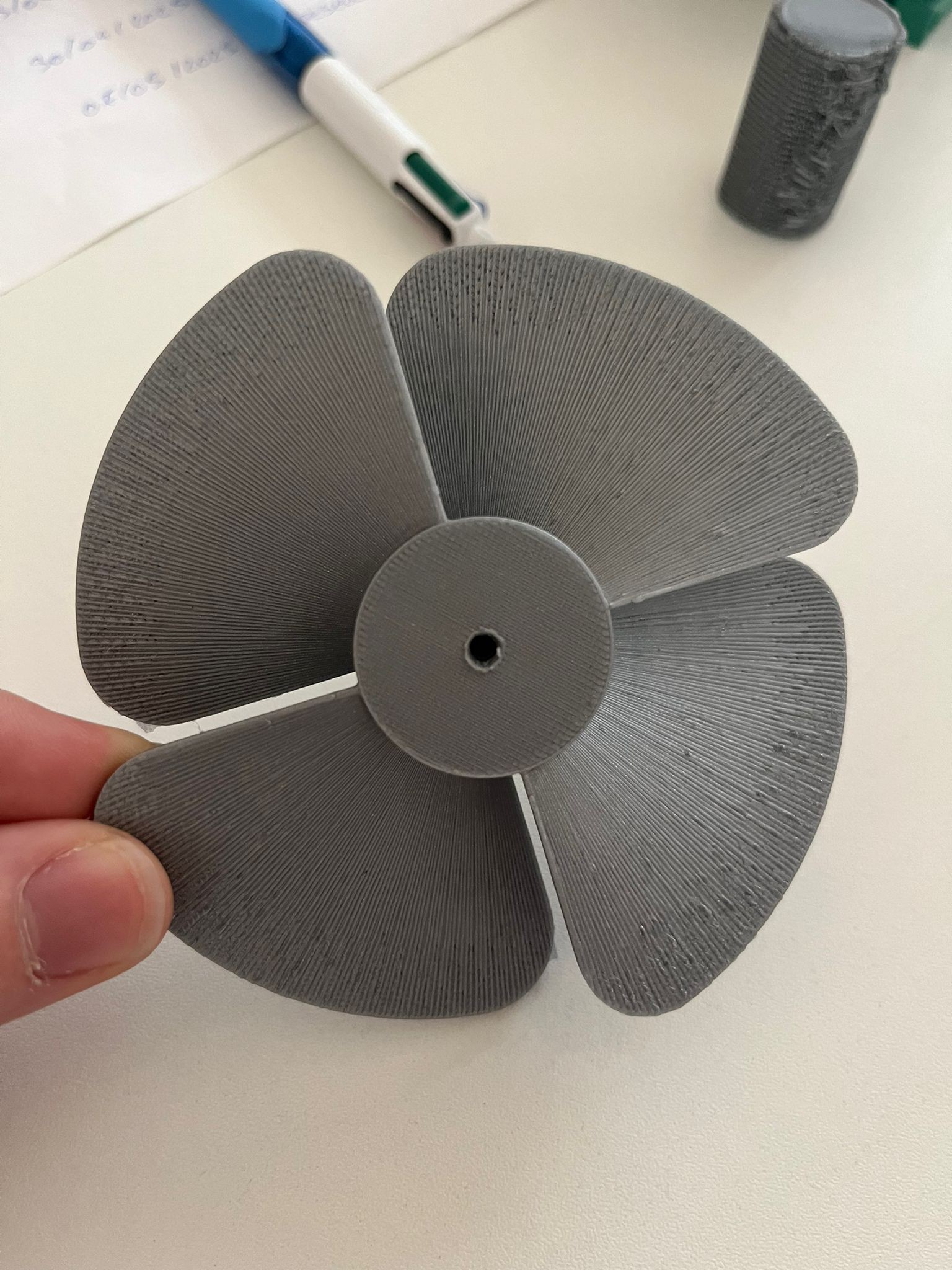
We also make a 3D print of the propeller that will be attach to the N20 motor
We test a scotch to reduce the space between the circle Cover and the plexiglas Tube
What's next ?
We have our presentation tomorrow but the point is to finish after our classes. We already 3D print a other support to manage the space between the servo-motor and the worm drive.
Also make an axle to fit in the motor and have a space between the Circle Cover and the N20 motor.
On this Week we tried to manage the worm drive and the support. we changed the direction of the 3D printing to vertical and not horizontal, it generates more supports but in the end we had a proper worm drive.
The issue is now with the support and the size of it, because it can not contain the worm drive next to the servo-motor in the plexiglass tube.
We also made some waterproofing tests that show us that there is a tiny space between the Circle Cover and the plexiglass tube. An 0-ring join can maybe solve our problem but not really sure of it.
On this Week five we had a lot of issues with the worm drive especially with the support that made worm drive unevenly
As you can see on this picture it's impossible to use the worm drive because of the scale and the support issue. The servo will not be competent to pilot this.
We will have to print the worm again drive and also make some support changes to link everything.
For the electronic part we decided to choose :
Raspberry Pi Pico W
DRV8833
Motor gear N20
Li-ion 7.4V
L7805CV
Servo-Motor FS90R
Here is the wiring diagram of the project :
The L7805CV is one of the most important part that permits the raspberry Pi Pico W to not burn with the alimentation of the Li-ion 7.4V.
The maximal tension of the DRV8833 is 10V and the N20 motor is 12V so the Li-ion 7.4V is a great alternative to manage the motor and control the raspberry with the L7805CV
For more detail go to the files and search for the datasheets.
Next week we will have to 3D print the support and an other worm drive. Also start the code to pilot the servo-motor and the N20.
For the fourth week we 3D printed the pieces that we needed to control the translation motion.
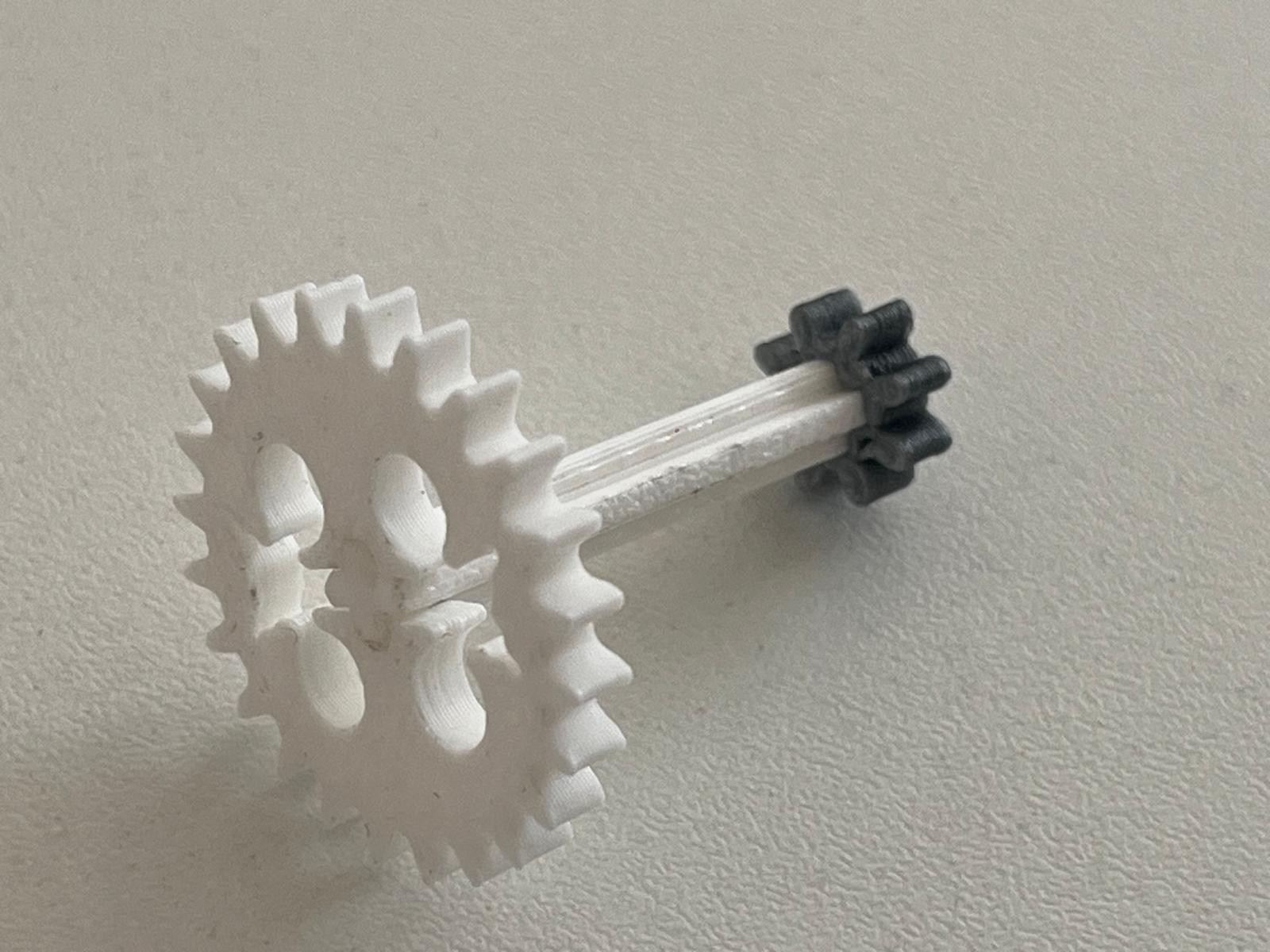
The 3D printing was messy for the gears, the reason was that the gears were really tiny, less than 8 tooths.
This part is for the Ballast System
Here is the gear nested in the axle, this will be attached to the 24teeth_Gear.
Now that we have the gears and the axle we can 3D print the rails to pilot the moving part of the syringe.
The gears will be translated to the rails.
If you have the occasion, maybe, try with a resin printer and not a 3D printing for the little pieces
( Go to the files and open : Rail1_Syringe.STL , Rail2_Syringe.STL Axle_Syringe.STL, Gear_24Tooth.STL, Gear8_Tooth.STL)
For the next week we will have to make a list of the electronics component and 3D printing the worm drive
On the third week of the project we went to different shops to find the plexiglass tube and the syringe. It was a bit hard to find what we were looking for because it's not really common to have a tube of plexiglass .
On amazon we found some pieces that allow us to start the main project.
Here is the link for the plexiglass tube Amazon - Link ( plexiglass tube ) and this link for the syringe that can contains 60ml Amazon - Link ( syringue )
We made some reflexions to find out how to close the tube. For the praticity of it maybe make a Cover that can be opened and closed to put the component in the submarine.
For the next week we will have to print the stl files of the CAD to control the translation of the syringe.
On the second week we decided to make a to-do list, to make sure that nothing will be forgotten during the project.
Here is the to-do list :
Control the buoyancy of the hull ------> for that use the mathematical formulas :
- Apparent Weight = Real Weight − Archimedean thrust
- Archimedean thrust = ρeau × Volume × gravity
Find a scale
Weight the tube Know the variables : peau = 1000kg/m3 , Volume of everything (electronics, seringue, ...) , gravity is 9.81 Test buoyancy with a plastic bag and determine the neutral point with dense objects
Control the syringe, with the rails --------> for that use a worm drive, make the sketch of the rails and/or the worm drive (Search if there's any stl models online)
Test it and see if the moving part of the syringe moves or not. If not try something different.
Control the propeller -----> use a driver to manage the tension. Find a stl propeller. Use the 3D machine to print it.
Choose the ESP32 See the doc of the ESP32 and the driver LN298. Make the code and adapt it to control the speed of the propeller.
How to manage the elements in the tube ----> maybe a underbody or stem. Mesure the inside height of the acrylic tube
Make the sketch of a underbody with the features
Remarks : Maybe buy another acrylic tub
Make a list of everything that we need : -ESP
-Driver
Find the equal to the Lego EV3 cable pinout for driving the syringe
For the next week we will have to buy the plexiglass tub and the syringe. But also do the CAD for the worm drive, the gears, the axle and the rails.
On This first week we looking for some documentation, or project that already exist.
We didn't find a lot of it, only two of them were interesting :
- Project for a submarine closer to a real-life mode (DIY)
- A Lego submarine
The first one is really interesting with the pump system and the balance. The other one was more compact and
We decided to take a couple of ideas in the both project. The balande system of the first one and the pump system ( with the seringue ) of the Lego project.
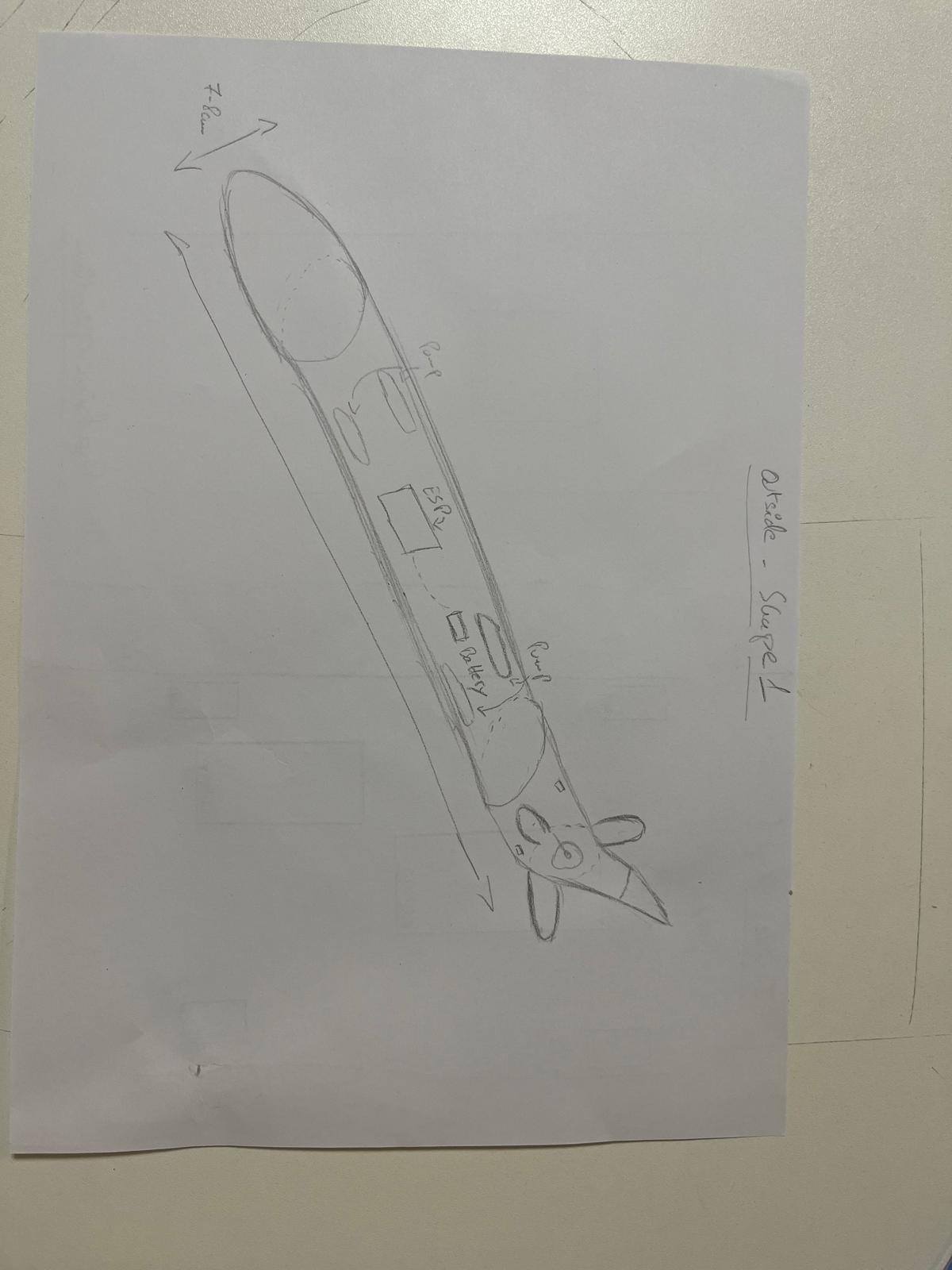
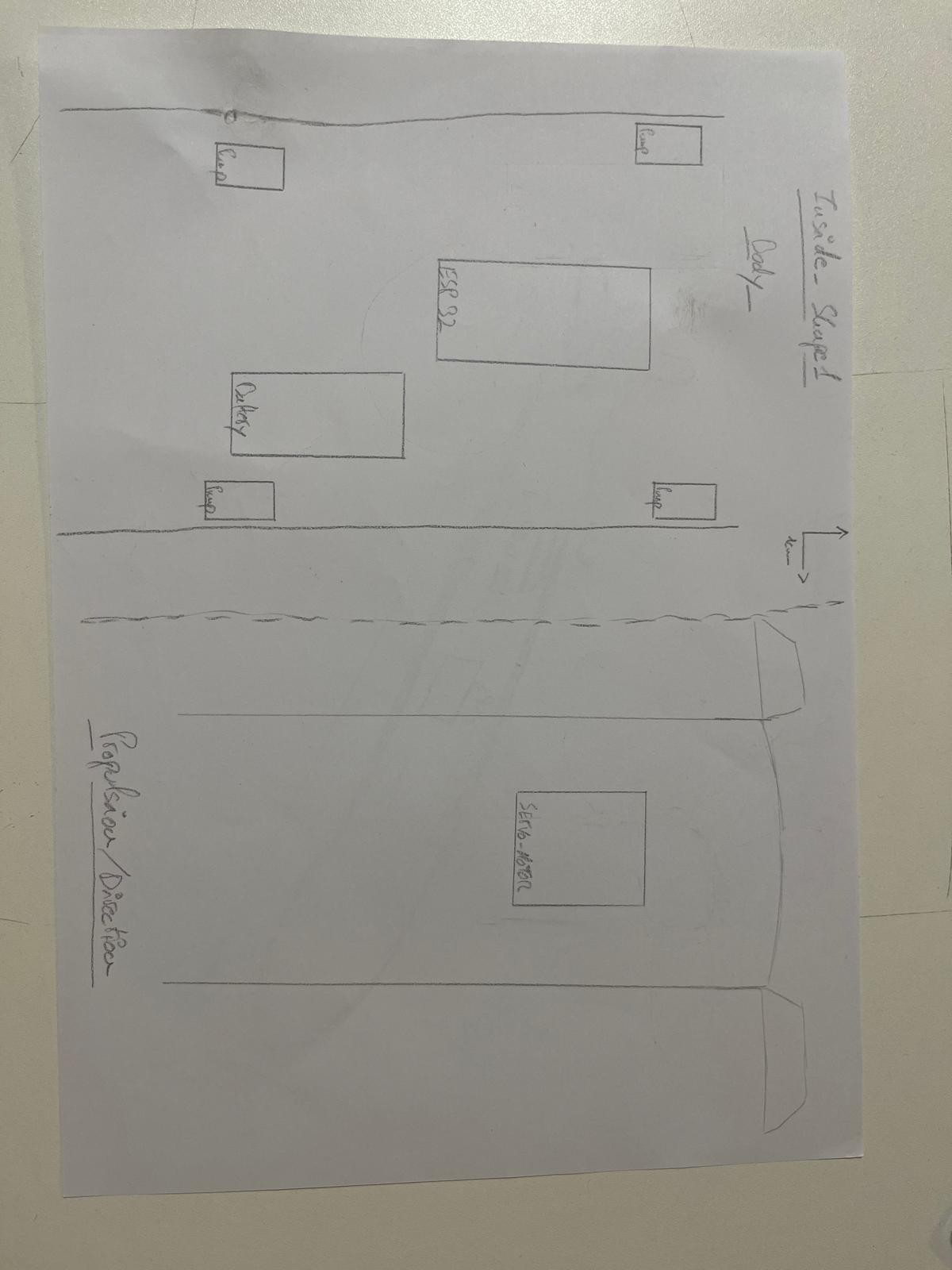
We also make some sketches to have an idea of the size
For the next week we will have to find a tube, in preference a transparent tube to see how the submarine works. Also make some research for the buoyancy.
Create an account to leave a comment. Already have an account? Log In.
Become a member to follow this project and never miss any updates
Brian Brocken