 alnwlsn
Any radiation experiment starts with the radiation source, and seeing as, much like everyone else, I don't have access to any of the more intreating materials, we'll be making do with whatever household sources we can find:
- smoke detectors
- don't really want to risk contamination taking one apart, plus they don't make beta-gamma tubes click anyways
- uranium glass
- these are pieces of artwork which I will not shatter in order to make some dumb clock. Plus, not very high click rate.
- thoriated welding electrodes
- not very high click rate
- polonium spark plugs
- half life too short; polonium is long gone anyways
- thoriated lantern mantles
- these wouldn't be a bad choice, you could even wrap a few around the geiger tube.
- radium clock hands
- it would be kind of ironic to make a clock out of parts from another clock
What I actually ended up using was a piece of radioactive ore. I'm not much of a rock hound, but the person who gave it to me definitely is; he personally mined it from a location in northern Canada. He told me it contains uranium and thorium, and though I forgot whatever mineral name he said it was called, to my untrained eye it looks like quite a nice sample of pitchblende, though you'd be forgiven for mistaking it for coal.
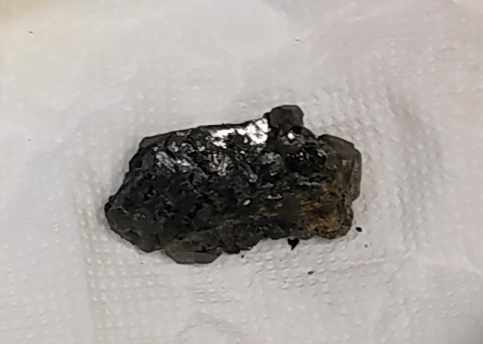
Fun fact, the name 'pitchblende' essentially translates to 'deceiving black rock'. When this material was discovered 500 years ago, miners thought it contained a metal ore like silver. It was heavy, after all. But when they tried to refine it, they got nothing (deceived). My sample is also noticeably heavier than a normal rock, though I did not weigh it (it's been in the clock for some time now), if I had to guess it would be about 40-50 grams.
Actually, one reason I picked the rock (other than that it makes the geiger counters click the fastest) is the fact that it's a rock. Uranium ore is never just uranium. If you have some that is freshly refined, leaving only the uranium atoms, it's activity level will increase over the course of months. That's because the daughter products that the uranium decays into will begin to build back up, and these are radioactive as well. The daughter products actually contribute most of what you are detecting with a regular beta-gamma geiger tube, as U-238, U-235, and Th-232 are all alpha emitters. Not a problem for a rock which has been around billions of years, which has had plenty of time for these daughter products to reach a steady state, constantly being generated by the parent uranium and thorium, then decaying per their own half life some time later.
For a rock, we aren't going to have to worry about the half life of the source either. The half lives of natural uranium and natural thorium are long. Remember, these atoms had to wait billions of years to end up in this experiment, and there is still plenty of them left in the sample. Your lifespan, or all of human history for that matter is just a rounding error on this scale, and we can effectively treat the rate of change of decay as zero.
Discussions
Become a Hackaday.io Member
Create an account to leave a comment. Already have an account? Log In.