Close
0%
0%

Electro-Pneumatic Two Timer Flasher

A simple two timer circuit to flash a light

Similar projects worth following
This is how an industrial automation engineer would flash a light from scratch. Two timing relays. Doesn't get much simpler than this!

Check my website for more details and snarky commentary. https://jacobertel.com/two-timer-flasher-circuit/

This circuit was made for Hackaday’s One Hertz Challenge. The challenge is to make something turn on and off once a second. Why would you want something to turn on and off once a second? I dunno. Maybe you’re just a poor little controls engineer working at a factory and your boss wants you to make a light blink when a machine isn’t working.

How would you do it?

Well if you wanted to earn brownie points with the older timers, you could use a 555 timer. But I don’t know how to do this. Maybe I did something like this back in undergrad. I forget.

If you wanted to be super precise you could synchronize a clock from GPS satellites orbiting the sky with a u-blox ZED-F9T. Sparkfun has a dev board for three Benjamins. This could get you down to 5 nanoseconds accuracy.

But remember, you’re just a lowly controls engineer. You don’t have time to design a 555 circuit, and your boss don’t care ’bout no nanoseconds. You have access to industrial control parts from the likes of Rockwell Automation, Siemens, and Square D. McMaster Carr, Grainger, and Automation Direct are also great places to look.

Your basic building block is a relay.

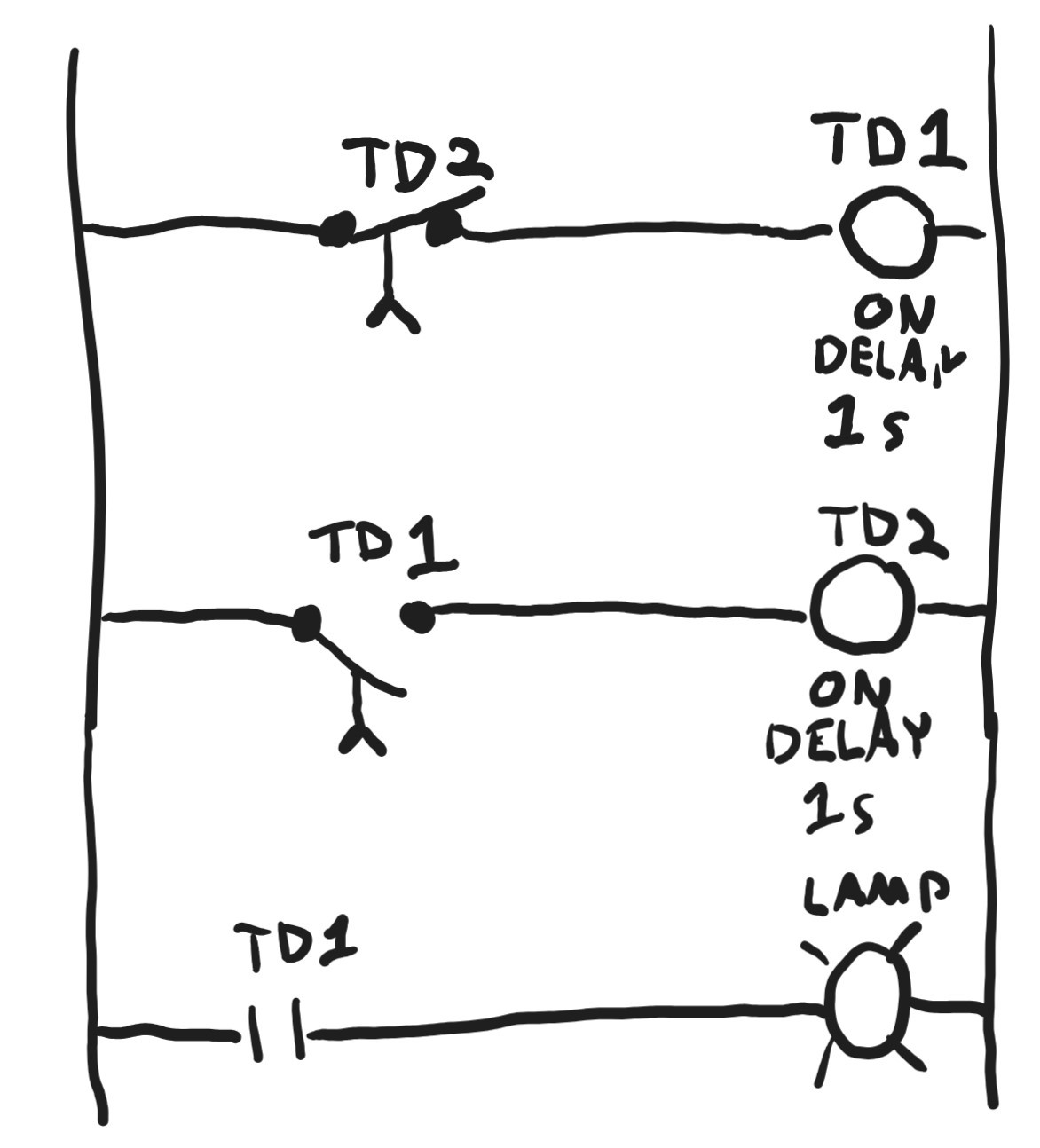
We can use two on-delay timers to make a light flash. 
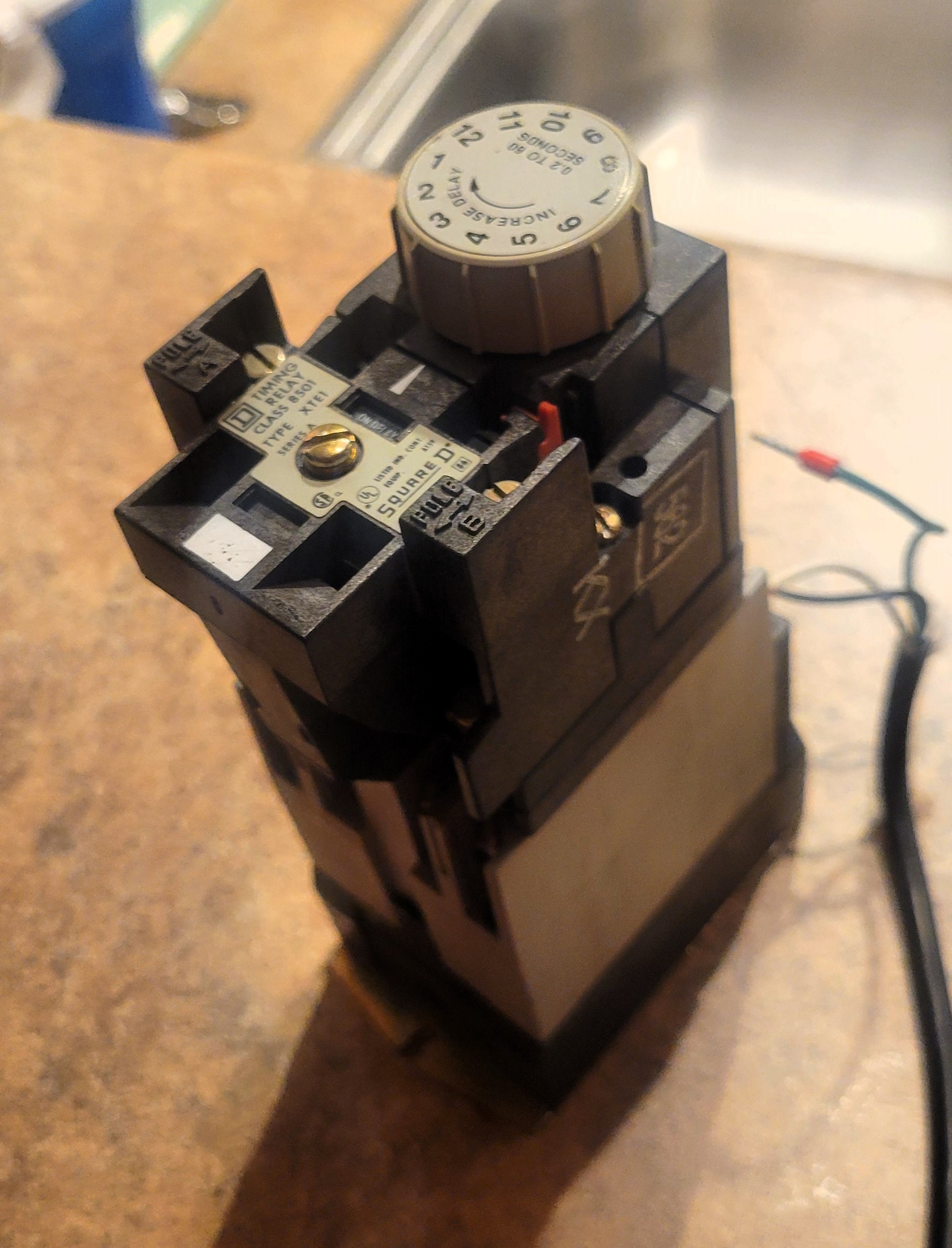
  • 2 × Square D 8501 X0 40 CP 8501 XTE1 20A Square D 8501 X control relay with a XTE1 timing add-on

  • Calibration...with a stop watch

    Jacob Ertel08/26/2025 at 03:23 0 comments

  • A working circuit!

    Jacob Ertel08/12/2025 at 05:26 0 comments

    A replacement relay arrived in the mail today from ebay. This relay was in much better shape and worked out of the box! I wired up the circuit and it appears to be working!

    I've got some more learning to do to understand how to use my oscilloscope. In school, I found the nice Agilent/Keysight scopes with physical knobs real easy to use on a DC circuit. But this is an AC signal. And the Fluke Scopemeters don't have knobs. But it does have a battery, and is practical to hold in your hand. It also has wifi, so you can lock it up in a 480Vac cabinet and view the results on your phone.

  • Working with used relays

    Jacob Ertel08/05/2025 at 04:08 0 comments

    I ordered the two timing relays seperately from ebay.

    The first one I received was in good condition. I hooked up a 120vac cheater cord to it and plugged it in to a GFCI protected kitchen outlet. The relay coil sounded good, and I could hear the click of the time delay contacts engaging.

    The second relay appeared used. There were bits of cut off wire sticking out of the terminals which I removed. I connected cheater cord to it, and plugged it in, hopefull that things would go just as smoothly. I was wrong!

    The Buzzzzzzz

    Clunking relays often buzz and chatter. I'd say it happens to 5-10% of them. Sometimes it an electrical problem, like a race condition or a poor termination. Though often times its a mechanical problem. At work, I'ved developed the fine art of "whacking it with a screw driver" till it behaves. But I could tell that wasn't going to work for this relay. It buzzed no matter what oriention I held it in.  I took of the timer block and removed the contacts. Still no improvement. Welp time to dive deeper.

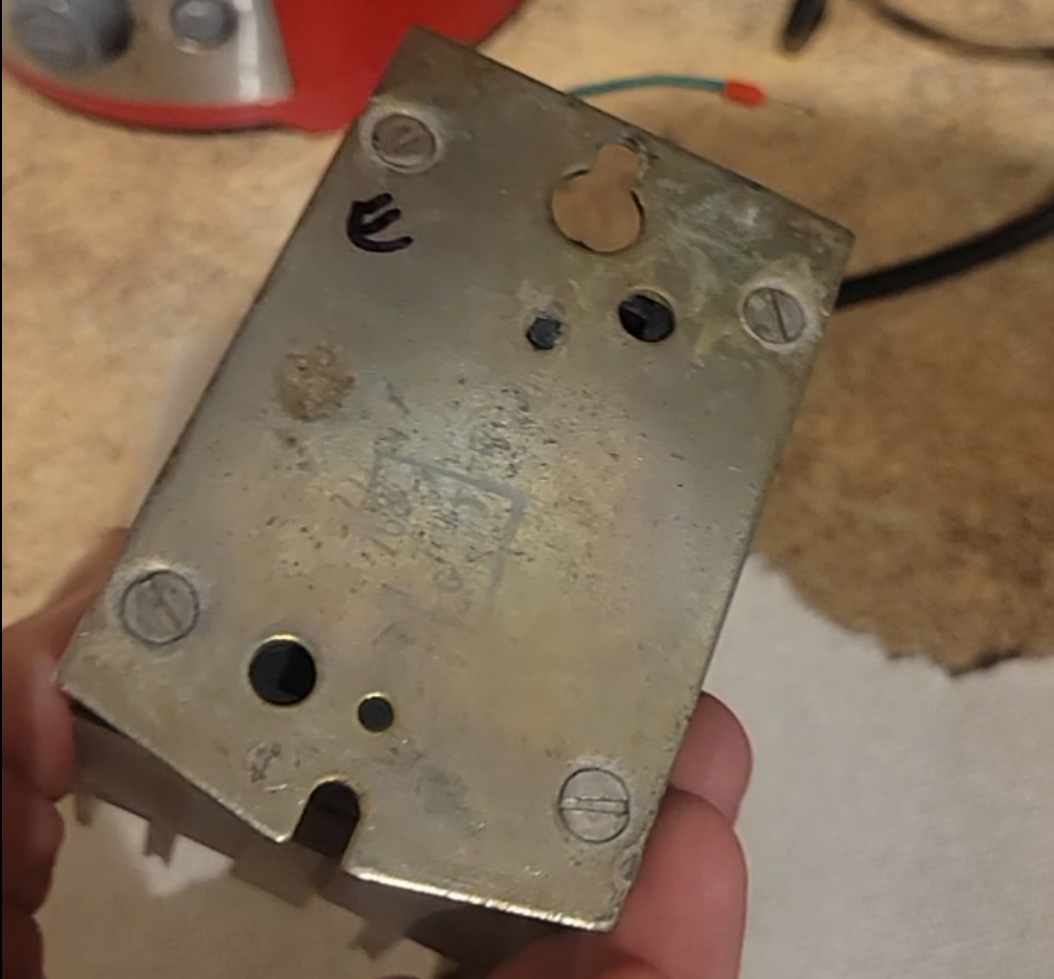
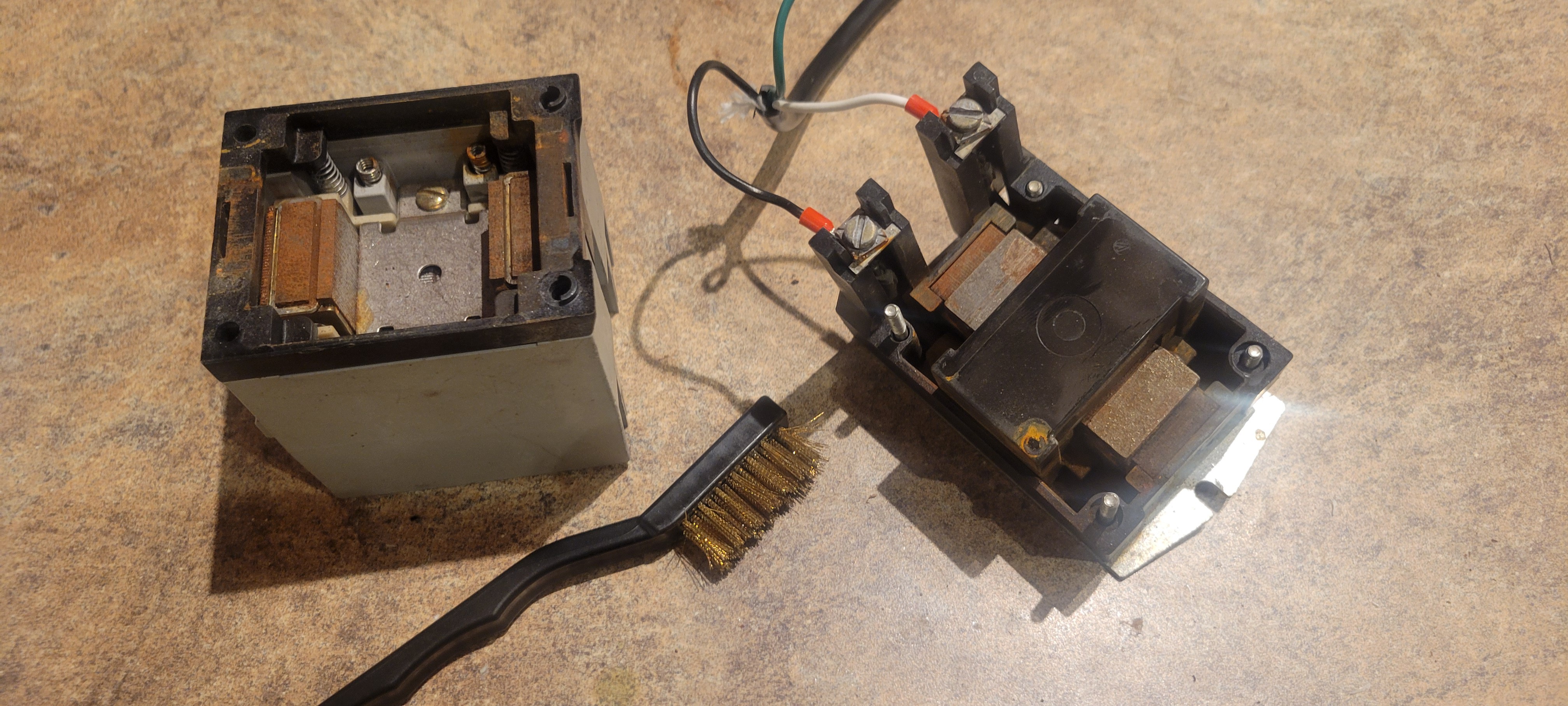
    This is a highly serviceable relay, and the coil is accessible by four screws on the bottom.

    I opened it up, and saw lots of rust.

    This relay probably had a hard life in an outdoor enclosure that leaked. I saw that the armature was rusty and started cleaning it up with a brass brush. Then a stainless brush. It sounded much better, but still wasn't perfect. 

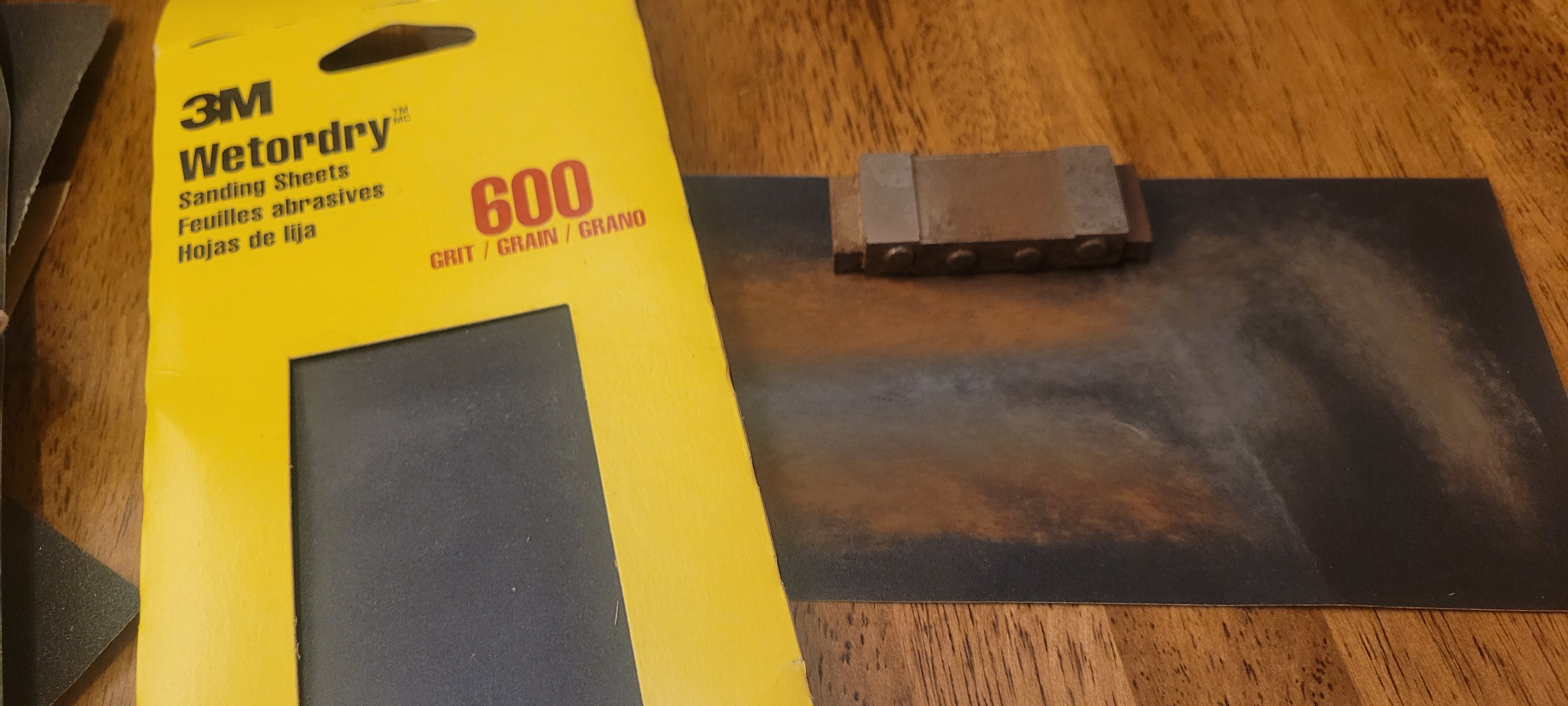
    I moved onto dry lapping with 600 grit. 

    Like every rebellious twenty something, I stayed up late lapping armatures.

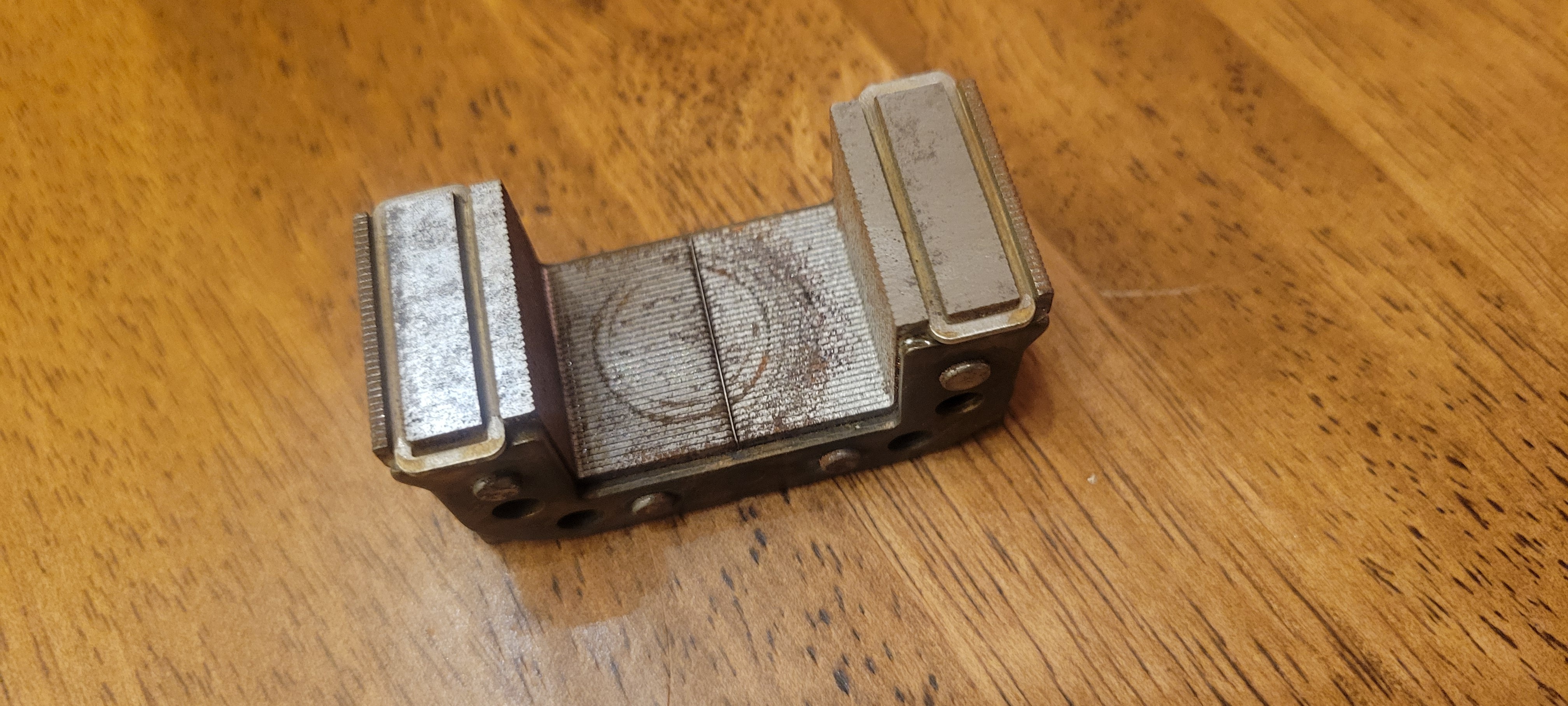
    This got everything nice and clean and it sounded good enough to move forward.

    The contacts also needed cleaning to make continuity. After all that, the timer wasn't working :( 

    Off to contact the seller on ebay

  • Waiting on the two timer relays I ordered from ebay

    Jacob Ertel07/30/2025 at 20:02 0 comments

    Hoping the rubber pieces in the pneumatic timer module aren't dry rotted and cracked

View all 4 project logs

  • 1
    Logic Diagram

    I messed up. This diagram would have a period of 2 seconds. Change the timer values to 0.5 seconds.

  • 2
    Step 2

View all instructions

Enjoy this project?

Share

Discussions

dmcglynn wrote 08/13/2025 at 17:40 point

As a fellow industrial control engineer, I love this entry. And I agree - I have always been amazed of the serviceability of the relays of the "past". We still have some 200 ton presses with old 1960's era AB relays clunking along. Why replace them when they still work? The manufacturer's solution to the problem is to mark up replacement parts by a factor of 20!

  Are you sure? yes | no

Jacob Ertel wrote 08/13/2025 at 19:00 point

Thanks for the comment! Yeah, I was surprised at how servicable the relay was too! I normally use Siemens 3RT IEC control relays in my designs, and some of my coworkers will mix in these Square D relays for the pneumatic time delay. I have a greater appreciation for why they do!

  Are you sure? yes | no

Similar Projects

Does this project spark your interest?

Become a member to follow this project and never miss any updates