 Tim
TimSo, what happens with our bundle of three candles? It will basically undo millennia of candle technology optimization to avoid candle flicker. If left alone in motionless air, the flames will suddenly start to rapidly change their height and begin to flicker. The image below shows two states in that cycle.
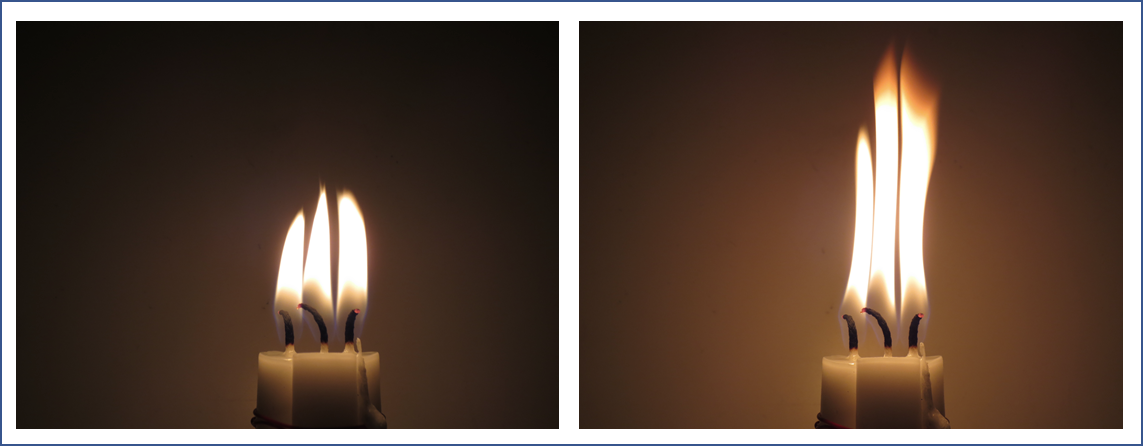
We can also record the brightness variation over time to understand this process better. In this case, I used a high-resolution ambient light sensor to sample the flicker over time. (This was part of more comprehensive experiments I conducted a while ago, which I'll write up in detail eventually.)
Plotting the brightness evolution over time shows that the oscillations are surprisingly stable, as shown in the image below. We can see a very nice sawtooth-like signal: the flame slowly grows larger until it collapses and the cycle begins anew.
On the right side of the image, you can see the power spectral density plot of the brightness signal on the left. The oscillation is remarkably stable at a frequency of 9.9 Hz.

This is very curious. Wouldn't you expect more chaotic behavior, considering that everything else about flames seems so random?
The phenomenon of flame oscillations has baffled researchers for a long time. Curiously, they found that the oscillation frequency of a candle flame (or rather a "wick-stabilized buoyant diffusion flame") depends mainly on just two variables: gravity and the dimension of the fuel source. A comprehensive review can be found in [3].
Now that is interesting: gravity is rather constant (on Earth) and the dimensions of the fuel source are defined by the size (diameter) of the candles and possibly their proximity.
This leaves us with a fairly stable source of oscillation, or timing, at approximately 10Hz.
There was this 1 Hz competition? So, why don't we use our flame oscillator reference to generate a 1 Hz clock signal?
[3] J. Xia and P. Zhang, "Flickering of buoyant diffusion flames," Combustion Science and Technology, 2018.
Discussions
Become a Hackaday.io Member
Create an account to leave a comment. Already have an account? Log In.
Very curious indeed!
The compliment of lava lamps for randomness. :)
Are you sure? yes | no
Hehe, indeed. The opposite of randomness. Did not think about it that way.
Are you sure? yes | no