 EMRE
EMRE

The 555 IC is a widely used type of integrated circuit for oscillation, time delay, and pulse signal generation. Due to its affordability and ease of use, it is one of the most preferred timer ICs today. Its operating voltage ranges from 4.5V to 15V, and it can provide an output current of up to 200mA. For more detailed information about this IC's specifications, you can easily refer to its datasheets. This IC can be used in three modes: Monostable, Astable, and Bistable. I will share the details of these modes with you along with practical applications.
- MONOSTABLE MODE
The monostable mode is known as the single-stable mode of the 555 timer IC; in this mode, the circuit normally stays LOW and only switches to HIGH for a specific duration when a trigger signal is applied, then automatically returns to LOW. The triggering usually occurs by applying a LOW signal to the TRIG pin, and the output remains HIGH for the duration determined by the RC time constant. The HIGH output time can be calculated using the formula T = 1.1 × R × C. Monostable mode is widely used in time-delay switch circuits, button debouncing, single pulse generation, and sensor-triggered applications. When a trigger signal is applied to the TRIG pin, an LED or load remains active for the specified time and then returns to the LOW state.
The duration for which the output stays HIGH in monostable mode depends on the values of R and C in the circuit:
T=1.1×R×CT = 1.1 \times R \times CT=1.1×R×C
-
R: Resistor (ohms)
-
C: Capacitor (farads)
-
T: Duration of the HIGH output (seconds)
For example, if R = 10 kΩ and C = 100 µF:
T=1.1×10,000×0.0001=1.1 secondsT = 1.1 \times 10,000 \times 0.0001 = 1.1 \, \text{seconds}T=1.1×10,000×0.0001=1.1seconds
This means that after triggering, the output will stay HIGH for approximately 1.1 seconds.
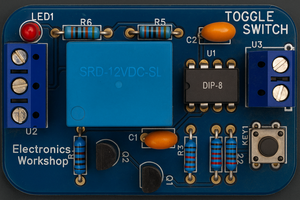
 electronicsworkshops
 RamBros
 Klaus Dormann
 Naman Chauhan