 Kutluhan Aktar

After scrutinizing pioneering research papers on AI-powered applications and improvements for restaurant food preparation and delivery, I had become fascinated by the prospects of AI-oriented solutions in the food service industry. Thus, I have started to conceptualize a state-of-the-art restaurant from the ground up to not only employ AI-assisted solutions to enhance a preexisting restaurant workstation in limited aspects to automate food preparation and service procedures, as extensively covered in the aforementioned research papers, but also utilize AI-based algorithms to give customers a considerable degree of autonomy in generating user-specific menus/deals based on their preferences to provide an authentic and personalized customer experience. In other words, I focused on developing a restaurant establishment from scratch, providing AI-assisted features in customer relations, special menu/deal generation, kiosk/web dashboard interactions, order management, food preparation, and food service processes.
While conceptualizing all of the AI-assisted features I wanted to implement in my hypothetical restaurant installation, I conducted extensive research about various restaurant types to pinpoint the best establishment layout that would effectively showcase my concepts and solutions. In this regard, I decided to base my restaurant establishment layout on popular drive-through restaurants since their fast-paced service requirements and high customer retention rates provide the ideal conditions to examine and emphasize my AI-assisted solutions as a proof-of-concept research project.
Considering a drive-through restaurant's structure and requirements, I started to work on determining my objectives regarding my AI-assisted solutions that would improve customers' overall impression by providing a personalized, attentive, and consistent experience from the restaurant web application (and dashboard) to the kiosk customer endpoint.
After considering different networking options between the restaurant web application and the kiosk customer endpoint, I decided to utilize LoRaWAN due to its long-range coverage, low power consumption, and consistency, especially for handling simultaneous and interconnected operations of a fast-paced drive-through restaurant.
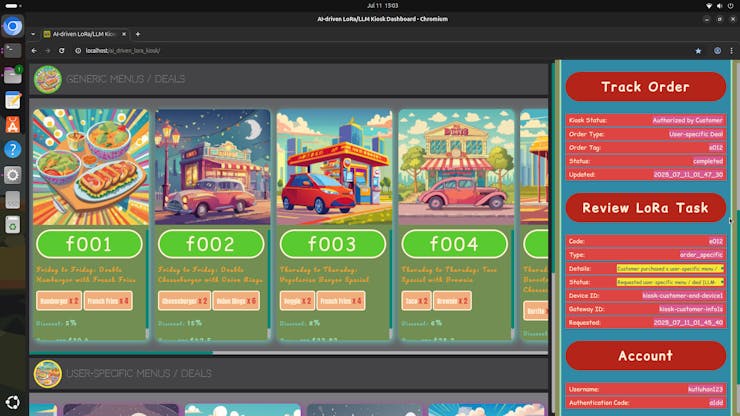
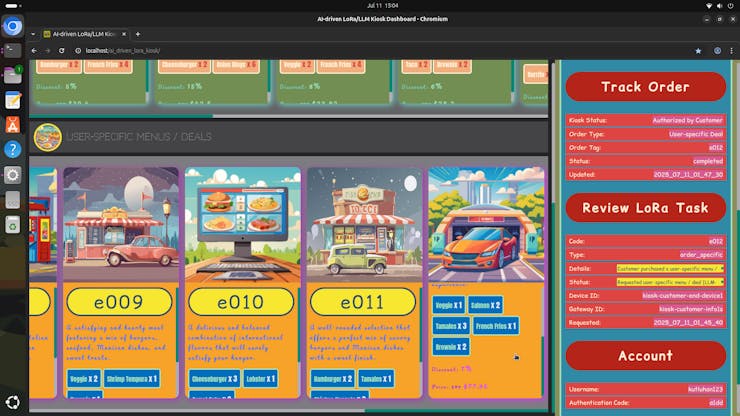
As opposed to the usual drive-through restaurant customer experience, in accordance with my AI-powered solutions, I concentrated on providing customers with the autonomy to generate user-specific menus/deals based on their preferences by employing different large language models (LLMs) enabled by the restaurant web application. In this regard, the web application allows the selected LLM to access customer preferences, available food item information (name, price, etc.), and food categories from the database to generate user-specific menus/deals. While producing menus/deals, the selected LLM determines the menu theme, description, the offered food item list, and the applied discount percentage.
In addition to the LLM-generated user-specific menus/deals, I decided to develop AI-assisted features to recognize registered customer vehicles for account authorization and identify food prep stations for performing the automatic food delivery process precisely in order to provide an outstanding AI-oriented customer experience. Nonetheless, I chose not to implement an involuntary data collection process for customer vehicles since I did not want to build a 1984-esque drive-through restaurant establishment :) In this regard, I developed vehicle image collection and account authorization based on vehicle recognition as opt-in restaurant features.
So, my initial objectives became as follows.
🤖 Objectives
✅ Developing a full-fledged web application to enable customers to create user accounts and provide contact information, payment settings, and menu/deal preferences.
✅ Enabling the web application to generate unique 4-digit authentication keys for each customer account.
✅ Preparing...
Read more »

 铲屎将军
铲屎将军
 EmericB
 hlew
hlew
 electronicsworkshops