MagicWolfi
-
Ultimate Destruction
10/18/2025 at 01:09 • 0 commentsI saved the overvoltage experiment for last as it might turn out fatal for the tiny little fellow. In fact I was determined to crank up the voltage until certain death. Sorry 555.
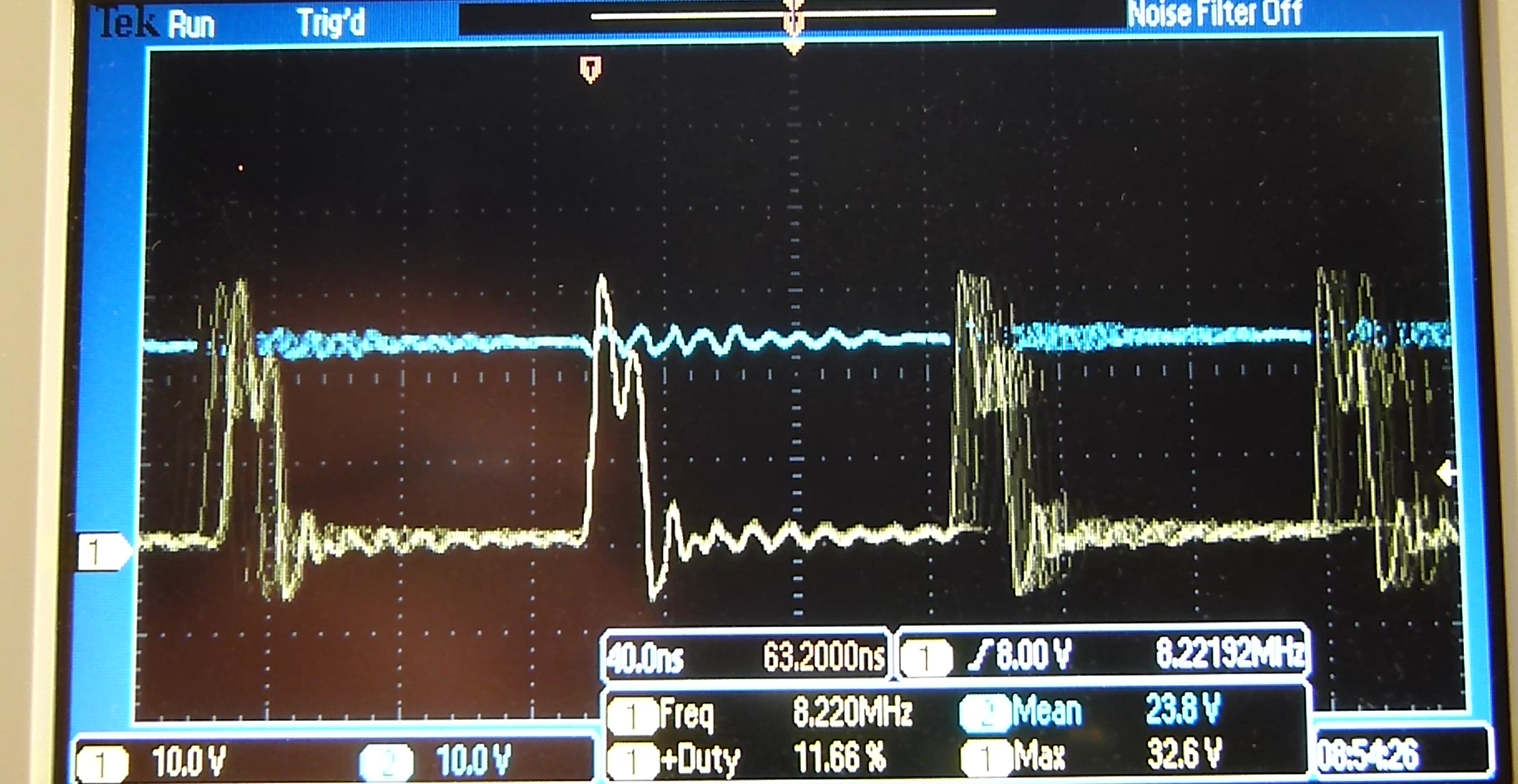
It did not take much. Back on the bench at room temperature the MIC1555 burnt out above 24V, but with encouraging results of 8.24 MHz sharply increased from the value at 23 V. So with a proper heat sink at low temperatures, it might survive longer at even higher voltages. At 24V it was drawing 35 mA and dissipating a whopping 0.84 W. I was recording the high voltage test live on video and I could argue that it did die ozcillating at 10.6 MHz, if the fequency measurement is assumed to still be correct from the the previous frame on the screen.
![]()
![]()
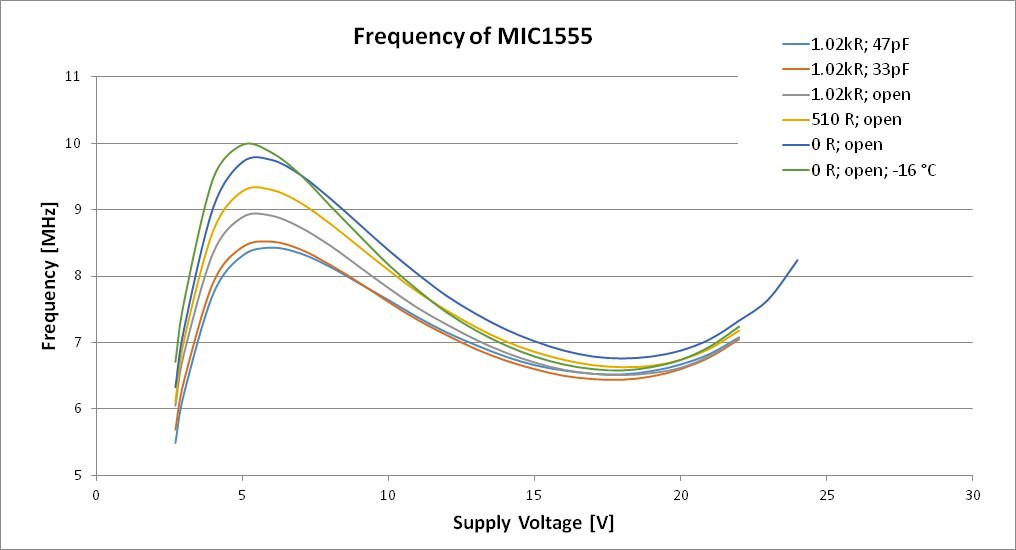
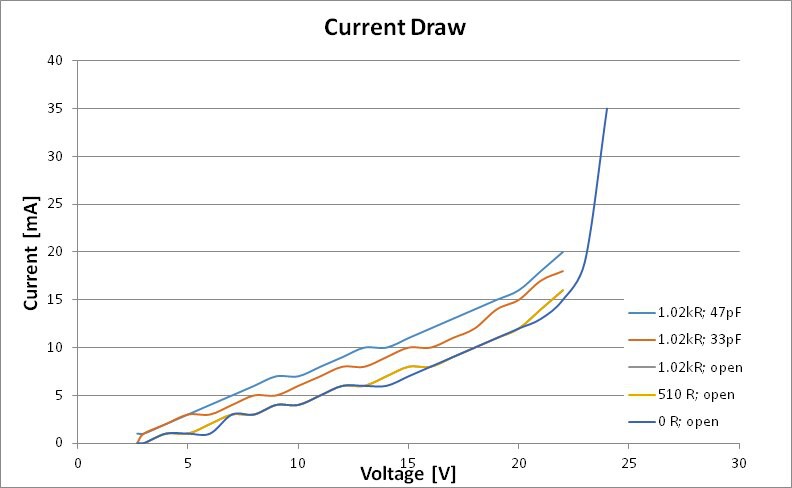
Here are the 2 graphs with the results of over-voltage added. Current and frequency increase with higher voltage. Especially the current is not linear any more. But to find out the cause of death a de-capping autopsy would be on order.
![]()
![]()
Conclusion: The 555 works well beyond the specified values and I had fun doing the measurements.
-
Pushing the limit
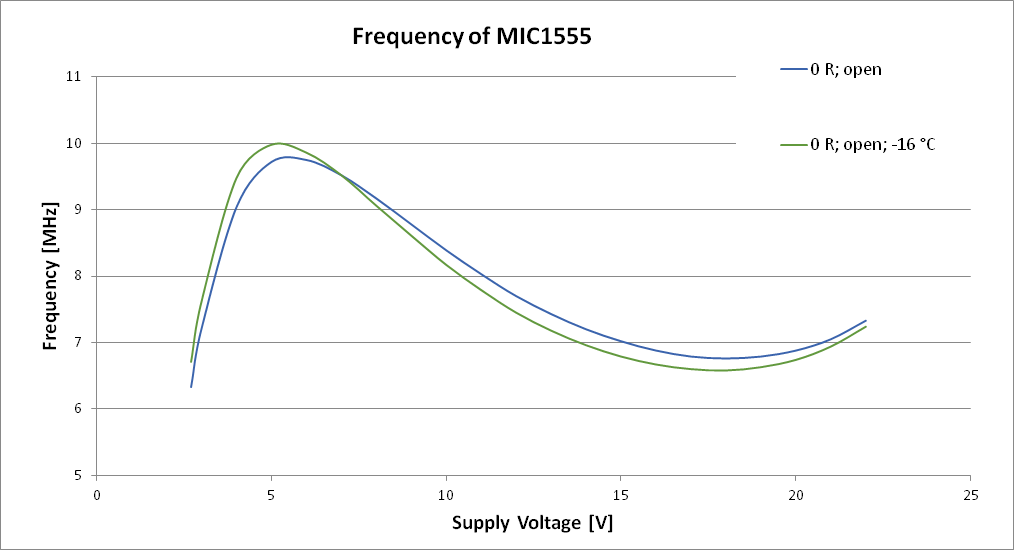
10/18/2025 at 00:58 • 0 commentsNow I am trying to push the limits even further. Overclocking often needs better cooling and increasing the operation voltage. The coldest temperature I can easily get to in my house is the freezer with -16 °C. Sticking the circuit in there and doing the voltage sweep again brought some improvement to 9.98 MHz at 5V and fine-tuned to 5.3 V got me to 10.01 MHz; above the desired 10 MHz margin twice the specified value in the datasheet.
![]()