 b.kainka

To understand the effect of these fuses more precisely, I recorded a characteristic curve. You can see that the fuse has a cold resistance of 14 ohms, which rises to 18 ohms at 2 V and approx. 110 mA due to heating. At even higher voltages, the resistance becomes much greater, so that the current drops significantly again. The fuse becomes hot and reaches approx. 60 degrees.
When I connect the circuit to a 6 V/0.5 A power supply, both lamps are initially half lit. Then, very slowly, one of them becomes brighter and the other gets darker. After one minute, only one lamp is still lit. The current settles at 150 mA. 100 mA flows through the lamp and 50 mA through the parallel PTC fuse to keep it nice and warm.
Now I press the button parallel to the lit lamp. It goes out when short-circuited, and the other one turns on. However, I still have to press the button for a few seconds until the first fuse has cooled down and the other one has become sufficiently warm. If I only press it briefly, the circuit returns to its last state. The circuit is therefore an RS flip-flop with a switching delay.
If you look closely at the characteristic curve, you may wonder whether this can work. The PTC fuse only allows a maximum of 110 mA to pass through, but a current of 150 mA flows. The fact that it works anyway is due to the PTC behavior of the incandescent lamps. At 6 V and 100 mA, they have a working resistance of 60 ohms. But the cold resistance of an incandescent lamp is ten times smaller, in this case 6 ohms. The currently cold incandescent lamp and the currently cold PTC fuse share the current, and together they manage to stay cool.




 Yann Guidon / YGDES

 rawe
rawe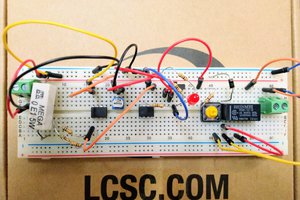
 Naman Chauhan
Part number found at Digikey:
Manufacturer Product Number
MF-R010
Description
PTC RESET FUSE 60V 100MA RADIAL