 b.kainka

I soldered the simple circuit unsupported on an old battery, which had already done its faithful service in a smoke detector. This is possible without a main switch, because the current consumption drops below 5 μA after ten minutes.
So you close the switch and then have a normal alternting blinker. When you release the button, the circuit should actually stop working, because the base charging current is then switched off. But it doesn't, the state changes a few more times in longer and longer time intervals. At the same time the LEDs are getting weaker and weaker. The fact that it continues at all is due to the dielectric absorption in the capacitors.
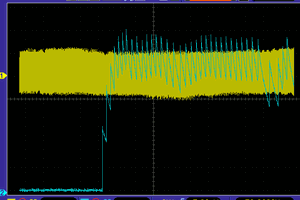
For the measurement with a scope I installed two ceramic capacitors with 100 nF, so that everything runs a little faster. If you use a good film capacitor it will not work because they show hardly any dielectric absorption. The voltage was measured between the two collectors. You can see the flashing getting slower and weaker. And whenever the circuit is about to tip over into the other state, it reacts very sensitively to external influences, hence the antenna.
You can in fact switch the state with a piezo lighter. Each ignition brings an electromagnetic pulse that can switch the LEDs from a distance of a few centimeters if it comes at the right time. And static charges can also be used to change the state. It depends somewhat on the type of flooring and shoes. In my lab, lifting a foot and then touching the antenna is enough. Foot up - yellow, foot down - red, and on and on. I just have to wait long enough for the indicator to reach full sensitivity.


 Applied Procrastination
 Yann Guidon / YGDES
 Mars
Mars
 Jay Riedl
Hi Elliot, thanks for reminding me to join. This is exactly my topic. And I find may interesting ideas in the challenge.