 Jake Wachlin
An important factor to the usefulness of this device is the worst-case accuracy of the current supply. I performed an analysis, which is included in the Github repo and described here. To understand the calculations, let's first discuss the key components and accuracy metrics. Note: all calibration is assumed to occur in climate controlled locations, so variability over temperature is ignored here.
| Component | Accuracy Metric | Notes |
| REF3030 | 0.2% | Fixed reference voltage |
| DAC80501 | TUE 0.06% FSR | Adjustable reference voltage |
| AD8603 | 50uV max offset voltage | |
| AD8276 | 0.05% gain error; 500uV max system offset voltage | |
| Shunt Resistors | All 0.1% accuracy | |
| AO3400A | 26.5-48mOhm range Ron --> assume 22mOhm variability | Extra resistance in PCB is not known, but designed to be minimal |
Analysis was done in Python here to compute the maximum percent error for each current level in the fixed reference voltage mode and for a variety of current settings for the adjustable reference voltage mode. The chart below shows the results.
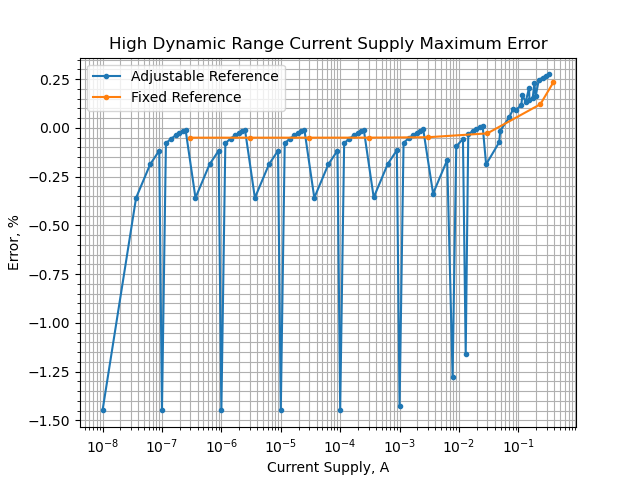
There are three interesting results here:
- The accuracy is quite good, typically +/- 0.25% accuracy over a lot of the operational range.
- The accuracy is worse at higher currents - this is due primarily to uncertainty of the on resistance of the shunt FET. At lower currents, that variability is small relative to the shunt resistance (e.g. 22mOhm vs 10MOhm), but it becomes relatively meaningful at lower shunt resistance (e.g. 22mOhm vs 7.66mOhm).
- The accuracy diverges to be worse than -1% at several levels. These correspond to the adjustable reference mode at small DAC output voltage. The total unadjusted error (TUE) for the DAC is 0.06% FSR worst case, which is 1.5mV. In this analysis, the lowest output DAC voltage shown is 100mV, so 1.5mV becomes a substantial error and dominates the error. Note that this is the worst case, and typical TUE is 0.025% FSR, which brings the typical error down within +/-0.6%
Overall, this analysis shows that for fixed current mode, the worst case expected accuracy based on datasheets is +/-0.3%, while the worst case expected accuracy for the adjustable reference voltage mode ranges based on the reference output voltage. If 100mV is the minimum output voltage used, the accuracy is +/-1.5%. If 500mV is the minimum output voltage used, the accuracy is +/-0.3%.
Discussions
Become a Hackaday.io Member
Create an account to leave a comment. Already have an account? Log In.