Close
0%
0%

Solder Grid

Simple grid tray system for all the soldering accessories

Similar projects worth following
Whenever I solder, I make a terrible mess around me. Bits of solder fly everywhere, wires are scattered all over, and flux pours like a stream. But I always knew it wasn’t my fault. Oh no. It’s the fault of the world. Of reality itself. It’s because ordinary, mortal three-dimensional space simply can’t withstand the creative energy flowing from my work. I always knew that to channel this passion I needed the right tools. And even more than that. I needed… a system!

And is there anything better than starting the design of a solder spool holder by first designing a system of interchangeable trays that can be swapped freely?! Of course not! On top of that, I had plenty of time thanks to the Christmas holidays. Plus, I had just bought a brand-new OSS TS12 soldering iron. The world was smiling at me, the world wanted me to do this.

At the moment, the project is being developed in Fusion 360, but if anyone is interested, I’ll try to port it to FreeCAD and OpenSCAD. I’ll definitely be uploading new STL files as quickly as possible after each post about a new tray.

Empty_tray.stl

Standard Tesselated Geometry - 40.37 kB - 12/29/2025 at 01:35

Download

Flux_tray.stl

Standard Tesselated Geometry - 309.22 kB - 12/29/2025 at 01:33

Download

  • In the beginning was the Flux.

    szynyszyl12/29/2025 at 01:31 0 comments

    And so, out of nothing, something was born. The first tile, a swallow heralding the arrival of countless, utterly excessive, and completely unnecessary 3D prints.

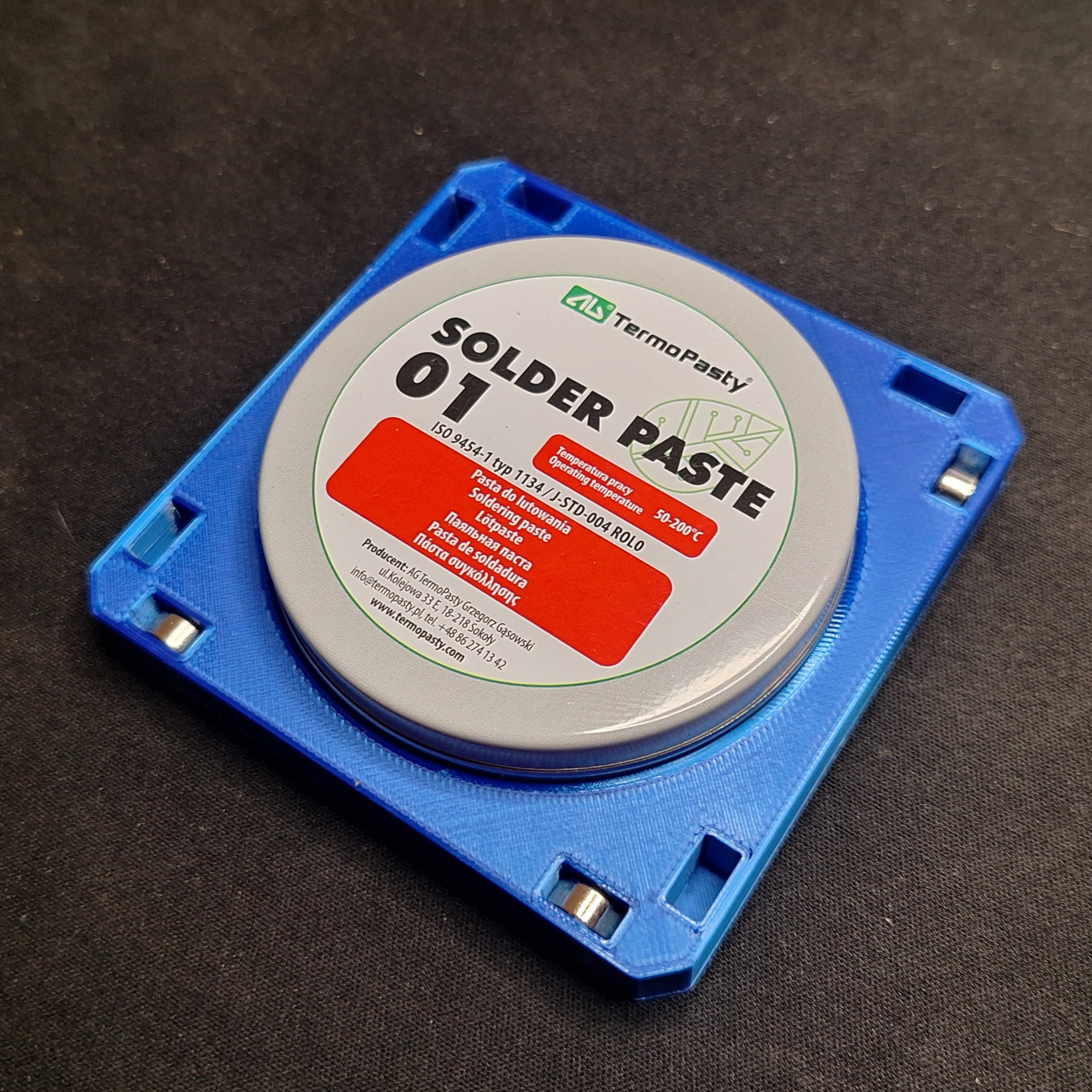
    That’s basically where it all started. I always have a problem with losing solder paste jars, so I wanted to make a holder where I’d always keep one. The tray is designed for a round jar with a 66 mm diameter. An extra 0.5 mm of tolerance is added to the diameter so the jar doesn’t get jammed in the tray.

  • Rules… without them, we live with the animals.

    szynyszyl12/29/2025 at 01:12 0 comments

    Rules should be simple. There shouldn’t be many of them, and they should be easy to remember. And in mechanical design, rules should be beautiful. Ugly rules are bad rules. A beautiful rule is a 10 mm base thickness for a tray. 7.62 mm would be an ugly thickness. Rules exist to be broken, but they should only be broken when it serves a purpose. Breaking rules just for the pleasure of destroying a beautiful system is like trampling fresh flowers growing in a forest clearing.

    RULES:

    • Basic cell dimensions: 80 × 80 × 10 mm
    • The space for magnets (or clips) starts 8 mm from the tray wall (8 mm is 1/10 of 80. That’s a nice rule).
    • The magnet slot is 8 mm long, 4 mm wide and 9 mm deep (those were exactly the magnets I happened to have at home over the holidays. Not every rule has to come from deep research; some are happy accidents).
    • Wall thickness at the magnets: 1.5 mm
    • The trays have 4 mm chamfered corners. I don’t fully know why yet, but I’m sure it will be important. And it looks much better.
    The modifiable space is a 66 × 66 mm square inside the tray. This comes from offsetting the tray’s outer dimensions by 7 mm, leaving an untouched rim for magnets and other mounting features around the entire tray. 6 mm was too thin, 8 mm was definitely too thick.

    That’s all. And yet, that’s everything. A handful of rules to brand the wicked and reward the righteous.

View all 2 project logs

Enjoy this project?

Share

Discussions

Similar Projects

Does this project spark your interest?

Become a member to follow this project and never miss any updates