 Silícios Lab

Introduction and Objective
The Problem
In the development of electronic monitoring systems, we often encounter a lack of devices that integrate precise reading and direct actuation. Industrial sensors are usually expensive and require complex PLCs. The need here was to create a compact and connected device capable of monitoring pressure in real time and reacting instantly to variations, without relying exclusively on the cloud for critical decisions, while maintaining remote supervision.
The Solution
The project consists of an intelligent control node based on the ESP32, using the MPS20N0040D-D piezoresistive sensor. The board not only reads the pressure and processes the data locally to manage a load via relay (such as valves or pumps), but also uses the power of the ESP32 SoC to overcome the physical barrier. Thanks to native Wi-Fi connectivity, pressure data is sent to the web, allowing industrial or residential processes to be monitored in real time from anywhere in the world through dashboards or applications.

Would you like to download the files and receive 5 printed circuit boards for this project? Access this link, create your PCBWay account, and download them now from our repository. Use the coupon and receive 5 free units delivered to your home.
The objective of this article is to present the complete solution for this electronic board, which was designed for pressure monitoring in various processes.
Throughout this text, we will detail the operation of each circuit on the board, from analog signal conditioning to power output protection.
Curious about how we transform millivolt signals into web-ready digital data? Follow the next chapter where we detail the Hardware Architecture.
Hardware Architecture and Electronic Schematic
Now we will detail how each component was integrated to ensure that the raw signal from the sensor is transformed into reliable information for the microcontroller and, subsequently, for the web.
The MPS20N0040D-D Sensor
The heart of the measurement is the MPS20N0040D-D sensor, which uses piezoresistive technology in a Wheatstone Bridge configuration.
,See the MPS20N0040D-D in figure below.

The major challenge here is its sensitivity: the output is a differential signal of very low amplitude (only a few millivolts). Without proper processing, any electrical noise would make the reading unstable, preventing accurate monitoring of industrial processes.
The ESP32 Microcontroller
We chose the ESP32 not only for its low cost, but also for its ecosystem. With two processing cores, it can read the sensor on one core while managing the Wi-Fi connection and data transmission to the web on the other. This prevents the network process from freezing or delaying pressure readings, ensuring true real-time monitoring.
Output Peripherals and Interface
The board was designed to be self-sufficient in the field:
Actuation Relay: Allows the board to interrupt or start a process (such as shutting down a compressor) as soon as a pressure limit is reached, acting as a local safety system.
Audiovisual Signaling: The buzzer and LED provide instant feedback to the operator. In IoT systems, local feedback is as important as remote feedback; the operator needs to know the system status even if the Wi-Fi network goes down.
Control Buttons: Allow interactions such as "tare" (resetting) the sensor or switching between manual and automatic operating modes.
Next, we will present the electronic schematic of the printed circuit board design.
Electronic Schematic
Below, we present all the blocks of the electronic circuit diagram.


One of the cornerstones of reliable hardware is its power management system. For this board, we designed a 12V VDC ~ 24 VDC input, a common voltage in industrial and automotive environments, which facilitates the integration of the project into real-world scenarios. However, to power the microcontroller and...
Read more »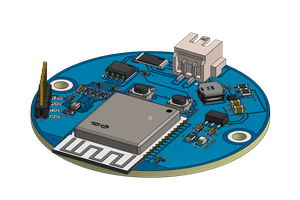
 Abid Jamal
 Dariush Salami
 agp.cooper