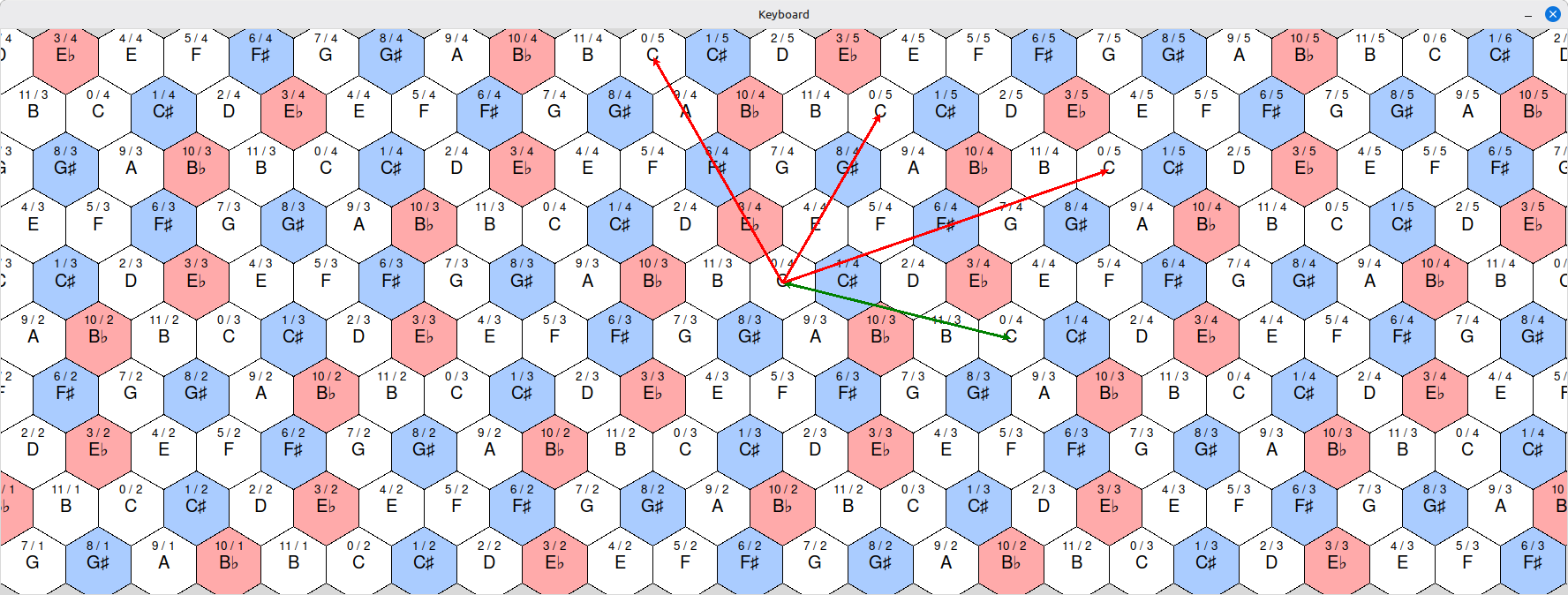
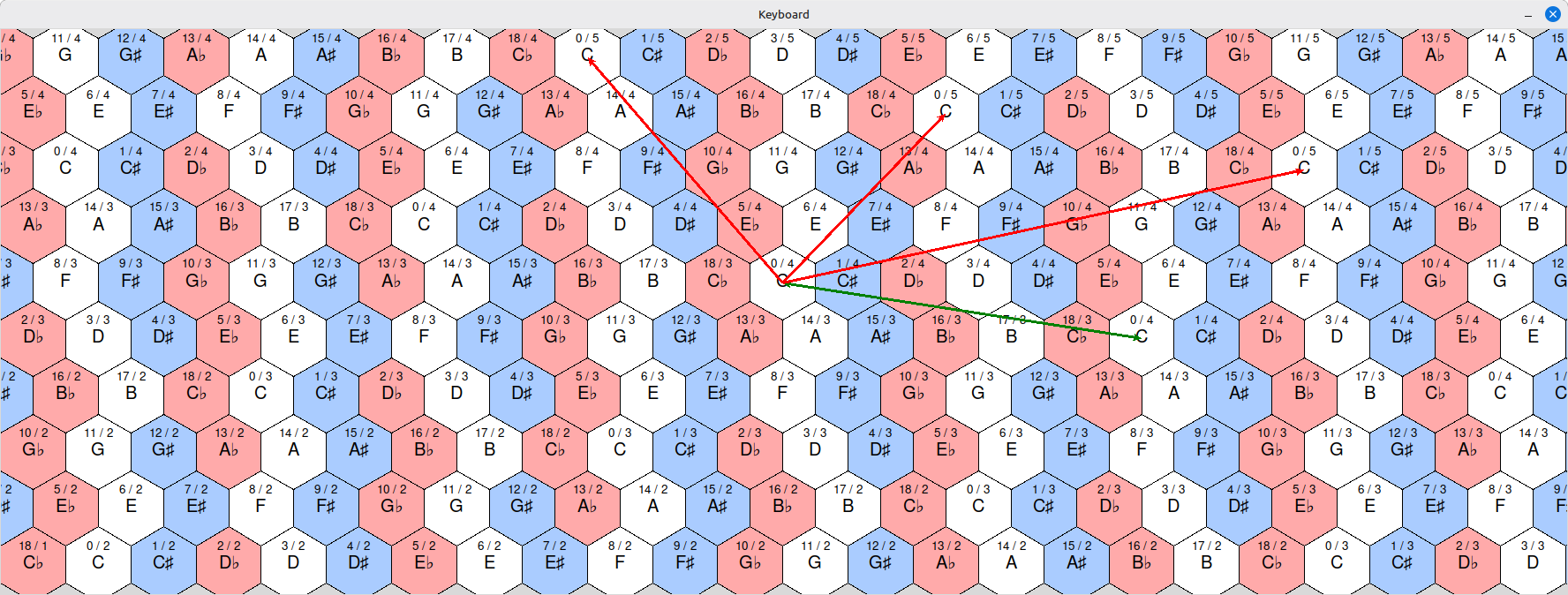
A music keyboard that is key-agnostic and microtone-friendly
To make the experience fit your profile, pick a username and tell us what interests you.
We found and based on your interests.
I mentioned "Isomorphic Tesselations for Musical Keyboards" by Maupin, Gerhard, and Park in a previous log. Here are some more comments on that paper.
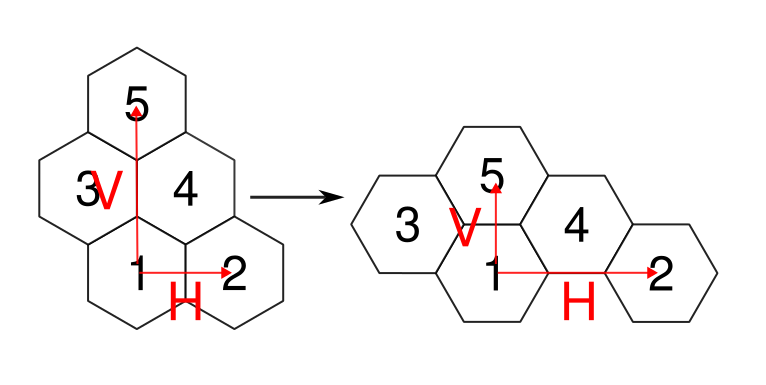
They consider a number of layouts and evaluate them for melodic and harmonic usage. Their conclusion strongly favors the Maupin layout, for which they show two forms: "original" and "inverse". Unfortunately they never give a definition of "inverse", and I honestly have no idea what it means for a square layout, but for hexagonal layouts "inversion" seems to mean this sort of transformation:
In their discussion of Maupin they write "The inverse arrangement is superior because the diatonic scale is less sloped and more linear, and the semitones are located directly above the root... The inverse arrangement offers chord shapes that are more comfortable to play." The first sentence seems to be copied and pasted from their discussion of Park, and I think is backwards for Maupin: It's the original arrangement that has the less sloped, more linear scale and semitones above the root. Likewise I think the original version's chord shapes are more comfortable.
Assigning Maupin's name to this layout seems presumptuous. "Original Maupin" looks like this:
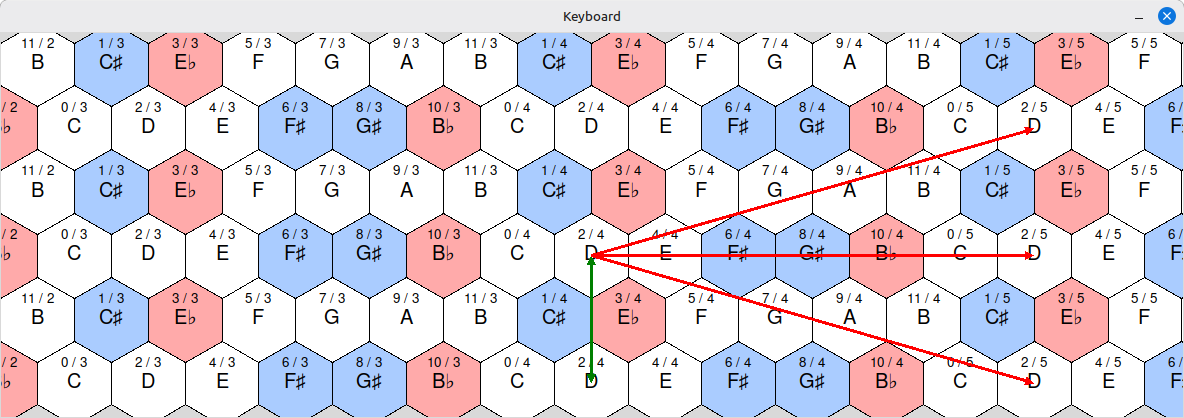
Compare that to Jankó:
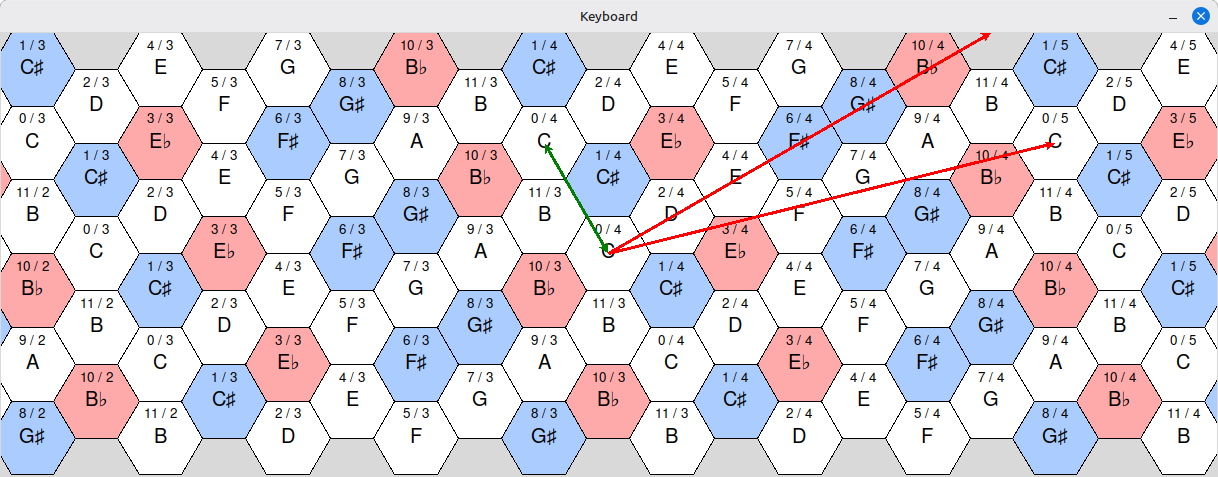
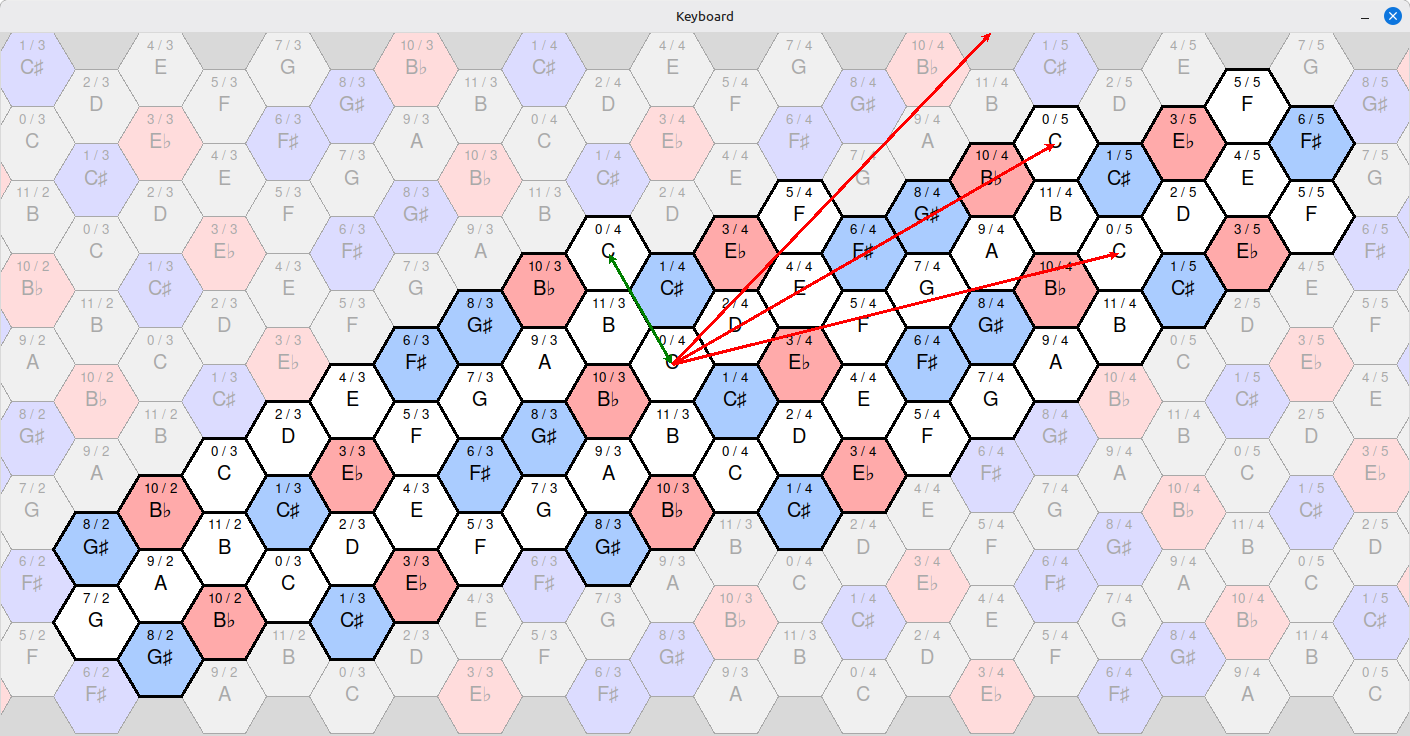
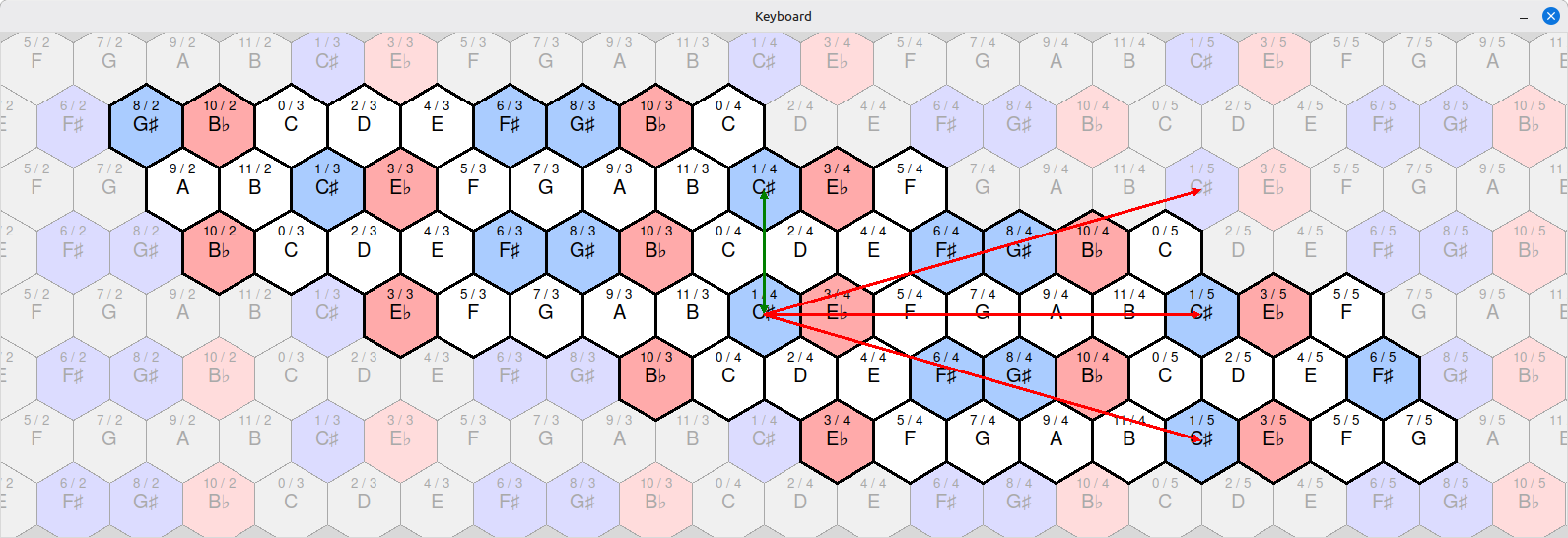
Maupin is exactly the same as Jankó, but rotated 30° counterclockwise. That might make scales easier to play with the right hand, but I'd think they'd be nearly impossible with the left. A 2-octave Maupin layout occupies a narrow stripe along the diagonal of a wide box:
while the same for Jankó more completely fills a narrower box:
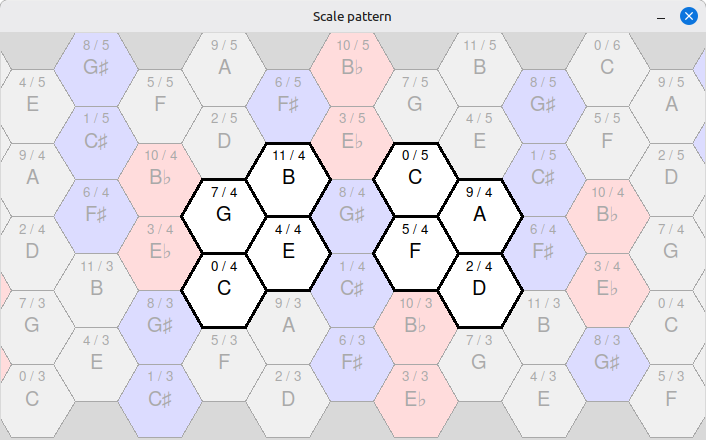
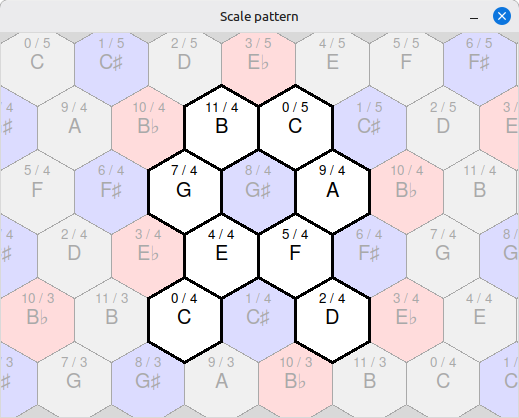
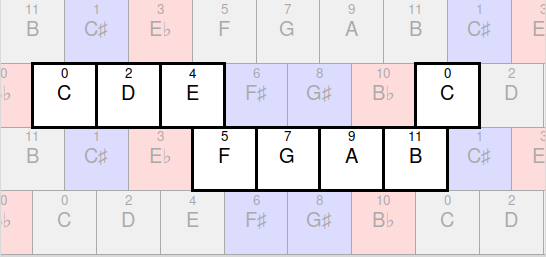
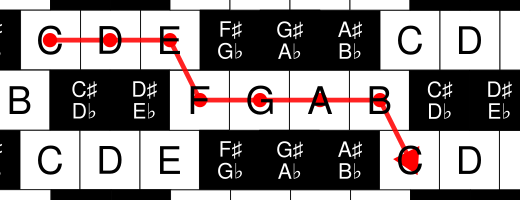
The diatonic scale pattern is interesting:
You bounce back and forth left to right in a nicely symmetric way. But notice you end with B, then C two columns to the right; if you want to continue the scale to another octave, you need to play that C with probably the first finger, then stretch another finger a further four columns to the right to hit the D, then continue as before upward but three columns right. A rather big shift to cover in three notes. Or you could continue bouncing back and forth, using the D on the left, E on the right, and so on, but that means the second octave pattern is different from the first, a violation of the isomorphic idea.
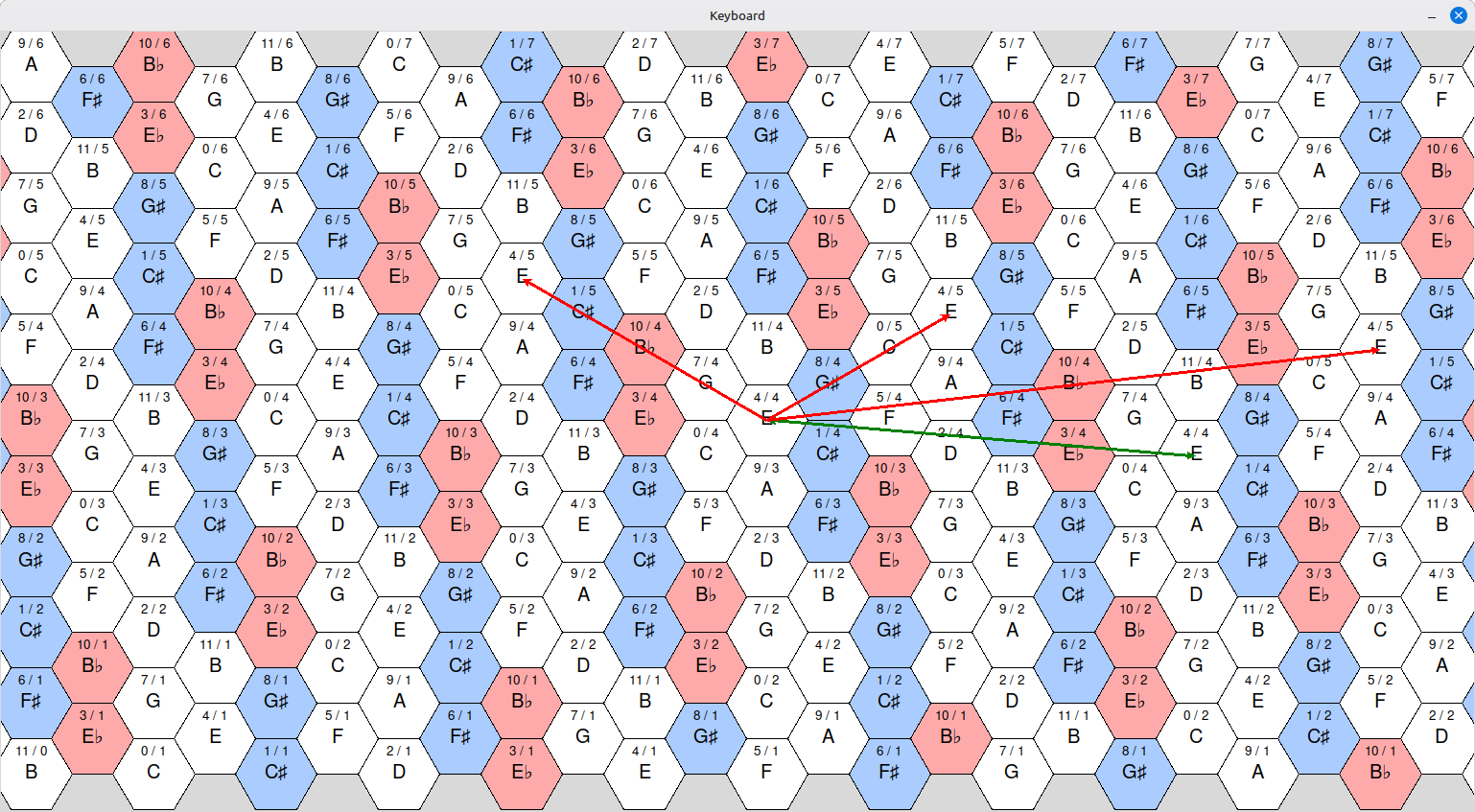
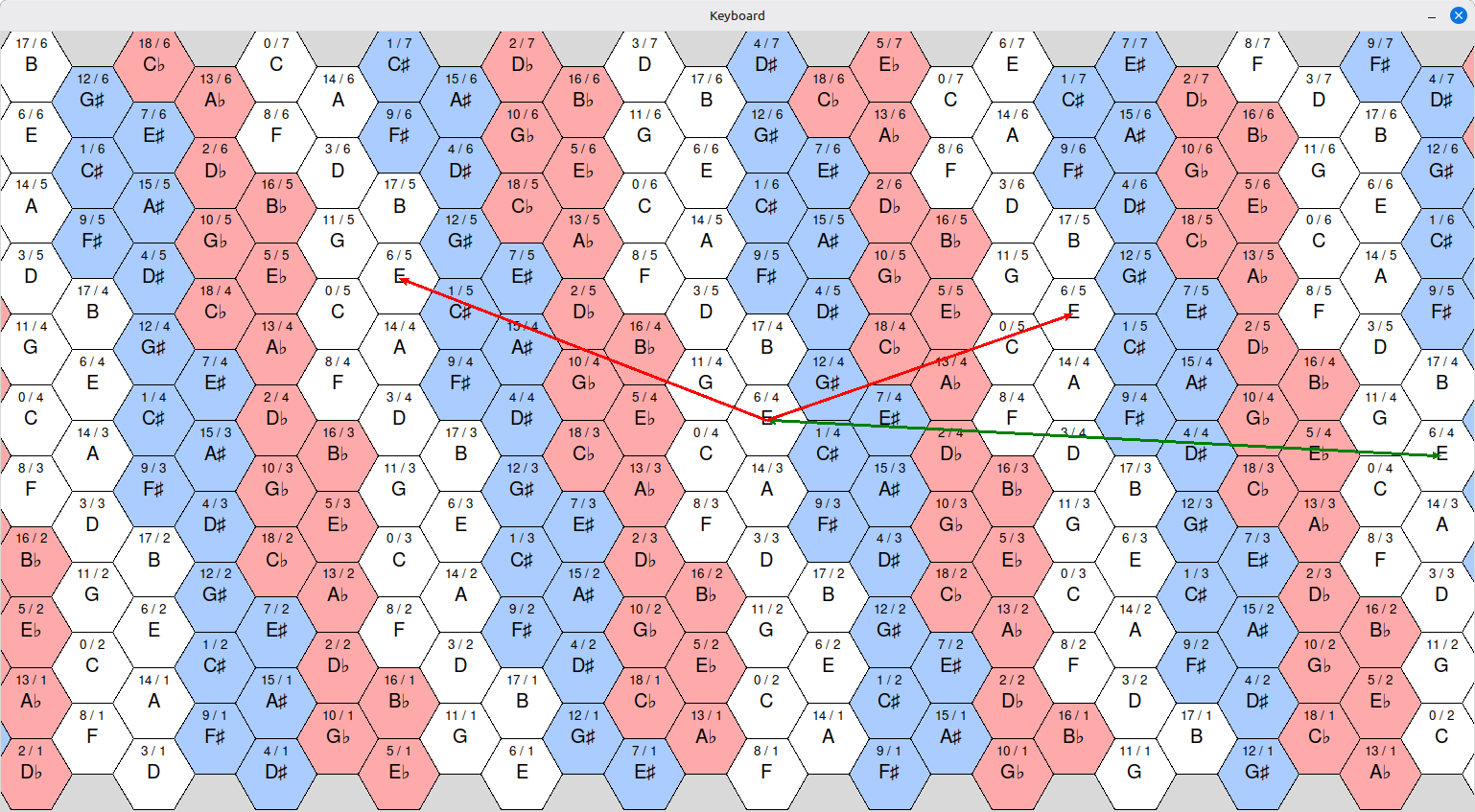
The similar layout in 19EDO is like this:
and there it's four columns from B to C and a further six columns to the next D. Preposterous!
The inverse version of the harmonic layout is saner:
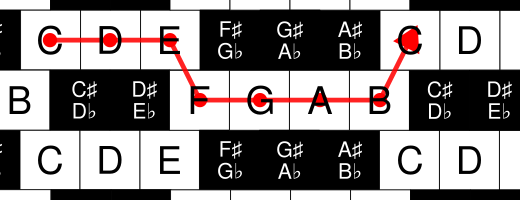
Here the scale pattern is narrower:
The distance from B to C to the next D is only three columns. Here's the 19 EDO version:
and it's five columns from B to C to D. Better, though still rather ugly.
The dominant seventh chord seems awkward in the original harmonic layout, and really awkward in the inverse. For the right hand, anyway. It looks fine for the left in the inverse. That seems to be a kind of generic problem for isomorphic keyboards: Things that work well for the right hand are often clumsy for the left, and vice versa. Taking a cue from split computer keyboards, maybe what you really need is two isomorphic keyboards, one optimized for one the left hand and one for the right! At least the conventional keyboard is fairly similarly good or bad for both hands. A point in favor of Jankó, or for just about any layout that has whole tones in the horizontal direction, is that the scales aren't very much slanted in either direction, so don't heavily favor one hand over the other. That plus Jankó's proximity of the semitone to the root, and the...
Read more »Perhaps a change of terminology is in order.
I've been looking at this paper by Maupin, Gerhard, and Park. They aim to discuss isomorphic keyboards in a general way, but unfortunately they do so strictly within 12EDO tuning.
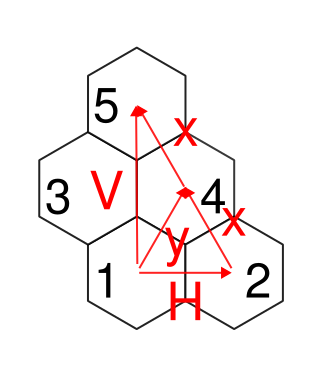
They characterize hexagonal layouts (staggered rows are essentially equivalent to hexagonal) by two numbers corresponding to the horizontal and vertical intervals — H and V in the diagram below.
For Jankó, H = 2 and V = 0 because key 2 is a whole tone (2 degrees in 12EDO), and key 5 is a unison (0 degrees), above key 1. Key 4 is a pitch halfway between the keys 2 and 5, so x = -1 semitone. y is +1 semitone.
But you can't describe what I've called 19EDO Jankó as having H = whole tone, V = unison because such a layout doesn't exist in 19EDO. You can see that because a whole tone in 19 EDO is H = 3 scale degrees, and x is half of H – V = 0 – 3, so it's -1.5 degrees — there's no such note in 19EDO!
If you think about these layouts in terms of diatonic intervals, rather than EDO scale degrees, you realize with H a whole tone upward and x a chromatic (let's say) semitone downward, then V is a whole tone minus two chromatic semitones — if key 1 is C then key 5 is D𝄫. In 12EDO that's enharmonic with C; in 19EDO it's enharmonic with C♯ (it's D𝄫♭, not D𝄫, that is enharmonic with C), and that is why an H = whole tone, V = unison parameterization doesn't work in 19EDO.
My first thought was "this is not a suitable way to refer to Jankó in non-12EDO tunings." But my second thought was "The name 'Jankó' is not a suitable way to refer to any layout in non-12EDO tunings." After all, the V=unison aspect was crucial to Jankó's approach. In a Jankó piano those two "keys", and the third one two rows higher that also plays the same note, really are physically all one key controlling one hammer striking one set of strings; there simply are three touch pieces on that one key. To do the analogous thing on a 19EDO piano you'd have to work out a design for a key that has touch pieces that are three rows apart and have a half touch piece width offset from each other.
You can have a 19EDO layout in which, like Jankó in 12EDO, H is a whole tone and y is a semitone, and then the closest keys to your starting point look close to the same. But go up two rows and things are different. The unisons are in different places, and that means you have to play the two layouts differently. It doesn't really make sense to call both layouts "Jankó".
In other news, I took a look at some of the pruned layouts I'd done and realized they were even goofier than I thought they were. In some the lowest and highest octaves have holes: for instance, there's an F♯, G♯, and A♯ at the low end but no G, A, or B. I've been improving the logic to make the layouts more sensible, but they tend to be a little larger.
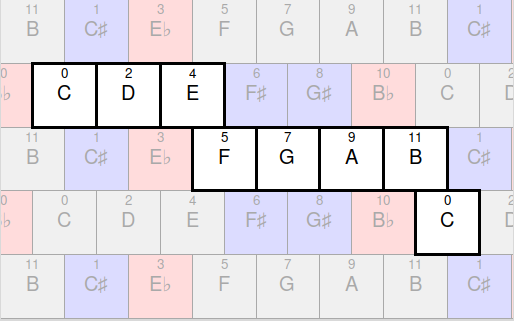
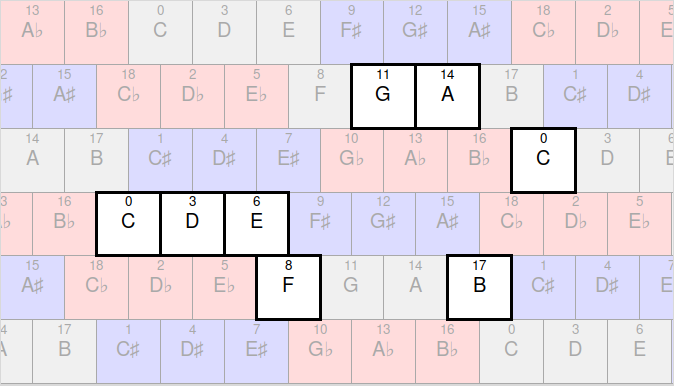
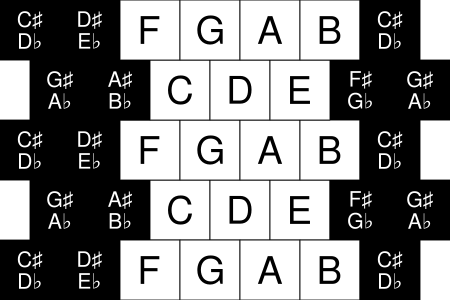
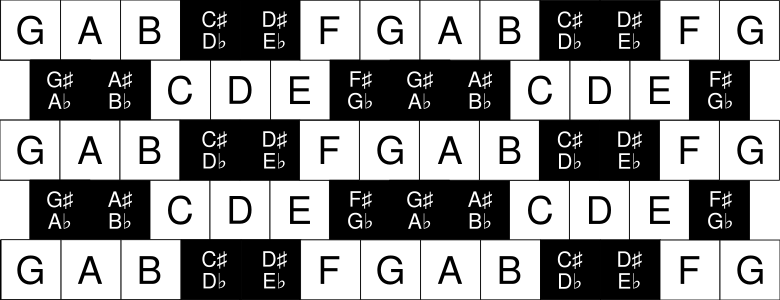
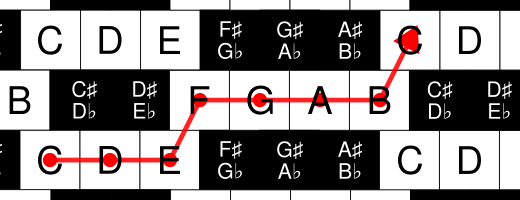
My thoughts on keyboard pruning were based on an assumption that you would use a pattern like this for a major scale:
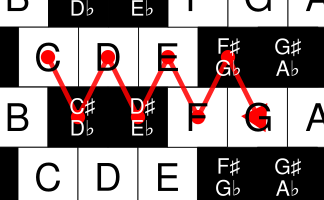
or alternatively:
(I'll call these Patterns 1 and 2.) How would you play these? Starting with Pattern 2, by analogy with standard piano (note, I am not a proficient keyboard player, I took two years of lessons when I was about 8, so I may get some of this wrong), playing with the right hand, you'd probably do CDE with your thumb and first two fingers, cross the thumb under to play F, continue to GAB with the first three fingers, and then cross the thumb under for C. For Pattern 1, I think more likely you'd use fingers 1–3 for CDE, thumb for F, fingers 1–2 for FG, thumb for B, finger 1 for C.
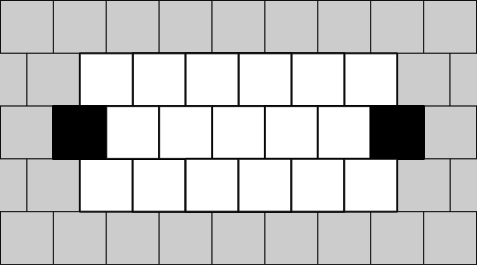
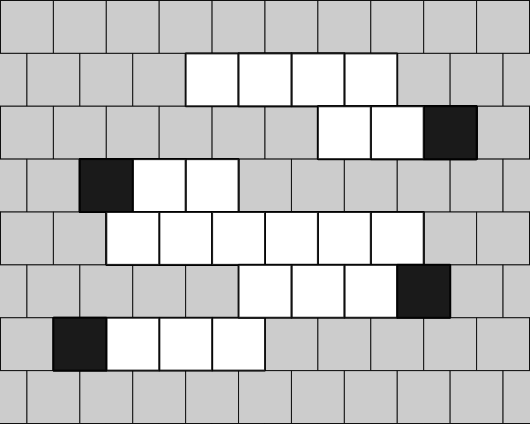
Focusing on Pattern 1, the keys used to play all the modes on a given tonic note are:
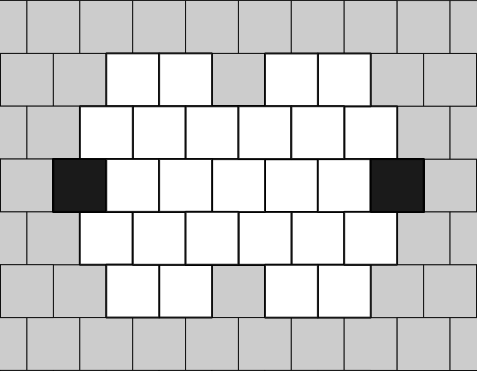
The black square on the left corresponds to the tonic note, and the one on the right is an octave higher. You need three rows, and can continue to higher octaves with the same three rows. That will get you half the scales, the other half start a row higher, so you end up needing four rows.
The second pattern (which is what I assumed in the previous log) shifts you down a row for each octave, which probably you would want to avoid.
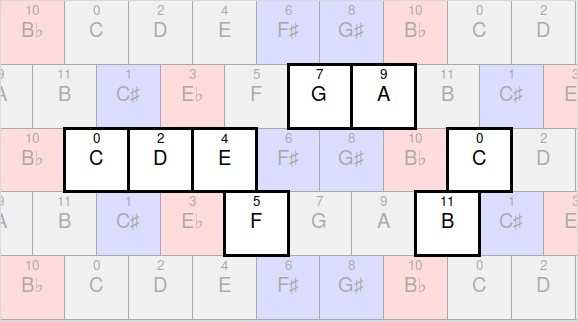
But this video prescribes a different major scale pattern (Pattern 3):
Fingering is fingers 1–3 for CDE, thumb for F, fingers 1–2 for GA, thumb for B, finger 1 for C.
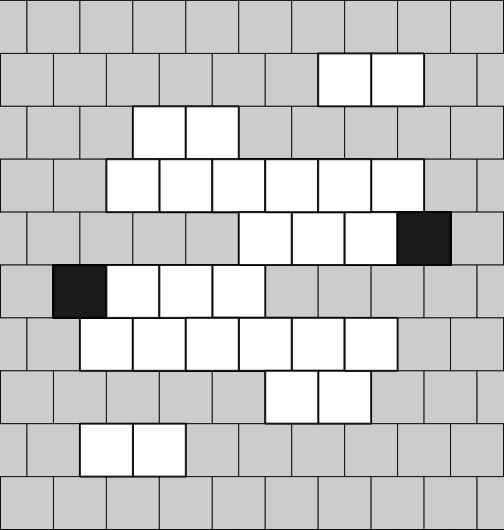
This probably does make more sense. Bringing the thumb under for B is easier using the A two rows higher. But with that pattern, the keys needed to play all the modes (and I'm assuming all modes are played with the same pattern, just starting at a different place in the pattern) are:
This needs five rows, not three, for all the modes starting on C. Six to cover all the starting notes. Using this scale pattern, the pruned layout for a single octave, 12EDO keyboard goes from 42 keys in 4 rows (as seen in the previous log) to 78 keys in 6 rows! Which is the number of rows on a Jankó piano. Go figure.
Not only that, but the layout becomes much less parallelogram-ish, more rectangular. There's rather little to be gained by omitting the keys at the ends of the top and bottom rows.
That's in 12EDO. Things get a lot hairier in 19EDO. Pattern 1 doesn't work; you can't end up repeating the tonic on the same row you started on. So I assumed Pattern 2. But if you adjust Pattern 3 to account for the difference in the enharmonic vector, it becomes (Pattern 4):
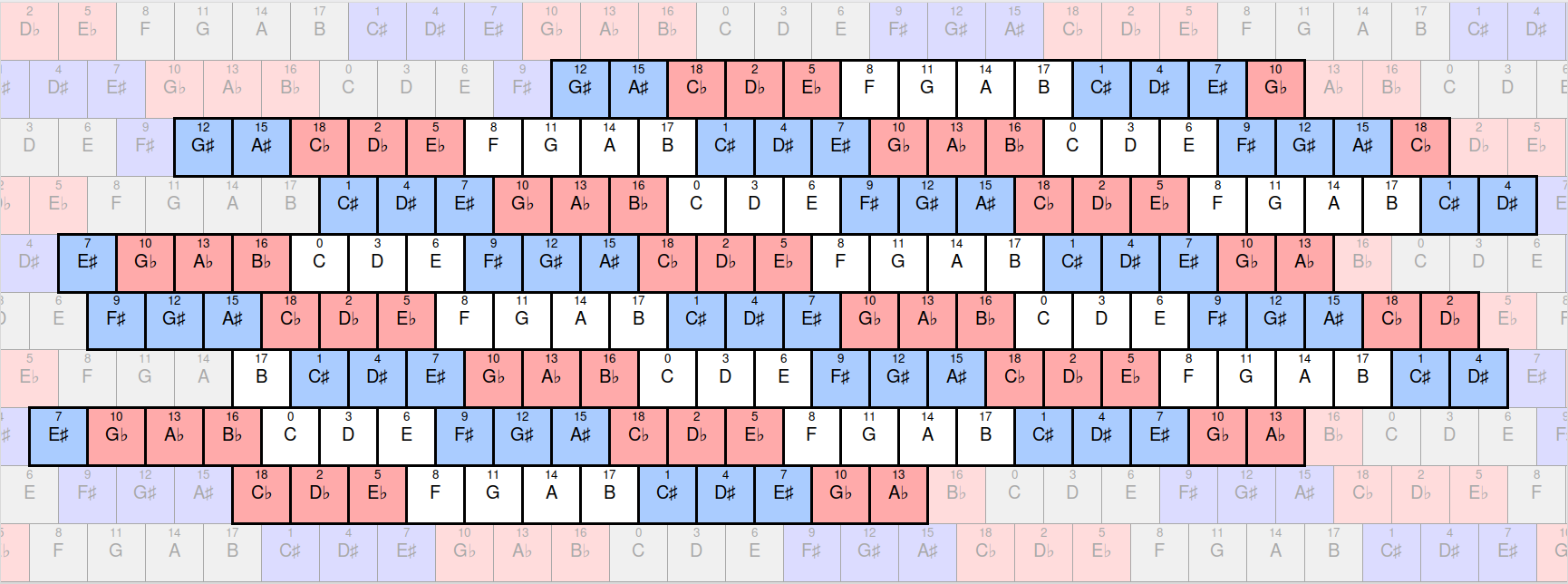
And then the keys needed for all modes on a single starting note become this alarming thing:
This needs eight rows! This is slightly mitigated by the fact you end one row higher than the start, instead of two rows lower as in Pattern 2. So you only need one additional row for each octave rather than two. Still, that's nine rows for two octaves, and then for all modes on all starting notes, you're up to ten rows.
That's if you insist on starting every mode on the same key. You can do a little better if you start the Lydian and Locrian on another key, three rows down and a half key left, that plays the same note:
158 keys in 8 rows, up from 86 keys in 6 rows with Pattern 2! It doesn't fill a rectangle as much as the 12EDO one does, but this is based on just playing diatonic scales; if you want to play 19-note chromatic scales you'll want to fill in at least a few more keys. Again, you don't gain much over just filling a rectangle with keys.
Do you want to see the same for 31EDO? No, you do not.
Pattern 3 may be the best choice for 12EDO, but the analogous Pattern 4 in 19EDO really seems to go off the rails.
As mentioned, there is a lot of redundancy in the Jankó layout: Every other row is the same. In the interests of finite space and finite cash, how much redundancy can be eliminated?
First, how many rows do you need?
In 12EDO, you can play a scale on two rows starting on the first row in any of six key signatures. And you can play the other six too if you start on the second row, but to play them with the same fingering pattern you need a third row.
Is that enough? Well, suppose you have a song that starts in C major and modulates to G. You can play the first part on the first two rows and the second part on the second and third rows. But now if you want to transpose that song to, say, A major, you'd need to play the first part on the second and third rows and the second part on the third and... fourth? You'd need four rows. That might be enough for most purposes, but I note the pictures I've seen of Jankó pianos have six rows.
Four rows really isn't enough in other tunings, In 19EDO a chromatic scale requires three rows. Playing a diatonic scale over one octave in one key requires two rows, so doing that in all keys requires four. But going into the second octave — even just to add the tonic at the top end of the scale — would require either a huge jump to the right or going up another row; now we're up to five. Six for two full octaves. Probably for 19EDO you'd want at least six rows.
How wide do the rows need to be? Suppose you always play scales on a slant from upper left to lower right, as is an option in 12EDO and is required (in one direction or the other) in 19EDO. Then if you have a rectangle filled with keys in six rows, how often would you use the keys in the lower left or upper right corners? Probably not much. So maybe what you'd want is shorter rows, offset so the whole keyboard is roughly a parallelogram rather than a rectangle.
Let's quantify this somewhat. Presumably you want to be able to play major scales. Presumably also minor scales. In fact, let's say you want to be able to play in any of the seven diatonic modes. If you work it out you find that the seven modes starting on C use a total of thirteen notes per octave between them: C, D♭, D, E♭, E, F, F♯, G♭, G, A♭, A, B♭, B. (Of course in 12EDO, but not in other tunings, there are only twelve notes because F♯ and G♭ are the same.) So provide a key for C and keys for the other twelve notes (plus another thirteen for each additional octave you want) and you can play in any mode on C. Provide a key for D and twelve (or 25) more keys and you can play in any mode on D. Do the same for all twelve or nineteen or whatever notes and you can play in any mode on any tonic note.
But having picked your C, there are lots of Ds to choose from; which do you use? It probably make most sense to use the same D that you already provided to play a C major scale. Et cetera; the goal would be to maximize overlaps between the keys for modes on a given tonic note and those used for modes on all the other tonic notes.
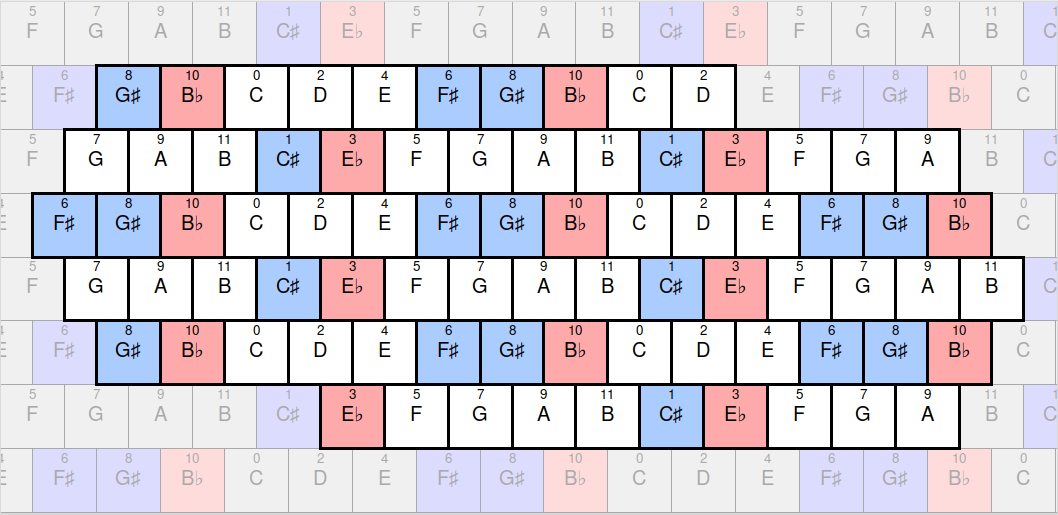
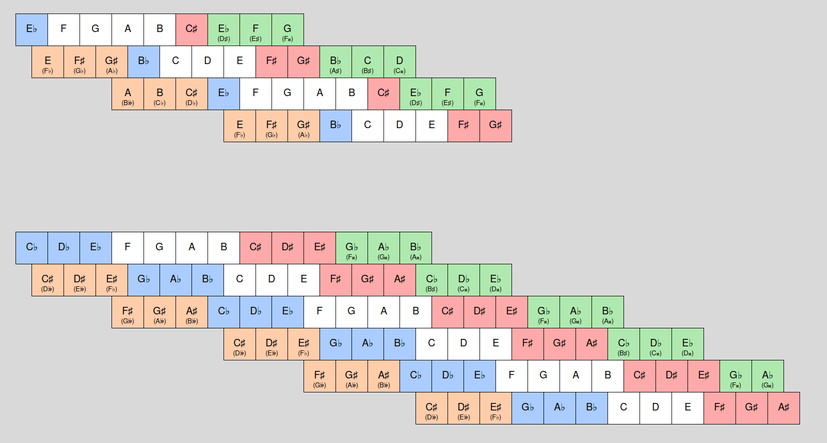
Which might be a tough optimization problem, but we're not handing out prizes for optimization. If you're using one or two more keys than the minimum, no biggie. For 12EDO over mode ranges of one octave, and for 19EDO over two octaves, I think these layouts ought to work pretty well:
I happen to know the 19EDO one is not the best, not in the sense of using the fewest keys. It uses 86, and I found another arrangement that uses only 85. A savings of a whole key, and with the added benefit that the total width is smaller — but it requires a seventh row. On the whole I like the one shown here better.
There's an additional factor at work. I've discussed these layouts assuming a tuning of an equal division of the octave into twelve steps (12 EDO). But a nice feature of these systems is that they can be used for other tunings. In these the rule that, for instance, C♯ is the same note as D♭ is not true, and there can be notes between E and F and between B and C. In 19 EDO, for example, each black key of a standard piano keyboard becomes two keys, and two more black keys go above E and B. It would be terrible trying to play 19 EDO on a standard keyboard; the layout doesn't at all match.
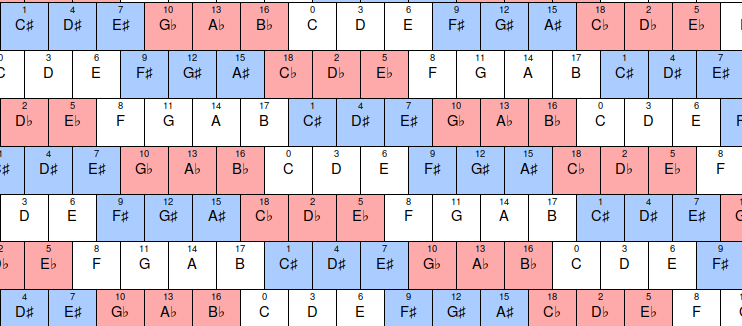
But you can map 19 EDO to an isomorpic keyboard in any of its layouts:
However, if you use Jankó for 19 EDO, you find it loses its symmetry; alternate rows are no longer the same. C♯ lines up with D♭ two rows down, for instance, not with another C♯. You still get duplicates — if each row is 19 keys wide then each row contains all 19 notes — but they don't line up the way they do in 12 EDO. In fact the duplicates are three rows apart, plus a small left/right shift. What it comes down to is that going above and right takes you up a chromatic semitone (C to C♯ for instance) while going below and right takes you up a diatonic semitone (C to D♭). Or vice versa. In 12 EDO chromatic and diatonic semitones are the same size, so you arrive at the same note either way, but not in any other tuning.
An implication is that you can only play scales on upward or downward slants. You can choose the mapping to do either, but not both, and you can't do horizontal. My sense is that playing scales (with the right hand at least) would be easier with the downward slant.
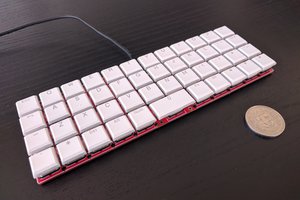
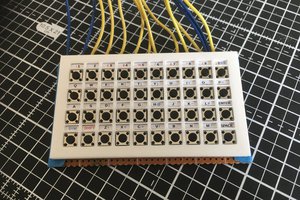
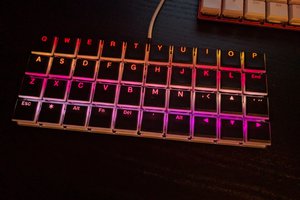
Something I've had on my mind for several years was to build an isomorphic music keyboard for use with synthesizers. I've finally moved that off the back burner and started design.
An isomorphic keyboard is one which, unlike a standard piano/organ keyboard, lets you play scales or tunes in any key without having to change the fingering patterns you use — you just shift your hand to a different point on the keyboard. In other words the intervallic relationships between keys are matched with their relative physical positions.
Isomorphic keyboards are especially well suited to electronic instruments, but ones for acoustic instruments go back at least into the nineteenth century. There are concertinas that have isomorphic button layouts, and chromatic button accordions.
There are numerous different isomorphic systems, of which Wicki-Hayden and Jankó seem to be the two most commonly used layouts. Both of these feature keys or buttons laid out in staggered rows. In both the keys along a horizontal row are whole tones apart from each other. The C key is next to the D key, then comes E, then F♯ (there is no E♯, or more accurately E♯ is the same as F♮, so a whole tone above E is F♯), G♯, A♯, C, and it repeats from there (an octave up). So half the twelve note chromatic scale is in one row. The other half is in the next row: C♯, D♯, F, G, A, B.
Where they differ is in the offset between the two rows. In the Wicki-Hayden layout the note above and to the right of another note is a perfect fifth higher: G is above and right of C. So the layout looks something like this:
This works very nicely for diatonic scales. What is less nice is that notes a semitone apart are fairly distant from each other, so a chromatic scale is (I think) rather confusing, major and minor chord shapes are very different, and augmented and diminished chords are even more different.
The Jankó layout has an upward semitone as the note above and right. And since a whole tone is two semitones, it follows that the note below and right is also an upward semitone. It comes out looking like this:
Here the diatonic scales are harder to play. Notes an octave apart are more of a stretch, and playing a scale requires moving the hand back and forth.
On the other hand, semitones are adjacent keys, the chromatic scale is very tidy,
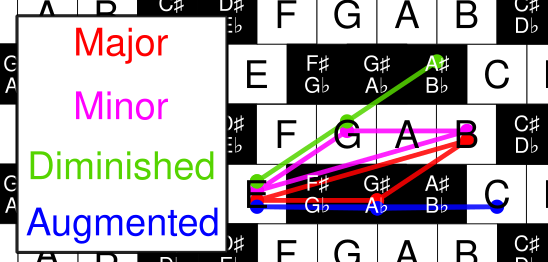
and major, minor, augmented, and diminished triads are quite similar.
An interesting attribute is that, while in Wicki-Hayden alternate rows are an octave apart, here they are the same. That means a fully populated array with, for instance, six rows has, for every note, three keys that play that note. This strikes me as more redundancy than necessary. But it does mean you can play diatonic scales not only slanting upwards as you go up the scale, but also downwards
or horizontally.
Another system is similar to Jankó but with the upward semitone going above and left instead of above and right. Actually I don't know what to call this layout; I haven't really seen it used in an isomorphic keyboard, though it's sort of related to the bayan accordion layout. I was contemplating it for a while, mainly because it puts octaves closer together and reduces the distance you have to move your hand side to side in playing scales relative to Jankó, while keeping the semitones reasonably close together. But I ended up deciding the chords are too awkward.
Create an account to leave a comment. Already have an account? Log In.
Become a member to follow this project and never miss any updates
Eric Jacob
deʃhipu
leadacid44