Tony Goacher
-
Prime time TV, lasers and an Amiga
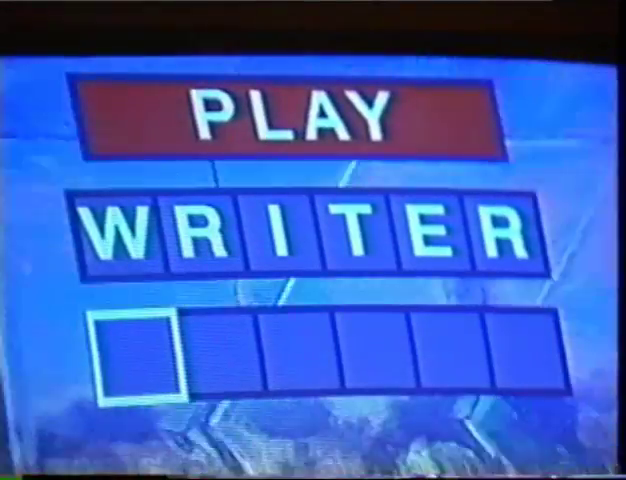
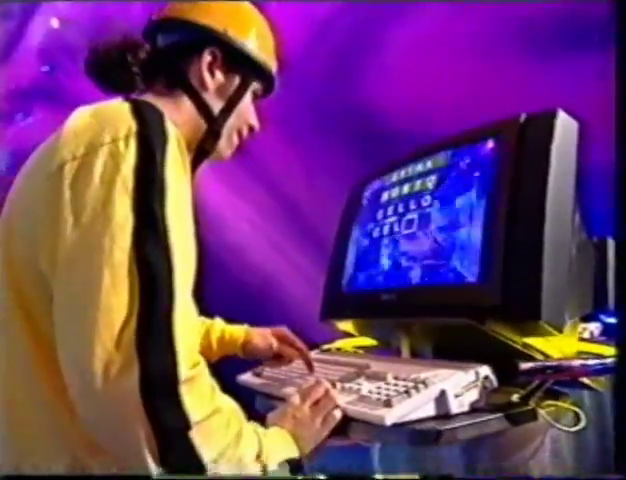
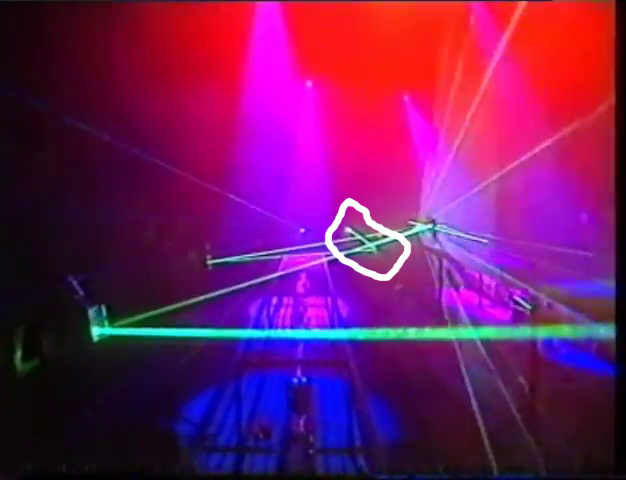
4 hours ago • 0 commentsThere's no decent pictures of any of this project. No digital cameras in those days. So you'll have to tolerate screen shots from a digitised VHS copy of the show itself. Though there is a link to the Super Round itself here.
It’s 1995. A friend of mine worked in the repair department at Granada Studios in Manchester, UK, but as part of an outsourcing drive,he was laid off—but he kept in touch with people there. When *The Krypton Factor* was being revamped, word came through that they were looking for someone to develop a “Laser Matrix” game.
We met with producer Tony Warren in Studio 12’s (it was huge) control room. On the way in, we even held the door open for Rita Fairclough from *Coronation Street*.
He explained the concept:
A challenge would appear on the Amiga screen—simple words, but with the keyboard alphabet shifted forwards or backwards.
The player couldn’t proceed until they solved it.The Amiga was chosen because of its genlock capability, allowing studio cameras to film the display without flicker.
Once completed, the player entered the laser matrix. A beam oscillated between two paths. Breaking the beam triggered a penalty light, and the player had to remain still until it went out. This, in effect, was a time penalty for breaking the beam
Our job was to:
* Detect the laser beam
* Feed that signal into the Amiga
* Let the Amiga trigger a signal back to the control room
* Convert that into a 10V control signal to drive a studio lightDMX was not used in the studio...everything was analogue.
![]()
![]()
The production would supply the lasers, Amiga, mirrors, and mounting. We had to build the electronics to tie it all together.
We were told the laser would be “visible”. We accepted. Given a deadline, we got to work.
I found an optical sensor that worked across most of the visible spectrum and designed the circuit in EasyPC (still going!).
Input to the Amiga was simple—a transistor switching 5 V.
Output to the control room was more interesting.
The control room was about 100 m away and electrically noisy. I used a 20 mA current loop to send the signal reliably. A second box in the control room converted that back and drove relays, switching a 10 V signal from the lighting desk.
---
The company I worked for had a proper PCB prototyping setup, so:
* Artwork plotted at 2:1
* Reduced onto presensitised board
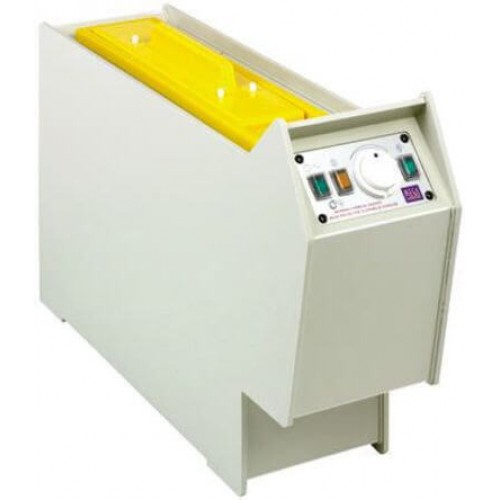
* Etched in an RS tank
* Drilled by handAll very civilised.
![]()
The production team had experimented with red laser diodes first. These cost a few hundred pounds at the time—but were basically invisible to TV cameras, even with haze.
So they brought in a laser display company.
They turned up with two argon-ion lasers.
These things were enormous—glass tubes about a metre long, requiring three-phase power.
This was not what I had in mind when they said ‘visible’.
Efficiency was under 0.1%, so they were water-cooled using a total-loss system:Tap → laser → drain.
I remember being told they were around 30 W optical output.
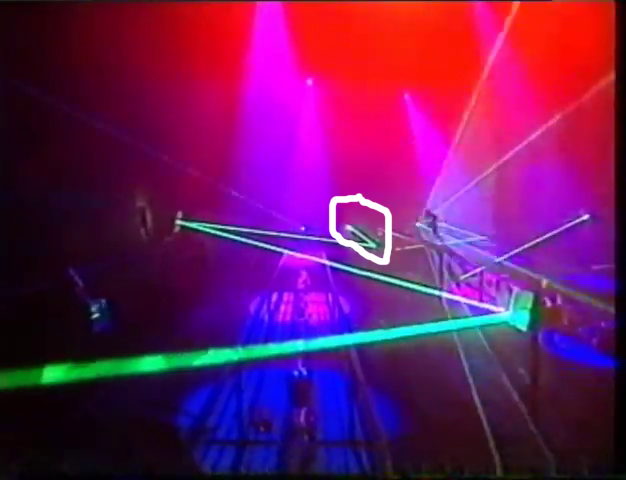
They produced blue and green light. The blue was removed using internal optics, leaving the green beam, which was fed into a built-in galvanometer scanner. The system switched the beam between two paths to make the maze more difficult.
We only had a single optical sensor. The beam switched paths in milliseconds, so the Amiga software simply ignored that brief gap.
You can see the two beam paths in the screenshots—the sensor sat at the final section where both paths converged.
![]()
![]()
Granada built the frame from 20 mm box section steel, with a raised walkway down the middle. The beams ran roughly at knee height.
When we arrived to set up, we discovered that mounting everything to the same frame was a mistake—any movement caused enough flex to throw the beam off the sensor.
Our fix was… direct.
We got an angle grinder and physically separated the walkway from the optical system.
Problem solved.
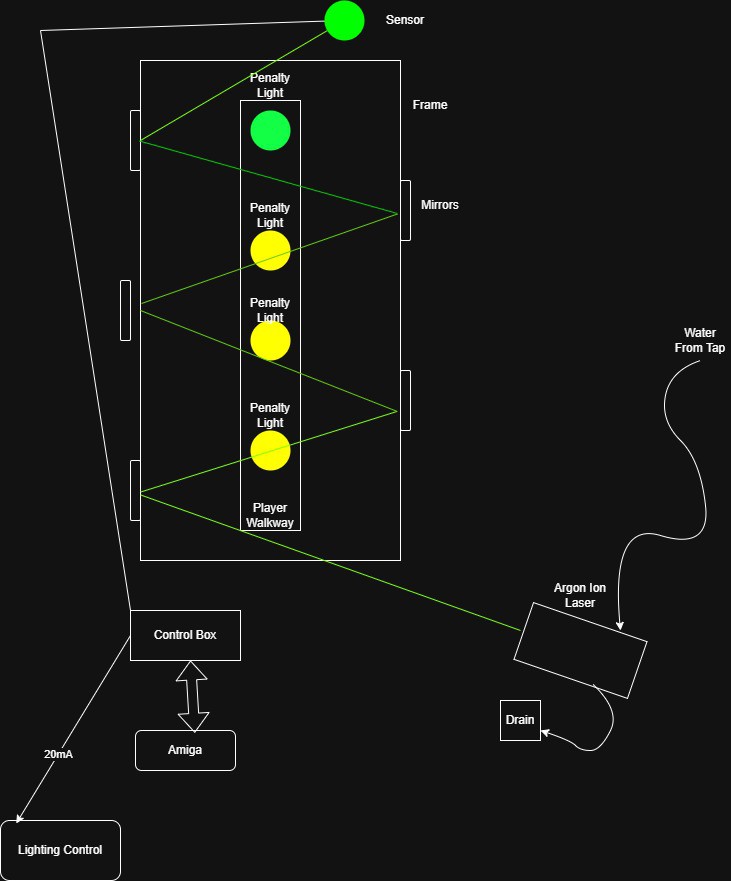
Here's a diagram of the system![]()
So picture this:
* Tens of watts of coherent light
* A narrow raised walkway
* Lasers at knee height
* Contestants stepping over them in a hurryPerfectly safe.
As for safety measures, the installation had:
Absolutely nothing.
No eyewear.
No interlocks.
No emergency cutoff.To be fair, I wasn’t responsible for the lasers… your honour.
I was present for several filming sessions and thoroughly enjoyed it. Long days, late nights, but I got to be part of a primetime TV show.
And we got paid… eventually.
The Super Round didn’t save the show. It ended after that series, with brief revivals in 2009 and 2010.
So I can honestly say:
I played a small part in the downfall of a UK primetime TV show.
Prime time game show, lasers and an Amiga
In 1995, the UK game show, The Krypton Factor, tried to reinvent itself. They needed a laser matrix game, and I was involved.