 Sagar 001

I am a fan of audio technology as it is cleared from most of my articles. I always try some new ICs or audio related things here. And today is the time for class D amplifiers. I made a subwoofer speaker that can handle up to 200W in stereo but I don’t have any good amplifier system that I can directly fit into my car. And that thing brings me towards TPA3221 IC. For the same price, anyone can get cheap Bluetooth speakers. But they distort at half volume, the bass rolls off a cliff. I want to drive my TP3221 amplifier directly from the car battery in this case.
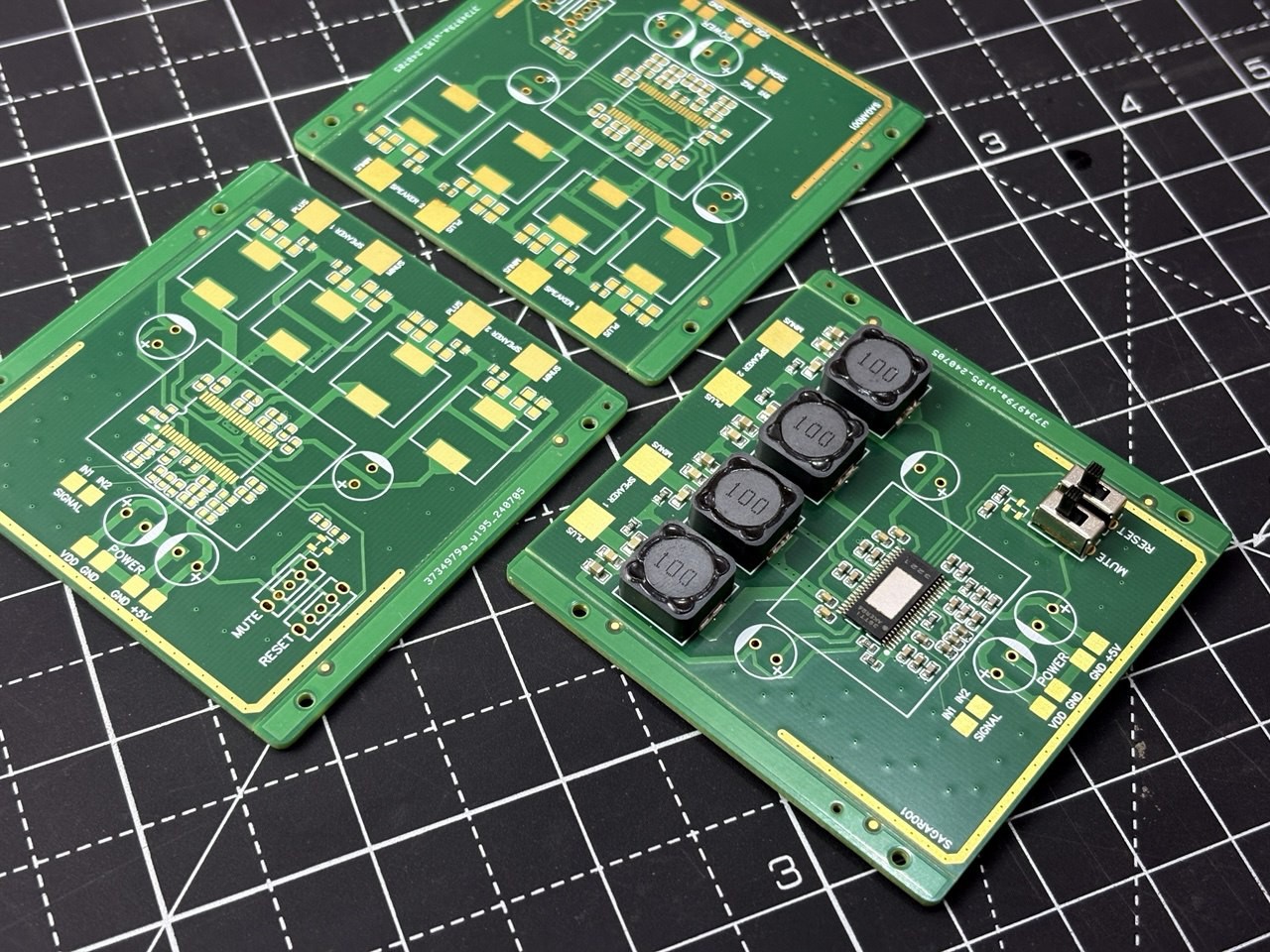
So that it can actually push real power into real speakers, with clean audio and proper engineering behind it. The goal was simple: a compact, high-efficiency stereo amplifier that can deliver 100W per channel into 4-ohm speakers. Just a clean analog-in, speaker-out power amplifier that I could pair with any source. In this article, I will walk you through the full design. Schematic and PCB layout with a real-world audio test and listening demo, check out the YouTube video linked with this project. I have designed a PCB in EasyEDA and fabricated it from JLCPCB and tested out the final prototype.
Why TPA3221?
There are dozens of Class-D amplifier ICs out there. The TPA3116, TPA3255, MAX98400 but the TPA3221 sits in a sweet spot that is hard to beat for a DIY stereo amplifier. Lets see what made me pick it:
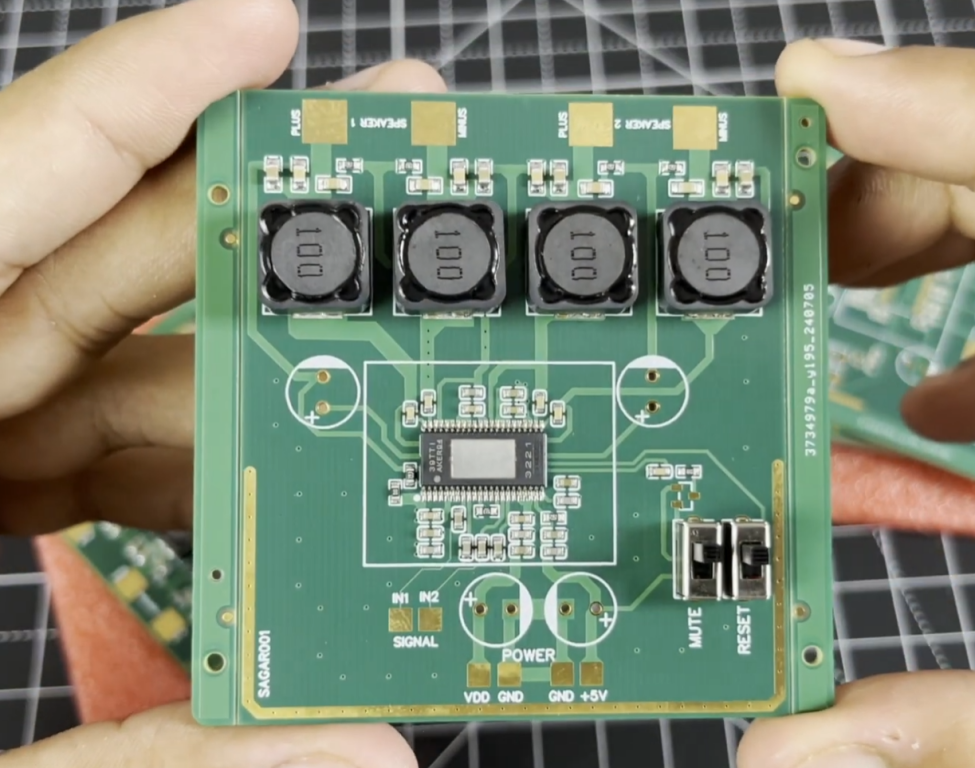
- 100W stereo (2 x BTL) or 200W mono (1 x PBTL) into 4-ohm loads.
- Closed-loop feedback architecture: It corrects for output filter and load variations in real time.
- 0.02% THD+N at 1W into 4 ohms.
- >108 dB SNR which is better than most commercial amplifiers in this power class.
- >90% efficiency at full load.
- Wide supply range: 7V to 30V on PVDD
- Built-in protections: undervoltage lockout, overcurrent and overtemperature
- Selectable gains: 18, 24, 30, or 34 dB that can be set with a single resistor
Circuit Design and Schematics:
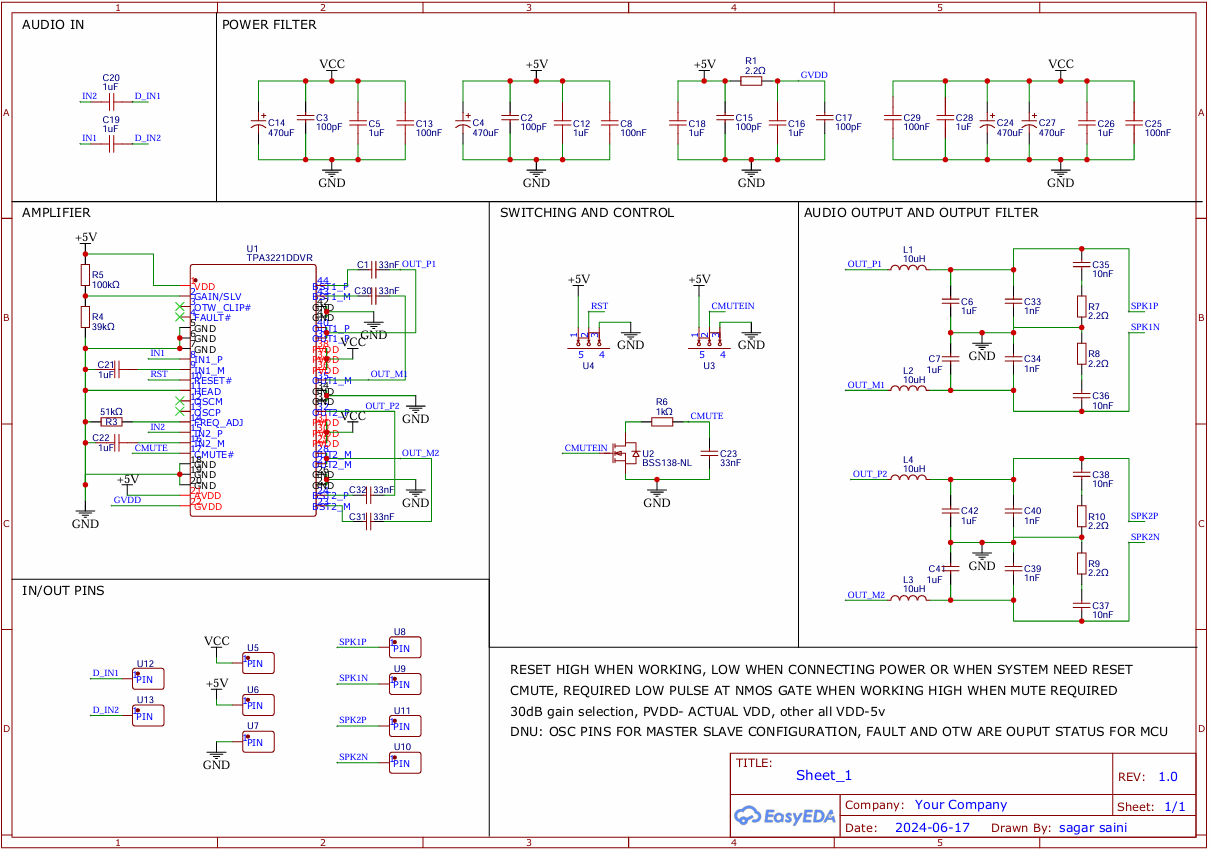
I designed the full schematic in EasyEDA and split it into four functional blocks: Audio Input, Power Filtering, Amplifier + Control, and Output Filter. Let me walk through each one.
1) Audio Input:
The input stage is straightforward. I used single-ended inputs (IN1, IN2) through 1uF AC coupling capacitors (C19, C20). These block any DC offset from the source and pass only the audio signal. The positive input pins (IN1_P, IN2_P) receive the signal. The negative inputs (IN1_M, IN2_M) are tied to AC ground through their own coupling caps. This sets up the single-ended input mode as described in the datasheet.
2) Power Filtering:
This is where I spent the most time. A Class-D amplifier switching at 600 kHz is essentially a high-frequency power converter, and the power supply decoupling has to be right or you will hear it. The main PVDD rail (7 to 30V) gets filtered with two 470uF electrolytic bulk caps (C14, C29) plus 100nF and 1uF ceramic caps placed close to the PVDD pins. For the 5V rail, I made a deliberate choice. I bypassed the internal LDO and used an external 5V supply. The TPA3221 has a built-in LDO, but for a high-power design, I prefer having a dedicated 5V source. This keeps the analog supply clean and avoids loading the internal regulator.
3) Amplifier Configuration:
The TPA3221 is configured in stereo BTL mode (2 x BTL). Gain is set to 30 dB by the resistor divider on the GAIN/SLV pin. R5 (100k) pulls to +5V and R4 (39k) pulls to GND. 2. R3 (51k) on the FREQ_ADJ pin to GND sets the nominal PWM frequency to 600kHz. The HEAD pin is left floating, which defaults to AD (amplitude-defined) modulation. AD mode gives lower idle current and better efficiency at low output levels. C1, C30, C31, C32 is 33nF on each BST pin pair. These charge during the low-side on-time and provide the gate drive voltage for the high-side MOSFETs.
4) Reset and Mute Control:
The RESET pin needs to be held HIGH during normal operation. When you first connect power, you pull it LOW momentarily to initialize the chip, then release...
Read more »