 Amir
Amir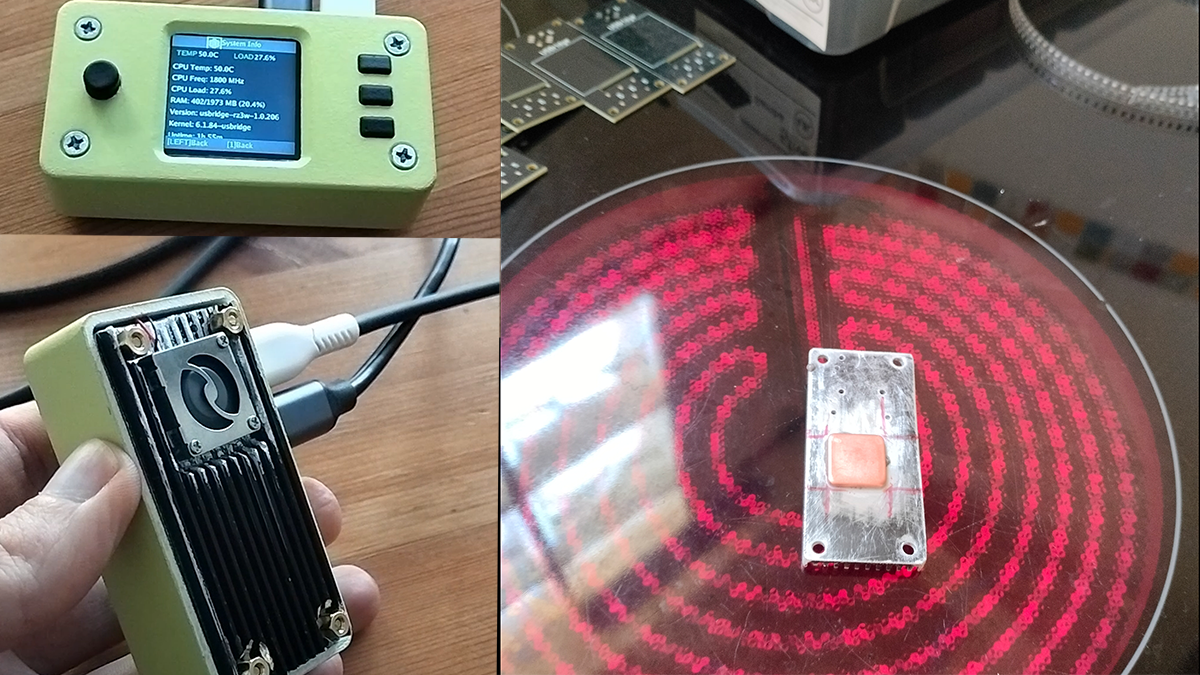
As I neared completion of the USBridge-KVM 2.0 hardware design, I encountered a significant thermal limitation. Processing raw HDMI video signals for real-time text recognition and streaming 2K video over SSH requires substantial computational resources, especially for a compact build based on the Radxa Zero 3W.
In my initial builds, I used a standard axial fan combined with 4-millimeter thermal pads to bridge the gap between the SoC and the heatsink. Under heavy loads, the processor temperature quickly rose to 70 °C. To ensure long-term stability and prevent thermal throttling, this was unacceptable.
I decided to redesign the entire thermal scheme, making two major changes:
Copper interface: I abandoned the thick and inefficient 4-millimeter thermal pads. Instead, I soldered a 2-millimeter copper pad directly to the heatsink. This provides a solid-metal interface with high thermal conductivity, which significantly reduces thermal resistance.
Turbine cooling: I replaced the axial fan with a high-static-pressure fan (turbine). Unlike axial fans, which struggle to operate in tight enclosures, the turbine fan draws heat horizontally through the radiator fins and expels it from the side of the enclosure.
The performance gain was immediate. After these modifications, the unit now maintains a stable 50.8°C under the same intensive load — a massive ~20°C drop.
This iteration ensures that the device can handle continuous 2K video streams and OCR processing without any performance degradation. The thermal design is now ready for the production-grade SLS 3D printed enclosures.
Discussions
Become a Hackaday.io Member
Create an account to leave a comment. Already have an account? Log In.